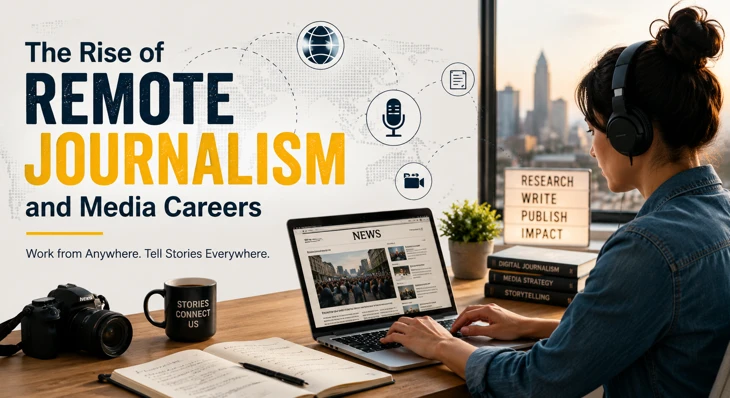
The Rise of Remote Journalism and Media Careers
Introduction: How Journalism Quietly Broke Free from Offices
Something interesting has been happening in the media world over the past few years. Journalism, which once lived inside busy newsrooms filled with ringing phones, paper drafts, and tight deadlines, has slowly moved out of the office walls. Today, a growing number of writers, reporters, and editors are building entire careers without ever stepping into a traditional newsroom.
Remote journalism and digital media careers are no longer “alternative” paths. For many professionals, they’ve become the normal way of working.
What makes this shift even more fascinating is how simple it looks on the surface. A laptop. A stable internet connection. And the ability to tell a story clearly. That’s often enough to participate in global news cycles, publish articles for international audiences, and collaborate with editors across time zones.
But behind this simplicity is a deeper transformation—one that is reshaping how news is created, shared, and consumed worldwide.
Journalism Isn’t Where It Used to Be Anymore
There was a time when journalism felt tied to a physical place. Reporters would gather in offices, editors would sit across desks marking changes, and everything revolved around print cycles or scheduled broadcasts.
That world hasn’t disappeared completely, but it no longer defines the industry.
The internet changed the pace of everything. News became instant. Audiences stopped waiting for tomorrow’s newspaper and started refreshing their feeds every minute. Naturally, journalism adapted.
Now, a single story might be written in India, edited in the UK, and published for readers in the US within the same hour. This kind of workflow has made remote news reporting not just possible, but efficient and often preferred.
Technology sits at the center of this change. Cloud documents replaced physical drafts. Video calls replaced newsroom meetings. Mobile phones turned into full reporting kits. Even interviews that once required travel now happen over a simple video link.
And slowly, without much noise, journalism became something you can do from almost anywhere.
What Remote Journalism Really Looks Like Today
Remote journalism is not just about working from home. It’s about how stories are built in a digital-first environment where location doesn’t limit opportunity.
A freelance journalist might be covering politics for one publication, writing feature stories for another, and contributing opinion pieces to a third—all while working from a café or a small home setup.
A digital media writer might focus on SEO-driven news content, helping publications reach readers through search engines and online platforms.
Then there are editors who coordinate with writers across countries, ensuring everything reads smoothly and remains factually correct before publication.
Even investigative journalists are now working independently, using online databases, public records, and digital communication tools to uncover stories that matter.
The idea of “remote journalism careers” has expanded far beyond writing alone. It now includes multimedia storytelling, podcast production, video reporting, and social media-based news coverage.
Why Remote Journalism Careers Are Growing So Fast
There isn’t just one reason behind this shift. It’s a mix of changes happening all at once.
News consumption habits have changed. People want updates instantly, not hours later. Media companies need to respond quickly, which makes remote teams incredibly valuable.
At the same time, digital platforms have opened the door for more voices. You don’t need to live in a media hub anymore to get published. You just need strong writing, reliable research, and consistency.
There’s also a practical side. Hiring remote journalists reduces costs for media companies. No office space. No relocation. More flexibility in building global teams.
And for journalists themselves, the appeal is obvious. More freedom. More opportunities. And the ability to work across multiple projects at once.
One of the most interesting things about modern media work is how many directions it offers.
Some professionals focus entirely on freelance journalism, pitching story ideas and working with different publications. It’s unpredictable at times, but it offers creative control that many writers value deeply.
Others move into digital content writing, where journalism blends with SEO and online publishing. These roles are often about writing stories that not only inform but also reach readers through search visibility.
Then there’s multimedia journalism, which feels very different from traditional writing. Here, storytelling happens through videos, audio clips, visuals, and interactive formats. A single story might include a written article, a short documentary, and a podcast episode.
Social media journalism has also become its own space. Platforms like X, Instagram, and YouTube are now where breaking news often appears first. Journalists in this area focus on speed, clarity, and audience engagement.
And behind all of this, remote editors quietly keep everything in place—reviewing drafts, checking facts, and shaping raw content into polished stories ready for publication.
Skills That Actually Matter in Remote Journalism
The tools may have changed, but the core skills still feel familiar.
Writing remains the foundation. If a story isn’t clear, nothing else matters. But now, clarity also includes writing for digital readers who skim, scroll, and move quickly.
Research skills are just as important. With so much information available online, the ability to verify sources and separate facts from noise is essential.
Digital awareness plays a big role, too. Knowing how content management systems work, understanding basic SEO, and being comfortable with collaboration tools are now part of everyday journalism work.
There’s also something less technical but equally important—discipline. Working remotely means managing your own time without supervision. Deadlines don’t disappear just because you’re not in an office.
And finally, adaptability. The media world changes quickly. Platforms evolve, audience preferences shift, and new storytelling formats keep emerging.
For many professionals, the biggest attraction is freedom.
Not just the freedom to work from different places, but the freedom to design a lifestyle that fits their rhythm. Some journalists work early mornings. Others prefer late nights. Remote work makes that possible.
There’s also a wider range of opportunities. A journalist in one country can easily write for publications based in another. Geography stops being a barrier.
Many people also appreciate the ability to build multiple income streams. Instead of relying on a single job, freelancers often work with several clients at the same time.
And perhaps most importantly, there’s creative independence. Remote journalists often have more space to explore niche topics, personal interests, and unique storytelling angles.
Challenges That Come With This Freedom
Of course, this way of working isn’t perfect.
Without a structured newsroom environment, it can sometimes be difficult to stay focused or maintain a steady routine.
Communication also becomes more dependent on digital tools, which can occasionally lead to misunderstandings or delays in feedback.
Competition is another reality. Since remote journalism is accessible, more people are entering the field, making it harder to stand out.
And then there’s information overload. With constant news updates everywhere, filtering what matters—and ensuring accuracy—takes effort and attention.
How People Are Building Careers in This Space
Most successful remote journalists didn’t start with perfect conditions. They built their careers step by step.
Many begin by writing small blog posts or contributing to online platforms. Over time, they build a portfolio that shows consistency and style.
Freelancing becomes a natural next step. It provides real-world experience, client interaction, and exposure to different types of writing.
Networking also plays a big role. A simple connection on a professional platform or a conversation in an online community can lead to long-term opportunities.
What matters most is persistence. In digital media careers, growth often comes from steady work rather than sudden breakthroughs.
The Future of Journalism Is Already Changing Shape
It’s clear that journalism is not going back to how it used to be.
Artificial intelligence is already assisting with research and editing. Data journalism is becoming more important. And immersive formats like virtual reality storytelling are slowly entering mainstream media.
We are also seeing hybrid newsroom models where some teams work remotely while others remain in offices. This balance seems likely to grow in the coming years.
The direction is clear: journalism is becoming more digital, more flexible, and more globally connected.
FAQs
What is remote journalism in simple terms?
It is the practice of reporting, writing, or editing news content from any location using digital tools rather than in a physical newsroom.
Is remote journalism a stable career option?
It can be, especially for those who build strong writing skills, reliable clients, and consistent work habits.
Clear writing, research ability, digital tool knowledge, and strong time management are key.
Can beginners enter freelance journalism easily?
Yes, many start with small writing gigs or blogging before moving into professional assignments.
Do remote journalists earn well?
Income varies widely, but experienced freelancers and niche specialists often earn competitive rates.
Conclusion: A Career That Keeps Expanding
Remote journalism and media careers are no longer a trend—they are part of how modern storytelling works.
The industry has moved beyond location-based limits and opened itself to anyone with curiosity, writing ability, and consistency.
There are challenges, yes, but there is also space to grow in ways that traditional models rarely allowed.
For many writers and reporters today, journalism is no longer a place they go to work. It’s something they carry with them, wherever they are.