📚 Table of Contents
- Why Remote Careers Are Becoming a Long-Term Reality
- 1. Software Development and Engineering
- 2. Digital Marketing Specialist
- 3. Data Analyst and Data Scientist
- 4. Cybersecurity Specialist
- 5. UI/UX Designer
- 6. Content Writer and Copywriter
- 7. Cloud Computing Specialist
- 8. Virtual Project Manager
- 9. Online Education and E-Learning Specialist
- 10. AI and Machine Learning Engineer
- Skills That Matter Most in Remote Careers
- What the Future of Remote Work Looks Like
- Conclusion
- FAQs
- 1. Which remote careers are expected to grow the most?
- 2. Is remote work here to stay?
- 3. Can beginners start remote careers without experience?
- 4. What skills matter most for remote jobs?
- 5. Do remote jobs offer stability?
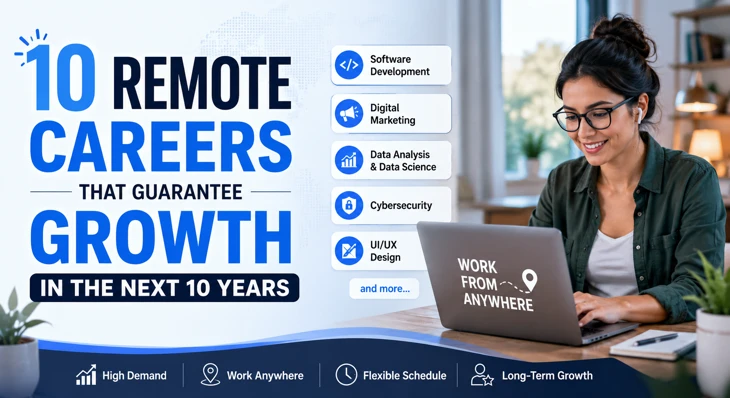
10 Remote Careers That Guarantee Growth in the Next 10 Years
Work doesn’t feel the same anymore—and honestly, it probably shouldn’t. The traditional idea of commuting to an office, sitting at a fixed desk, and following a rigid schedule is slowly fading. In its place, remote careers have quietly taken over, reshaping how people build income, skills, and long-term stability. What’s interesting is that this shift didn’t happen overnight. It built up over time through technology, changing expectations, and a growing demand for flexibility. Today, the ability to work from anywhere is no longer a luxury—it’s becoming a standard. And if you’re thinking ahead, the real question isn’t whether remote work will continue. Which careers will still be growing ten years from now? This guide walks through 10 remote careers expected to remain in strong demand, along with how they actually work in real-world situations—not just theory.Why Remote Careers Are Becoming a Long-Term Reality
A few years ago, remote work was treated like a benefit. Now it’s closer to a business model. Companies have realized something simple: talent doesn’t need to sit in the same building to produce great results. There’s also another shift happening quietly in the background. Businesses are becoming more digital, more automated, and more global. That combination naturally supports remote work. You can see this change happening through everyday trends:- Teams are now spread across multiple countries instead of one office
- Cloud tools handle most of the work that once required physical infrastructure
- AI is taking over repetitive tasks, freeing people for higher-value roles
- Hiring is becoming skill-based rather than location-based
- Professionals are prioritizing flexibility over traditional office setups
1. Software Development and Engineering
If there’s one field that quietly powers almost everything digital today, it’s software development. Every app, website, and online service depends on developers working behind the scenes. And the demand isn’t slowing down anytime soon. In fact, it’s expanding as more industries go digital. It’s common now for developers to work entirely remotely—sometimes never meeting their teams in person. A typical day might involve fixing bugs in a mobile app, building new features for a fintech platform, or improving backend systems that handle thousands of users. The work is technical, but also deeply creative. You’re essentially building tools people rely on every single day.2. Digital Marketing Specialist
Every brand you see online—whether it’s a startup or a global company—relies on digital marketing to stay visible. Without it, even great products can go unnoticed. This role has become incredibly flexible. One person might manage SEO for a website in the morning, run ad campaigns in the afternoon, and analyze performance data in the evening. What makes it especially interesting is how fast it evolves. Strategies that worked two years ago may already feel outdated. A real example? A marketer working remotely could be handling campaigns for multiple international clients, adjusting content and ads based on real-time performance data.3. Data Analyst and Data Scientist
Data is everywhere, but raw data doesn’t mean much until someone interprets it. That’s where analysts and data scientists come in. They look at patterns—how customers behave, what products are performing well, where users drop off—and turn that into decisions businesses can actually use. For example, a data analyst working with an online store might notice that users abandon their cart at checkout. From there, they could suggest small changes that directly improve sales. It’s a quiet but powerful role. You don’t always see the impact, but you definitely feel it in the results.4. Cybersecurity Specialist
As more businesses move online, security becomes something no one can ignore. Cybersecurity professionals are the people making sure systems stay protected. They don’t just respond to attacks—they prevent them. In a remote setup, their work often involves monitoring systems, checking alerts, and tightening security protocols before problems even appear. It’s a field that stays relevant because threats don’t slow down—they evolve.5. UI/UX Designer
Have you ever used an app that just felt easy? Or one that made you leave immediately because it was confusing? That difference is UI/UX design. These professionals shape how digital products look and feel. Their job is to make sure users don’t just use an app—they enjoy using it. A designer might start by studying how people interact with a product, then redesign screens to remove friction. Even small improvements can make a big difference in user engagement.6. Content Writer and Copywriter
Behind every website, blog, or product page, there’s writing that guides, explains, and persuades. This is one of the most accessible remote careers because it relies on communication rather than heavy technical training. A writer might spend one day creating blog posts, the next writing landing pages, and another crafting email campaigns that help businesses connect with customers. What makes it powerful is simplicity: the right words can influence decisions more than complex strategies.7. Cloud Computing Specialist
Most of the apps and services we use today don’t run on physical servers sitting in a room—they run on the cloud. Cloud specialists help companies move, manage, and secure that infrastructure. In practice, this could mean ensuring a company’s website stays online during heavy traffic or managing secure data storage across regions. It’s technical work, but it’s also what keeps modern digital systems running smoothly.8. Virtual Project Manager
When teams are spread across different cities—or even continents—someone needs to keep everything aligned. That’s where project managers come in. Their job isn’t just about tracking tasks. It’s about making sure people stay connected, deadlines are realistic, and work actually moves forward. A typical day might involve coordinating between developers, designers, and marketers who are all working in different time zones. Without this role, remote teams would quickly become chaotic.9. Online Education and E-Learning Specialist
Learning is no longer limited to classrooms. People now take courses from their phones, laptops, or tablets—anywhere, anytime. E-learning specialists design these experiences. They might create interactive modules for corporate training or build full online courses that teach new skills to global audiences. The focus isn’t just teaching—it’s making learning engaging enough that people actually complete it.10. AI and Machine Learning Engineer
Artificial intelligence is changing how industries operate—from healthcare to entertainment to finance. AI engineers build systems that learn from data and improve over time. These systems might recommend movies, detect fraud, or even power chat-based tools. It’s one of the fastest-growing fields because companies are still figuring out how far AI can go—and they need experts to guide that journey.Skills That Matter Most in Remote Careers
Technical skills help you get started, but long-term success in remote work depends on how you handle day-to-day challenges. A few things make a big difference:- Being able to communicate clearly without face-to-face interaction
- Managing your time without constant supervision
- Staying comfortable with new tools and platforms
- Learning continuously instead of relying on old skills
- Solving problems independently instead of waiting for instructions