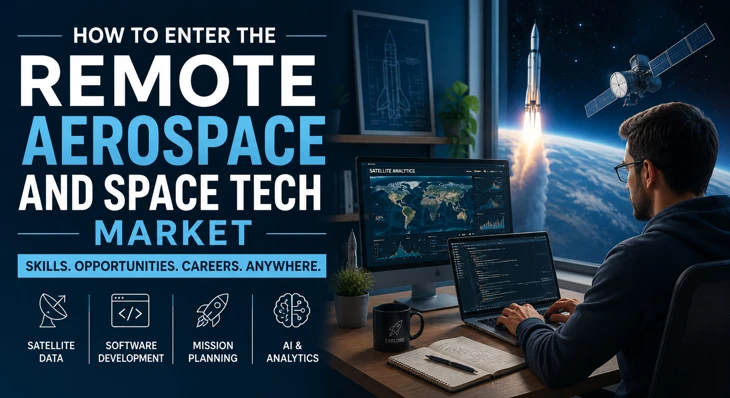
How to Enter the Remote Aerospace and Space Tech Market
Introduction
There was a time when working in aerospace or space technology meant one thing—physically being inside a lab, hangar, or government facility, surrounded by complex machines and restricted access. That picture has changed more than most people realize.
Today, a growing part of the aerospace and space tech world runs through laptops, cloud platforms, simulation tools, and global collaboration systems. Engineers, analysts, and developers are contributing to satellites orbiting Earth and software guiding missions to space—all while working remotely from different corners of the world.
If you’ve been trying to understand how to enter the remote aerospace and space tech market, the answer isn't tied to a single fixed path anymore. It’s more flexible, more skill-driven, and in many ways, more open than ever before.
The real question isn’t “Do I qualify?” It’s closer to “Which part of this ecosystem fits my strengths—and how do I start building from there?”
Let’s break it down in a practical, grounded way.
What the Remote Aerospace and Space Tech World Looks Like Today
Aerospace used to feel like a closed industry. But behind the scenes, it has slowly transformed into a software-heavy, data-driven ecosystem.
Think about satellite imagery, flight optimization systems, GPS navigation, and space mission simulations. A large portion of this work now lives in code rather than physical machinery.
That shift is exactly what opened the door for remote aerospace jobs and space tech careers.
Instead of everyone working in the same building, teams are now spread across continents—connected through cloud platforms, real-time data systems, and collaborative engineering tools.
Why remote work fits this industry naturally
It didn’t happen overnight. A few practical shifts made it possible:
For one, most aerospace systems today are digital-first. Whether it’s analyzing satellite data or testing flight algorithms, the real work happens on computers.
Then there’s cloud computing. Engineers no longer need to sit next to massive hardware systems to run simulations—they can access them remotely.
And finally, the rise of private space companies and startups changed hiring patterns. These teams care more about capability than geography.
Put simply, talent matters more than location now.
Where Opportunities Actually Exist
If you’re trying to break in, it helps to know that “aerospace” is not just one thing. It’s a collection of overlapping fields.
Some of them are heavily engineering-focused, while others lean more toward software, analytics, or AI.
You’ll often find remote opportunities in areas like satellite data analysis, where companies process huge volumes of Earth observation data for agriculture, defense, climate research, and logistics.
Another growing area is aerospace software development. These roles focus on building systems that help aircraft and spacecraft operate safely and efficiently.
Then there’s simulation and mission planning—where teams model space environments, orbital paths, and system behaviors before anything is physically launched.
And of course, AI has begun to play a major role. From predictive maintenance in aviation to autonomous navigation systems, machine learning is quietly becoming a core part of aerospace work.
You don’t need to fit all of these. You only need one entry point.
Skills That Actually Help You Get In
Let’s be honest—this field is technical. But that doesn’t mean you need to know everything before you start.
What matters more is direction and consistency.
If you lean toward software, Python is almost unavoidable. It’s used everywhere—from data pipelines to simulation tools. C++ shows up in performance-heavy systems, especially in embedded aerospace software.
For simulation and modeling work, tools like MATLAB are still widely used. If you’re interested in design or mechanical systems, CAD tools like SolidWorks or CATIA can be useful.
But here’s something people often overlook: data handling skills are just as important as engineering knowledge now. A lot of aerospace work involves processing large datasets from satellites or flight systems.
And then there’s AI and machine learning, which is becoming a common layer across multiple aerospace applications.
The human side of skills
Technical ability gets you noticed, but how you work determines whether you stay.
Remote aerospace teams depend heavily on clear communication. You’re often working across time zones, sometimes without real-time interaction. That means your documentation, updates, and clarity matter a lot.
Attention to detail is another non-negotiable. In aerospace systems, small mistakes can scale into serious problems.
And then there’s discipline. Remote work sounds flexible, but in reality, it demands structure from you, not your environment.
Education: The Traditional and Modern Routes
There’s a common belief that aerospace is only for aerospace engineers. That’s no longer entirely true.
Yes, degrees in aerospace engineering, mechanical engineering, physics, or computer science still give a strong foundation. They help you understand the underlying principles that drive the industry.
But the hiring landscape has changed.
A growing number of professionals enter through non-traditional paths—especially in software, AI, and data-heavy roles.
Online learning has played a big part in this shift. Courses in machine learning, cloud computing, CAD design, and data science now act as stepping stones into aerospace-related careers.
What matters more than the label on your degree is whether you can actually build or solve something relevant.
How People Actually Break Into Remote Aerospace Jobs
Most people don’t enter this field through a single application. It’s usually a gradual process.
They start by choosing a focus area—specific enough to build skills around but broad enough to explore.
Maybe it’s satellite data analysis. Maybe it’s aerospace software. Or maybe it’s AI in aviation systems.
Once that direction is clear, the next step is building small, practical projects.
Not theoretical exercises. Real work that shows understanding.
For example, someone might take publicly available satellite data and analyze environmental changes over time. Another person might build a simple flight-simulation model or an automation tool using Python.
These projects gradually become a portfolio. And that portfolio often matters more than a resume in this space.
Then comes exposure—contributing to open-source projects, joining aerospace communities, or working with startups on small freelance tasks.
That combination is usually what opens the first real door.
Where to Look for Remote Opportunities
One of the challenges in this industry is that remote roles aren’t always labeled clearly.
You might not always see “remote aerospace job” in bold letters.
Instead, you’ll find roles hidden under titles like aerospace software engineer, satellite data analyst, space systems developer, or aviation data scientist.
These roles often appear on company career pages, startup hiring boards, and specialized tech platforms.
LinkedIn is still a major hub, especially if you follow aerospace companies and participate in discussions.
But niche communities and forums often surface opportunities earlier than mainstream platforms.
Networking: The Part People Underestimate
In aerospace and space tech, who you know can sometimes matter as much as what you know.
Not in a superficial way—but in the sense that many opportunities come through conversations, collaborations, and visibility.
Engaging in aerospace forums, contributing to discussions, joining virtual hackathons, or even sharing your projects publicly can make a difference over time.
You’re not trying to “sell yourself.” You’re just making your work visible in the right places.
And that visibility compounds.
The Challenges Nobody Talks About
Breaking into remote aerospace work is exciting, but it’s not effortless.
One common challenge is feeling underqualified at the beginning. This is normal. The industry is technical, and almost everyone initially feels that gap.
Another challenge is the lack of obvious entry-level remote roles. Many companies still prefer hybrid setups for certain positions.
Then there’s complexity. Aerospace systems are not simple, and learning them takes time.
The solution in all these cases is surprisingly consistent: start small, stay focused, and build real output rather than waiting for perfect readiness.
A Realistic Example of Entry
Imagine someone with a basic background in programming.
They start learning Python more deeply and move into data analysis. Then they discover satellite imagery datasets and begin experimenting with environmental tracking projects.
They publish their work online, gradually improve it, and eventually start contributing to open-source aerospace tools.
Along the way, they connect with professionals in the field through online communities.
Eventually, one of those connections leads to a remote opportunity at a space tech startup.
Nothing about that journey is instant. But it is realistic.
What the Future Looks Like
The aerospace and space tech industry is moving in a very clear direction: more automation, more AI, and more digital infrastructure.
Private space companies are expanding quickly. Satellite networks are growing. Aviation systems are becoming more intelligent.
And as these systems become more software-driven, remote collaboration becomes even more natural.
In simple terms, the industry is becoming less about physical presence and more about digital contribution.
FAQs
Can someone without an aerospace degree enter this field?
Yes. Many roles in software, AI, and data analysis are open to people from different academic backgrounds.
Are remote aerospace jobs actually common?
They are becoming more common, especially in startups and software-driven space companies.
What should I learn first?
Python or data analysis is often a strong starting point, depending on your direction.
How long does it take to get in?
It varies, but consistent learners often see progress within 6 to 18 months.
Do I need advanced math skills?
Not always. It depends on the role, but many entry points emphasize coding and data skills.
Conclusion
Getting into the remote aerospace and space tech market is less about fitting a traditional mold and more about building relevant capability step by step.
The industry is expanding, becoming more digital, and increasingly open to global talent.
If you stay consistent, focus on one direction, and keep building practical work, you don’t just learn about the field—you become part of it.
And that’s usually how most real careers in this space begin.