📚 Table of Contents
- Why Online Courses Matter More Than Ever for Remote Careers
- Best Coursera Courses for Remote Job Seekers
- 1. Google Data Analytics Professional Certificate
- 2. Google IT Support Professional Certificate
- 3. Meta Front-End Developer Professional Certificate
- 4. Digital Marketing Specialization (University of Illinois)
- 5. Google Project Management Certificate
- Best edX Courses for Remote Job Seekers
- 1. CS50’s Introduction to Computer Science (Harvard University)
- 2. HarvardX Data Science Professional Certificate
- 3. Business Communication Skills (University of British Columbia)
- 4. Introduction to Cloud Computing (Microsoft on edX)
- 5. Entrepreneurship in Emerging Economies (Harvard University)
- Skills That Actually Help You Land Remote Jobs
- Technical skills that matter
- Soft skills that make a difference
- How to Pick the Right Course for Your Remote Career Path
- A Realistic Example of Career Growth
- Simple Tips to Turn Learning into a Remote Job
- FAQs
- 1. Are Coursera and edX certificates enough to get remote jobs?
- 2. Can beginners really start these courses?
- 3. Which course helps me get a job the fastest?
- 4. Do remote jobs require a degree?
- 5. How long does it take to complete these courses?
- Conclusion
Best Coursera and edX Courses for Remote Job Seekers
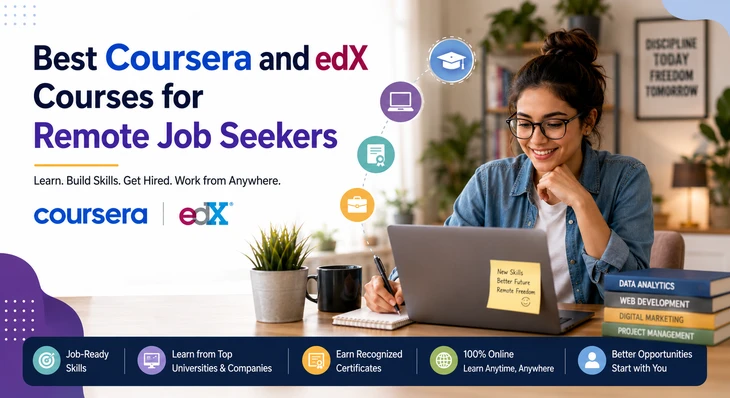
Remote work has quietly shifted from being a “nice option” to a serious career path. Today, people are building full-time incomes from home offices, coffee shops, and co-working spaces using skills they learned online. The interesting part? Many of them didn’t go back to college—they simply picked the right online courses and stayed consistent. If you’re exploring the best Coursera and edX courses for remote job seekers, you’re already thinking in the right direction. But the real question is: which courses actually help you get hired—not just collect certificates? Let’s break it down in a simple, practical way so you can move from learning → skills → real remote opportunities.Why Online Courses Matter More Than Ever for Remote Careers
Remote companies don’t just hire based on degrees anymore. They look for proof of skills, real understanding, and the ability to work independently. That’s exactly where platforms like Coursera and edX come in. Instead of spending years in traditional education, you can:- Learn job-ready skills from global universities and companies
- Build confidence through hands-on projects
- Earn certificates that strengthen your resume
- Explore career paths without huge financial risk
Best Coursera Courses for Remote Job Seekers
Coursera has become a go-to platform for learners aiming for remote-friendly careers. What makes it powerful is its partnership with companies like Google, IBM, and Meta—so you’re learning what the industry actually uses.1. Google Data Analytics Professional Certificate
If you’re unsure where to start, this is one of the safest entry points. You’ll gradually learn how to think like a data professional, even if you’ve never worked with data before. What you’ll pick up:- Cleaning and organizing raw data
- Working with spreadsheets and SQL
- Creating simple visual dashboards
- Understanding real business problems
2. Google IT Support Professional Certificate
Not everyone comes from a tech background—and that’s perfectly fine. This course is designed for absolute beginners who want to step into IT. You’ll learn how systems actually work behind the scenes:- Troubleshooting everyday tech issues
- Basics of networking and operating systems
- Security fundamentals
- Supporting users in real-world scenarios
3. Meta Front-End Developer Professional Certificate
If building websites sounds exciting, this path is worth exploring. You’ll start from scratch and slowly build the confidence to create real web pages and applications. Skills covered include:- HTML, CSS, and JavaScript
- Responsive web design
- React fundamentals
- Version control using Git
4. Digital Marketing Specialization (University of Illinois)
Digital marketing is one of the most flexible remote careers today. You can work with clients across countries without leaving your home. This course helps you understand how online businesses grow. You’ll explore:- Search engine optimization (SEO)
- Social media strategy
- Paid advertising basics
- Customer behavior and analytics
5. Google Project Management Certificate
Remote teams need structure, and that’s where project managers shine. This course focuses on how work actually gets done in remote environments. You’ll learn:- Agile and Scrum methods
- Planning and tracking projects
- Communication across teams
- Managing deadlines and risks
Best edX Courses for Remote Job Seekers
edX feels a bit more academic compared to Coursera. It’s ideal if you prefer structured learning from universities such as Harvard, MIT, and Berkeley.1. CS50’s Introduction to Computer Science (Harvard University)
This is one of the most recommended starting points for anyone entering tech. Don’t worry if you’ve never coded before—this course starts from the basics and builds up slowly. You’ll understand:- How programming actually works
- Problem-solving using code
- Basics of algorithms
- Simple web development concepts
2. HarvardX Data Science Professional Certificate
If data excites you, this program takes things deeper. You’ll explore:- R programming fundamentals
- Data visualization techniques
- Statistical thinking
- Machine learning basics
3. Business Communication Skills (University of British Columbia)
Remote work isn’t just about skills—it’s about communication. When your team is spread across time zones, how you write and speak matters a lot. This course helps you improve:- Professional writing (emails, reports, messages)
- Clear and confident communication
- Presentation skills
- Cross-cultural understanding
4. Introduction to Cloud Computing (Microsoft on edX)
Cloud technology powers almost every modern remote job. This course gives you a simple understanding of how it all works. You’ll learn:- What cloud computing actually means
- Basics of Microsoft Azure
- Deployment and storage concepts
- Security fundamentals
5. Entrepreneurship in Emerging Economies (Harvard University)
Not everyone wants a traditional job. Some want to build something of their own. This course is great for freelancers and future founders. You’ll explore:- How to identify real-world problems
- Building simple business models
- Innovation in global markets
- Startup thinking mindset
Skills That Actually Help You Land Remote Jobs
Courses are important, but skills are what get you hired. Remote employers usually look for a mix of technical ability and personal discipline.Technical skills that matter
- Data handling and analysis
- Basic coding knowledge
- Digital marketing tools
- Cloud and collaboration platforms
- Project tracking systems
Soft skills that make a difference
- Time management without supervision
- Clear written communication
- Problem-solving attitude
- Adaptability in changing tasks
- Self-motivation and consistency
How to Pick the Right Course for Your Remote Career Path
Choosing randomly rarely works. Instead, match your interest with a direction. Ask yourself:- Do I enjoy numbers and patterns? → Go for Data Analytics
- Do I like creativity and content? → Try Digital Marketing
- Do I enjoy building things? → Explore Web Development
- Do I prefer organization and planning? → Project Management fits well
- Do I want flexibility or freelancing? → Communication + Entrepreneurship
A Realistic Example of Career Growth
Think of someone starting with zero experience in tech. They begin with a Google IT Support Certificate, practice small troubleshooting tasks, and slowly build confidence. Within months, they land a remote support job. Later, they move into cloud support or system administration after adding another certification. That’s how most remote careers actually grow—step by step, not overnight.Simple Tips to Turn Learning into a Remote Job
Finishing a course is just the beginning. The real progress happens after that. Try this approach:- Build a small portfolio (even personal projects work)
- Update LinkedIn with certifications and skills
- Apply consistently to remote roles
- Practice virtual interviews
- Join online communities in your field