📚 Table of Contents
- What Are AI Tutors in Online Learning?
- How AI Tutors Actually Work Behind the Scenes
- Learning Pattern Analysis
- Natural Language Understanding
- Adaptive Learning Engine
- Instant Feedback Loop
- Key Benefits of AI Tutors in Online Learning
- Personalized Learning Experience
- Always Available Support
- Affordable Learning Solutions
- Faster Concept Understanding
- Safe Learning Environment
- Real-World Use of AI Tutors
- School-Level Learning
- Higher Education Support
- Skill Development for Professionals
- Language Learning Practice
- AI Tutors vs Traditional Teaching Methods
- Human Teachers
- AI Tutors
- Challenges Faced by AI Tutors
- Limited Emotional Connection
- Dependence on Technology
- Data Privacy Concerns
- Creativity Limitations
- The Future of AI Tutors in Education
- Practical Example of AI Tutors in Action
- Why AI Tutors Are Becoming Essential
- Best Ways to Use AI Tutors Effectively
- Set Clear Learning Goals
- Stay Consistent
- Combine AI with Human Learning
- Review Progress Regularly
- FAQs: AI Tutors in Online Learning
- 1. What exactly are AI tutors in online learning?
- 2. Do AI tutors replace human teachers?
- 3. Are AI tutors useful for exam preparation?
- 4. Which subjects can AI tutors help with?
- 5. Can beginners use AI tutors easily?
- Conclusion
AI Tutors in Online Learning: How Intelligent Systems Are Changing the Way We Study
The world of education has shifted faster in the last few years than in the previous few decades. Traditional classrooms are still important, but they are no longer the only place where real learning happens. Today, students are learning on mobile apps, virtual platforms, and intelligent systems that adapt to their needs. At the center of this transformation are AI tutors in online learning, quietly reshaping how knowledge is delivered and understood. What makes this change so significant is not just technology, but the way learning itself is becoming more personal, flexible, and responsive. Instead of a one-size-fits-all approach, learners now experience education that adjusts to their pace, strengths, and struggles.What Are AI Tutors in Online Learning?
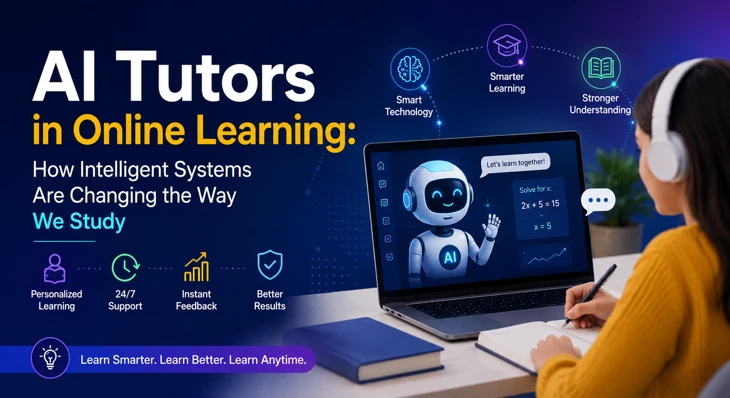
AI tutors are digital learning assistants powered by artificial intelligence that simulate the role of a personal teacher. They guide students step by step, explain difficult topics, and provide practice based on individual performance. Unlike standard online courses that follow a fixed structure, AI-powered tutoring systems respond to the learner in real time. They observe how a student interacts with content, detect gaps in understanding, and adjust lessons accordingly. For example, if a learner struggles with fractions or grammar rules, the system automatically slows down, simplifies explanations, and offers extra practice until the concept becomes clear. This level of personalized learning was once possible only with private tutors.How AI Tutors Actually Work Behind the Scenes
Even though they feel simple to use, AI tutors rely on several advanced technologies working together quietly in the background.Learning Pattern Analysis
Every click, answer, and attempt is tracked to understand how a learner is progressing. Over time, the system builds a detailed learning profile that helps it decide what to teach next.Natural Language Understanding
Through natural language processing, AI tutors can understand typed or spoken questions in everyday language. Students don’t need technical commands—they can simply ask questions as they would to a human teacher.Adaptive Learning Engine
The system continuously adjusts difficulty levels. If a student is performing well, the student is introduced to harder questions. If the student struggles, it revisits foundational concepts.Instant Feedback Loop
Instead of waiting for a teacher to check assignments, learners receive immediate feedback. This helps correct mistakes instantly and improves retention.Key Benefits of AI Tutors in Online Learning
The growing popularity of AI tutors is not accidental. They solve real challenges faced by learners in traditional education systems.Personalized Learning Experience
No two students learn in the same way. AI tutors in online learning create customized learning paths based on individual performance, ensuring that every learner progresses at a comfortable pace.Always Available Support
Learning doesn’t always happen during school hours. Whether it’s early-morning revision or late-night doubt-solving, AI tutors are available 24/7.Affordable Learning Solutions
Private tutoring can be expensive and inaccessible for many. AI-based platforms provide cost-effective alternatives that still deliver high-quality education.Faster Concept Understanding
Complex topics are broken down into simple, easy-to-understand explanations, helping learners grasp concepts more quickly.Safe Learning Environment
Many students hesitate to ask questions in classrooms. AI tutors remove this pressure by offering a judgment-free space for learning.Real-World Use of AI Tutors
AI-driven learning tools are no longer experimental—they are actively used across schools, colleges, and professional training programs.School-Level Learning
Students use interactive apps that turn subjects like math and science into engaging exercises, quizzes, and games.Higher Education Support
College students rely on AI tools in subjects such as engineering, programming, and economics, where step-by-step explanations are essential.Skill Development for Professionals
Working professionals use AI learning platforms to upskill in areas such as data analysis, coding, and digital marketing.Language Learning Practice
AI tutors help learners improve vocabulary, pronunciation, and communication skills through interactive conversations and corrections.AI Tutors vs Traditional Teaching Methods
Both AI tutors and human teachers play important roles in modern education. Instead of replacing one another, they complement each other.Human Teachers
- Provide emotional understanding and mentorship
- Encourage creativity and critical thinking
- Offer real-world classroom interaction
AI Tutors
- Provide instant answers and explanations
- Offer unlimited practice opportunities
- Deliver highly personalized learning paths
Challenges Faced by AI Tutors
Even though AI in education is powerful, it still has certain limitations that need attention.Limited Emotional Connection
AI cannot fully understand human emotions, stress, or motivation levels the way a teacher can.Dependence on Technology
A stable internet connection and device access are required, which can be a barrier in some regions.Data Privacy Concerns
Since learning data is collected for personalization, protecting user privacy is extremely important.Creativity Limitations
AI systems are excellent at structured teaching but may struggle with open-ended or highly creative discussions.The Future of AI Tutors in Education
The role of AI in learning is expected to grow even further in the coming years. Education is moving toward a model where every student has a personalized digital learning companion. In the near future, we may see:- AI tutors that understand emotions and engagement levels
- Virtual classrooms supported by immersive technologies
- Fully customized study plans for every learner
- Seamless integration of AI into school curricula
Practical Example of AI Tutors in Action
Imagine a student preparing for competitive exams. Instead of going through hundreds of pages blindly, they use an AI tutor that studies their performance. The system identifies weak areas, builds a daily study plan, explains difficult topics in simple language, and provides regular quizzes for revision. Over time, the student becomes more confident and focused. This kind of structured yet flexible support makes learning far more effective than traditional methods alone.Why AI Tutors Are Becoming Essential
Modern learners expect education that fits their lifestyle, not the other way around. This is where AI tutors in online learning play a crucial role. They are especially helpful for:- Students who need flexible study schedules
- Learners who struggle in large classrooms
- Professionals balancing work and study
- Anyone who prefers self-paced learning