📚 Table of Contents
- When Remote Work Starts Feeling “Too Quiet”
- Mentorship in a Remote Career Doesn’t Look Formal Anymore
- Why People Struggle More in Remote Careers Than They Admit
- What Real Mentorship Actually Changes
- Things Start Feeling Less Random
- Communication Improves Without You Noticing It
- Confidence Builds Quietly, Not Loudly
- Accountability That Doesn’t Feel Heavy
- Finding a Mentor in a Remote World Isn’t About Luck
- Being a Mentee Is the Part People Underestimate
- When Mentorship Doesn’t Work Well
- What This Looks Like in Real Life
- Where Mentorship Is Going Next in Remote Careers
- FAQs
- Why is mentorship important in remote careers?
- How do people usually find mentors online?
- Can mentorship really improve career growth?
- How often should mentorship happen?
- What makes a good mentor in remote work?
- Conclusion
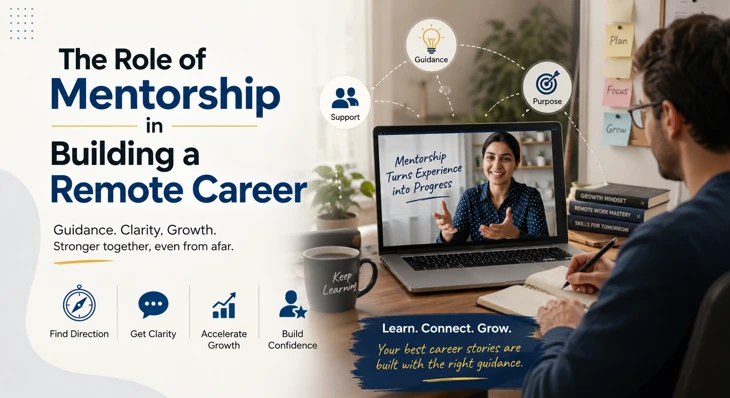
The Role of Mentorship in Building a Remote Career
Remote work sounds simple on paper. You log in, do your tasks, log out, and life feels flexible. No commute. No office noise. No strict 9-to-5 breathing down your neck. But anyone who has actually lived inside a remote career for a while knows it’s not that clean. Some days feel productive. Other days feel like you’re busy but not really moving anywhere. And in between all that quiet independence, there’s a strange gap that shows up over time—lack of direction, lack of feedback, and honestly, sometimes just lack of confidence in your own pace. That’s usually where mentorship starts to matter more than people expect. Not as some formal system. Not as a corporate checkbox. But as a real human connection that helps you figure things out when things feel slightly unclear.When Remote Work Starts Feeling “Too Quiet”
At first, working remotely feels like freedom. You choose your hours, your space, even your own rhythm. It feels like control. But after a few months, something subtle shifts. You stop getting casual feedback. Nobody is really watching your progress in real time. And even if you’re doing well, you’re not always sure. That uncertainty builds quietly. You might find yourself over-checking your work. Or switching between tasks too often. Or wondering if other people in your role are moving faster than you. It’s not a skill problem. It’s a visibility problem. And that’s exactly the kind of gap mentorship fills. A good mentor doesn’t take over your journey. They just help you see it more clearly, especially on days when everything feels a bit foggy.Mentorship in a Remote Career Doesn’t Look Formal Anymore
Forget the old image of mentorship—scheduled meetings in an office, structured agendas, polished career talks. Remote mentorship is far more flexible and, honestly, more human than that. It might be a 15-minute call after work. A quick voice note when you’re stuck. Or a message that says, “You’re overthinking this part—simplify it.” That’s it. But those small moments matter more than they look. Because remote work doesn’t need more information. It needs clarity at the right time. A mentor in this space usually helps you:- Understand what “good work” actually looks like in real projects
- Stop wasting time on things that don’t really matter yet
- Handle feedback without overthinking it
- Stay steady when motivation dips
Why People Struggle More in Remote Careers Than They Admit
Nobody really talks about this part openly, but remote work can feel isolating in a very quiet way. You’re not struggling loudly. You’re just… unsure sometimes. And that uncertainty can show up in different ways. You might delay decisions because there’s no one to quickly validate them. Or spend extra hours polishing work that was already fine. Or feel like you’re behind even when you’re not. It’s a strange loop. And the longer it goes on, the more normal it starts to feel. Common challenges remote professionals quietly deal with include:- Not knowing if they’re actually improving
- Losing touch with industry expectations
- Working hard but feeling directionless
- Struggling to prioritize skills that matter long-term
What Real Mentorship Actually Changes
A lot of people assume mentorship is about advice. It’s not. It’s about pattern recognition—helping you notice what you can’t see clearly on your own yet.Things Start Feeling Less Random
Without guidance, learning feels scattered. One week, you’re deep into a tool. Next week, something else grabs your attention. It feels like progress, but it’s not always focused progress. A mentor helps tighten that focus. Not by restricting you, but by pointing out what actually matters right now versus what can wait. And that alone changes how fast people grow.Communication Improves Without You Noticing It
Remote work lives inside messages, emails, comments, and calls. If your communication is unclear, everything feels harder than it should. Mentors often help in very small ways here. Like showing you how to phrase updates better. Or how to ask questions that actually get useful answers. Or when to say less instead of more. You don’t notice the improvement day by day. But after a few months, people start responding to you differently. That’s usually when it clicks.Confidence Builds Quietly, Not Loudly
Confidence in remote work isn’t about being seen. It’s about being sure. And that usually comes from feedback you trust. When someone experienced says, “You’re on the right track,” it removes a layer of hesitation that most remote professionals carry silently. You start making decisions faster. You stop second-guessing everything. You trust your process a little more. Not because you suddenly know everything—but because you’re no longer guessing alone.Accountability That Doesn’t Feel Heavy
Nobody likes pressure. But most people respond well to consistency. When you know someone will check in on your progress—not to judge it, but to understand it—you naturally stay more consistent. It’s not control. It’s rhythm. And remote careers need rhythm more than motivation.Finding a Mentor in a Remote World Isn’t About Luck
There’s a myth that mentorship just “happens.” In remote work, it rarely does. Most of the time, you have to look for it intentionally. Sometimes it starts in a professional community. Sometimes during a webinar where someone says something that sticks. Sometimes in a random conversation that turns into something more consistent over time. But the starting point doesn’t matter as much as the connection itself. A strong mentor usually feels like someone who:- Explains things clearly without making it complicated
- Has actually worked in remote or hybrid environments
- Tells you the truth, even when it’s not perfectly comfortable
- Helps you think better, not just act faster
Being a Mentee Is the Part People Underestimate
Mentorship doesn’t work if you just listen. It works when you apply. The people who grow fastest are usually not the ones who collect the most advice—they’re the ones who actually act on it. They test things. They make mistakes. They adjust. Simple habits make a big difference:- Trying feedback instead of just noting it down
- Setting small weekly goals instead of big vague plans
- Talking honestly about where they’re stuck
- Tracking progress in a way that feels real, not forced