📚 Table of Contents
- Learning doesn’t feel like it used to
- Why do people respond to it so naturally
- Small wins feel bigger than they should
- Progress you can actually see changes everything
- Routine forms without pressure
- What gamified learning usually looks like in practice
- The progress system
- Rewards that don’t feel forced
- Challenges that break monotony
- Friendly competition
- Where you already experience it without noticing
- Workplace learning that doesn’t feel heavy
- Language learning that builds habits quietly
- Coding platforms that feel like puzzles
- Certification courses that feel less endless
- What actually changes for learners over time
- People stick around longer
- Learning becomes less intimidating
- Confidence grows quietly
- Drop-off rates naturally fall
- It’s not perfect, though
- Where things are heading next
- The bigger shift no one talks about
- What makes it actually work
- Conclusion
How Gamification Is Transforming Online Skill Development
Online learning has changed in ways most people didn’t expect. Not long ago, it felt like sitting alone in front of long videos, trying hard to stay focused, promising yourself you’d finish “someday.” Now it feels different—lighter, faster, and strangely more engaging. A big reason for that shift is gamification in online skill development. It has quietly slipped into learning platforms and changed how people behave without them even noticing. You don’t just “study” anymore. You move. You unlock. You progress. And somehow, that changes everything.Learning doesn’t feel like it used to
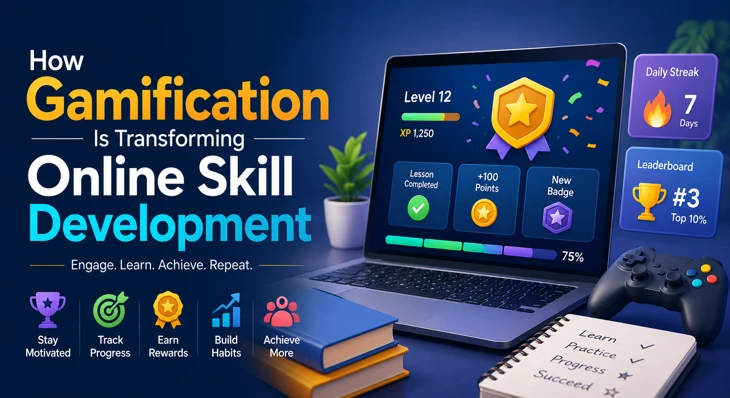
Think back to traditional online courses. You click play, sit through a lecture, maybe take notes… and then what? There’s often no real sense of movement. That’s where most learners lose interest—not because they’re lazy, but because nothing feels alive in the process. Now compare that with modern platforms. You complete a short lesson. A small animation shows progress. A badge appears. A level unlocks. It’s subtle, but your brain reacts immediately. That’s the shift. Gamification in online skill development is basically that invisible layer that turns passive learning into something interactive enough to hold attention.Why do people respond to it so naturally
Here’s the interesting part—this isn’t really about technology. It’s about human behavior. People like progress. Even a little progress. When learning shows you that progress clearly, something clicks.Small wins feel bigger than they should
Finish a 5-minute module and earn points? It doesn’t sound like much, but it creates a sense of completion. That feeling is powerful enough to pull you into the next lesson.Progress you can actually see changes everything
A bar moving from 40% to 45% might seem minor, but psychologically, it matters. It tells your brain: you’re not stuck. And when people feel stuck, they stop.Routine forms without pressure
Many platforms encourage streaks or daily activity. Not in a pushy way—but just enough to make you think, “I’ll do a little today so I don’t lose momentum.” That’s how habits quietly form.What gamified learning usually looks like in practice
You’ve probably already seen it—even if you didn’t call it gamification. It’s in apps. Courses. Training portals. Even onboarding systems at work.The progress system
Almost every modern learning platform has some version of it. A bar. A percentage. A level. It sounds simple, but it keeps people grounded. You always know where you stand.Rewards that don’t feel forced
Badges, XP points, or certificates appear after tasks. Nothing dramatic. Just enough recognition to make the effort feel visible.Challenges that break monotony
Instead of long theory sections, learners are given small tasks. Solve this. Choose that. Fix this scenario. It feels more like doing than reading.Friendly competition
Leaderboards exist, but they’re not always about winning. More often, they’re just a reminder that others are moving too. That alone is enough motivation for many people.Where you already experience it without noticing
Gamification in online skill development isn’t something you need to “opt into.” It’s already everywhere.Workplace learning that doesn’t feel heavy
Many companies now use interactive training modules instead of traditional presentations. Employees complete tasks, earn scores, and unlock certifications along the way. The difference? People actually finish it.Language learning that builds habits quietly
If you’ve ever used a language app, you know the feeling of not wanting to break a streak. Some days you might only spend five minutes—but you still show up. That’s the system working in the background.Coding platforms that feel like puzzles
Instead of reading theory for hours, learners solve small problems. One by one. Each solution builds confidence without overwhelming them.Certification courses that feel less endless
Even long professional courses now break content into stages. You don’t see a massive wall of content—you see steps. That changes perception completely.What actually changes for learners over time
The biggest impact isn’t instant. It builds gradually. At first, it just feels more engaging. But after a while, behavior starts to shift.People stick around longer
Not because they have more time—but because it doesn’t feel like effort in the same way.Learning becomes less intimidating
Big topics shrink into smaller pieces. And smaller pieces feel manageable.Confidence grows quietly
You don’t suddenly feel confident. It happens after a series of small completions that add up without you noticing.Drop-off rates naturally fall
When people see progress, they’re less likely to abandon the course halfway. It’s that simple.It’s not perfect, though
As useful as gamification is for online skill development, it has its limits. Sometimes the focus shifts too much toward rewards instead of actual understanding. A learner might chase badges without fully absorbing the concept behind them. And if the system is poorly designed, it can feel repetitive instead of engaging. So balance matters more than anything else.Where things are heading next
We’re only seeing the early version of this idea. AI is starting to personalize learning paths based on how someone performs. Two learners might go through completely different experiences without realizing it. And then there’s immersive tech. Virtual environments. Simulated workplaces. Interactive 3D learning spaces. Imagine practicing communication in a virtual meeting or solving real-world business problems in a simulated environment. That’s not far away anymore. When that combines with gamification, learning stops feeling like instruction and starts feeling like an experience.The bigger shift no one talks about
Something subtle is happening underneath all of this. People are no longer treating learning as a task with an end point. It’s becoming continuous. A quick lesson here. A short challenge there. A few minutes during a break. It doesn’t feel heavy anymore—it fits into life instead of sitting outside it. And that’s the real change.What makes it actually work
Not every system gets it right. The effective ones usually do a few things well without making it obvious.- Progress is always visible
- Tasks feel small but meaningful
- Rewards don’t overpower learning
- Difficulty grows gradually
- Real-world relevance is built in