📚 Table of Contents
- Why Online Tech Bootcamps Are Opening Doors to Remote Work
- 1. CareerFoundry – A Guided Path for Career Changers
- A Learning Experience Built Around Support
- 2. Springboard – Flexible Learning with Structured Career Outcomes
- What Learners Appreciate Most
- Designed for Remote-Ready Professionals
- 3. BloomTech (Formerly Lambda School) – Learn Now, Pay Later Model
- Programs That Focus on High-Demand Skills
- Built for Remote Opportunities
- 4. Udacity – Industry-Aligned Nanodegree Programs
- Popular Learning Paths
- Why It Works for Remote Careers
- 5. Thinkful – Personalized Mentorship with Career Focus
- What Makes It Easy to Follow
- Preparing for Remote Work Environments
- 6. Flatiron School – Intensive Training with Strong Industry Reach
- Learning Experience
- Remote Job Pathways
- 7. Codecademy Pro – Self-Paced Learning for Beginners
- Skills You Can Build
- A Stepping Stone Into Remote Work
- How to Choose the Right Online Tech Bootcamp
- Start With Your Career Goal
- Look at Career Support Systems
- Check Learning Flexibility
- Consider Industry Reputation
- Real Experience: A Simple Career Shift That Worked
- The Future of Remote Tech Careers
- FAQs
- 1. Are online tech bootcamps useful for remote jobs?
- 2. How long does it take to finish a bootcamp?
- 3. Can beginners start without technical experience?
- 4. Do bootcamps guarantee employment?
- 5. Which tech fields are best for remote work?
- Conclusion
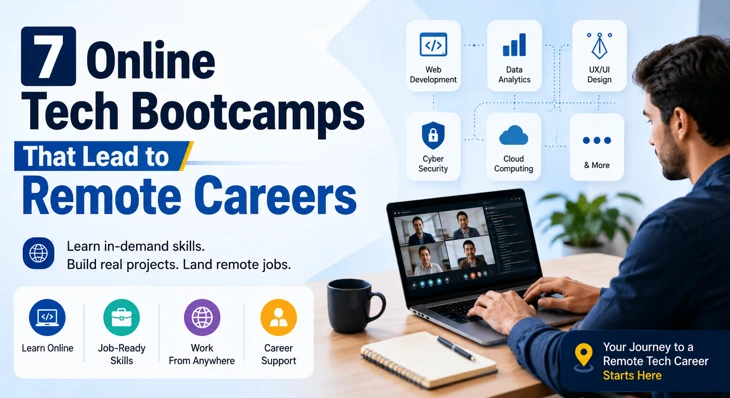
7 Online Tech Bootcamps That Lead to Remote Careers
Breaking into tech doesn’t look the same anymore. A few years ago, most people assumed you needed a computer science degree, years of classroom study, and an internship pipeline to even stand a chance. That’s no longer the reality. Today, many professionals are building successful remote careers through online tech bootcamps that focus on practical skills rather than theory-heavy academics. What makes this shift even more interesting is how accessible it has become. With just a laptop and internet connection, learners from anywhere can now train for roles in software development, data analytics, UX design, cybersecurity, and more. And in many cases, they are landing remote jobs within months of completing their training. This guide takes a closer look at seven well-known online tech bootcamps that are helping people step into remote-first careers. Each one follows a slightly different approach, but all of them share a common goal—getting you job-ready in a practical, focused way.Why Online Tech Bootcamps Are Opening Doors to Remote Work
There’s a reason online tech bootcamps have exploded in popularity. Companies are no longer hiring only within their local regions. Remote work has pushed organizations to seek talent globally, creating significant opportunities for skilled professionals. Bootcamps fit perfectly into this new world of work because they focus on what actually matters on the job. Instead of spending years studying theory, learners focus on:- Building real-world projects that mirror industry tasks
- Learning tools used by remote teams every day
- Developing job-ready technical and communication skills
- Creating a portfolio that shows practical ability
- Getting career support for interviews and job searches
1. CareerFoundry – A Guided Path for Career Changers
CareerFoundry is often recommended for beginners who want structure and personal support while switching into tech. It offers learning paths in UX design, web development, data analytics, and product management. What sets it apart is the level of guidance throughout the journey. Instead of learning alone, students are paired with mentors who stay involved from the first lesson to the final job application stage.A Learning Experience Built Around Support
The bootcamp doesn’t just teach technical skills. It also focuses on how to think and work like someone in a remote tech role. Students learn collaboration tools, workflow systems, and project management—skills that matter in distributed teams. Many graduates move into remote UX or developer roles, especially in startups and digital agencies that hire globally.2. Springboard – Flexible Learning with Structured Career Outcomes
Springboard has built a strong reputation for its flexible learning model combined with career-focused outcomes. Its programs cover software engineering, data science, cybersecurity, and UI/UX design. Instead of rigid classroom-style lessons, students progress through guided modules with consistent mentorship support.What Learners Appreciate Most
- One-on-one mentorship that keeps learning on track
- Portfolio-based projects that simulate real job tasks
- Structured career preparation sessions
Designed for Remote-Ready Professionals
A major focus is on preparing students for modern work environments where teams are often distributed. Graduates are trained to communicate clearly, manage tasks independently, and collaborate across time zones.3. BloomTech (Formerly Lambda School) – Learn Now, Pay Later Model
BloomTech, formerly known as Lambda School, gained attention for its income-share agreement model. Instead of paying upfront, students begin paying tuition only after they secure a job.Programs That Focus on High-Demand Skills
- Full Stack Web Development
- Data Science
- Backend Engineering
Built for Remote Opportunities
Because most of the skills taught align with remote-first tech roles, many graduates end up working with global teams. The focus on collaboration tools, version control systems, and project workflows prepares learners for distributed work setups.4. Udacity – Industry-Aligned Nanodegree Programs
Udacity stands out for its partnership-driven learning model. Many of its Nanodegree programs are built with input from companies like Google, Amazon, and IBM.Popular Learning Paths
- AI Programming with Python
- Cloud DevOps Engineering
- Data Analyst Program
Why It Works for Remote Careers
Udacity’s approach is highly practical. Learners build real projects that can be added directly to a portfolio. This becomes especially useful when applying for remote roles in fields like cloud computing, AI, or data engineering.5. Thinkful – Personalized Mentorship with Career Focus
Thinkful takes a more personalized approach by pairing students with mentors and career coaches. It offers programs in software engineering, UX/UI design, data science, and digital marketing.What Makes It Easy to Follow
- Flexible learning schedules
- Weekly mentor sessions
- Career coaching support from day one
Preparing for Remote Work Environments
Thinkful places strong emphasis on communication and real-world workflow practices. Students are trained to work independently while still collaborating effectively—an essential balance in remote jobs.6. Flatiron School – Intensive Training with Strong Industry Reach
Flatiron School is known for its immersive learning style and strong industry reputation. It offers programs in software engineering, cybersecurity, data science, and product design.Learning Experience
The curriculum is fast-paced and project-driven. Students spend most of their time building applications, solving problems, and refining their portfolios.Remote Job Pathways
Flatiron graduates often secure positions in companies that support hybrid or fully remote work environments. The school also provides strong interview preparation and employer networking support.7. Codecademy Pro – Self-Paced Learning for Beginners
Codecademy Pro is ideal for people who prefer learning at their own pace. It uses an interactive approach where learners write code directly in the browser.Skills You Can Build
- Web development fundamentals
- Front-end and back-end coding basics
- Entry-level data science concepts
A Stepping Stone Into Remote Work
While it’s more foundational compared to full bootcamps, Codecademy is a great starting point for freelancing or entry-level remote roles. Many learners use it to build confidence before moving into advanced programs.How to Choose the Right Online Tech Bootcamp
There’s no one-size-fits-all option here. The right choice depends on your goals, schedule, and preferred learning style.Start With Your Career Goal
Think about the role you actually want:- Software developer
- UX/UI designer
- Data analyst
- Cybersecurity specialist
Look at Career Support Systems
Strong bootcamps usually offer:- Resume and portfolio building
- Interview preparation
- Mentor guidance