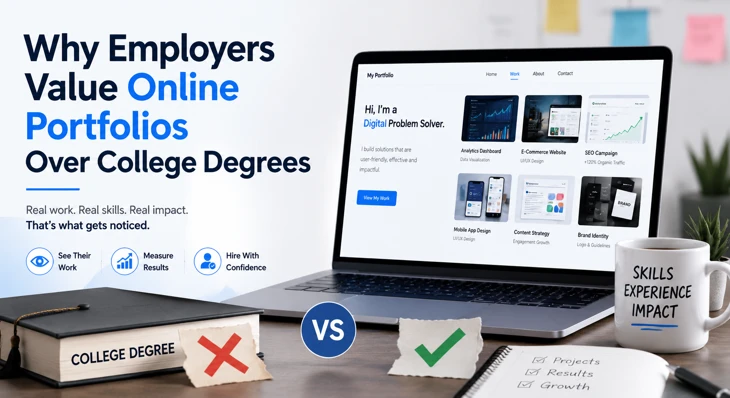
Why Employers Value Online Portfolios Over College Degrees
Hiring doesn’t really happen the way people imagine it does anymore. It’s not always a long, formal process with carefully read resumes and step-by-step comparisons. More often, it’s fast. Someone opens your profile, scrolls a bit, pauses for a second… and clicks on your work.
Not your degree. Not your marks. Your work.
That small shift is exactly why online portfolios have become so important. They don’t try to convince anyone with words. They quietly prove things through results. And in a job market where attention spans are short and expectations are high, that proof carries weight.
The Quiet Change in How People Get Hired
If you talk to hiring managers today, many of them won’t say there was a single “big change.” It just… evolved.
A few years back, things were more predictable. A good college name, decent grades, a clean resume—those alone could get you into interviews.
Now? Things feel less linear.
Tools change constantly. Roles overlap. Skills that mattered a few years ago get replaced faster than job titles can be updated. So naturally, employers started looking for something more reliable than academic history.
Not instead of education, but beyond it.
When they evaluate candidates now, they’re usually trying to figure out simple things like:
- Can this person actually build or deliver something useful?
- Have they worked on anything outside a classroom setting?
- Do they understand how real problems behave when there’s no perfect answer?
That’s where portfolios quietly enter the picture without much noise—but a lot of impact.
Degrees Still Matter… Just Not in the Same Way
It’s easy to misread this conversation as “degrees don’t matter anymore.” That’s not really true.
They do matter. Just differently.
A degree still tells you someone has spent time learning, following structure, and building foundational understanding. That’s useful.
But it doesn’t always show how someone behaves when things get messy in real-world work situations.
For example, someone might understand SEO in theory, but experiencing a real ranking drop on a live website feels completely different. Or someone might know marketing concepts but never experienced the pressure of a real campaign budget.
That’s usually where employers pause and start looking for evidence.
Not explanations. Evidence.
Why Portfolios Feel More Convincing Instantly
There’s something different about opening a portfolio. You don’t need to interpret too much. You just see the work.
And in most cases, that’s enough to form an opinion.
A developer’s GitHub, for instance, doesn’t need a long introduction. You can see how they think through code structure and problem-solving.
A designer’s work shows decisions—what they chose to include, what they left out, and how they balanced usability with visuals.
A writer’s samples make tone and clarity obvious without any self-description.
The interesting part is how quickly people judge it—not because they’re rushing, but because the work speaks for itself.
And then there’s something else employers notice, even if they don’t always say it out loud.
Growth.
A portfolio often shows a journey. Early work might look basic. Later work feels more confident, more intentional. That visible progress says a lot about how someone learns over time.
How Hiring Managers Actually Go Through Portfolios
Most hiring decisions don’t start with excitement. They start with a question:
Can this person handle the role without constant hand-holding?
So when someone opens a portfolio, they’re not just “looking at work.” They’re scanning for signals.
They look for things like whether the project actually matches the job role. They try to understand how decisions were made, not just what the final result looks like. If there’s any measurable impact—better traffic, improved engagement, faster performance—that stands out immediately.
And consistency matters more than people think. One strong project is good. A pattern of strong thinking across multiple projects is what really builds trust.
Sometimes, a simple explanation of
why something was done leaves a stronger impression than the result itself.
Some industries have already moved ahead without making it a formal rule.
In tech, for example, nobody really cares how you learned to code if you can build something solid. Many developers are self-taught, and their work speaks louder than any certificate.
In marketing, results matter more than theory. If you’ve increased conversions or improved reach, that’s what gets attention.
Design is even more direct. You either solve visual and usability problems or you don’t—and your portfolio shows that instantly.
Writing works the same way. You don’t need to say you’re good with words. Your samples already answer that.
Even in data roles, dashboards and insights from real datasets carry more weight than academic exercises.
A Situation That Happens More Than People Expect
Picture two candidates applying for the same role.
One has strong academic performance but very limited real-world experience.
The other doesn’t have an advanced degree but has worked on real projects that show clear outcomes.
In many real hiring situations, the second person gets selected.
Not because education is ignored—but because employers want to reduce uncertainty. They prefer someone who can step in and contribute, not someone who still needs time to adjust.
A portfolio helps remove that uncertainty quickly.
Why Hiring Is Slowly Shifting Toward Skills
This change isn’t dramatic. It’s gradual.
Companies are increasingly focusing on what candidates can actually do rather than what they claim on paper.
So instead of relying only on resumes, many hiring processes now include practical tasks, portfolio reviews, and real-world problem-solving exercises.
It’s a more grounded way of evaluating people—especially in remote hiring, where physical presence no longer plays a role.
Portfolios naturally fit into this new system because they show work without needing interpretation.
Trust Is the Real Reason Portfolios Win
At the center of all hiring decisions is one thing: trust.
A degree tells you someone has studied a subject.
A portfolio shows how they’ve used it.
That difference may sound small, but in practice it changes everything.
When employers can see actual work, they don’t have to imagine how someone performs—they already know.
And that makes decisions easier, faster, and more confident.
What a Good Portfolio Actually Looks Like
A lot of people overcomplicate portfolios. They try to include everything they’ve ever done, thinking more is better.
In reality, it’s the opposite.
A strong portfolio feels selective. It shows only the work that truly represents your current ability.
Each project should do a bit of storytelling—what the situation was, what you did, and what changed because of it. Nothing overly polished. Just clear.
If someone can understand your work without effort, you’ve already done most of the job.
And the best portfolios never feel “finished.” They evolve as the person grows.
Where Things Seem to Be Headed
Hiring trends already point in a clear direction.
More companies are prioritizing real performance over academic scores. Problem-solving over memorized theory. Demonstrated ability in the listed skills.
Degrees are still part of the picture, but they’re no longer the gatekeepers they once were.
In fast-moving fields like tech, marketing, and design, portfolios are often the first thing reviewed.
Not the last.
Conclusion
The growing importance of online portfolios over college degrees says something simple about today’s job market: proof matters more than promises.
Education still has value, but it no longer tells the full story on its own.
A portfolio fills that gap by showing what someone can actually do in real situations—not just what they’ve studied.
And for job seekers, that shift is actually encouraging. It means opportunity isn’t locked behind one path anymore.
At the end of the day, education explains what you learned.
A portfolio shows what you can do with it.
FAQs
1. Why are employers valuing portfolios more than degrees?
Because they show real, practical ability instead of only theoretical knowledge.
2. Can someone get hired without a degree if their portfolio is strong?
Yes. Many companies in tech, marketing, and design now focus more on skills and real work.
3. What should a strong portfolio include?
A few strong projects, simple explanations, tools used, and real outcomes wherever possible.
GitHub, personal websites, Behance, LinkedIn, and content platforms like Medium.
5. How often should a portfolio be updated?
Whenever you complete meaningful work or improve your skills, it should reflect your current level, not only your past.