📚 Table of Contents
- Introduction: Work No Longer Looks the Same
- Understanding Skill Stacking in a Practical Way
- Why Skill Stacking Fits Perfectly with Remote Work
- Work is more fluid than before
- Output matters more than titles
- Global competition has increased
- The Skills That Work Best When Combined
- Communication + Digital Tools
- Writing + SEO + Content Strategy
- Design + User Understanding + Basic Tech Awareness
- Marketing + Analytics + Creativity
- How People Actually Build a Strong Skill Stack
- What Skill Stacking Looks Like in Real Life
- Where People Go Wrong with Skill Stacking
- The Future of Remote Employability and Skill Stacking
- FAQs: Skill Stacking and Remote Careers
- 1. What does skill stacking actually mean in simple terms?
- 2. Why is skill stacking important for remote work?
- 3. Which skills are most useful for remote employability?
- 4. How long does it take to build a skill stack?
- 5. Do I need technical skills for skill stacking?
- Conclusion: Building a Career That Actually Lasts
Why Skill Stacking Is Becoming the Real Advantage for Remote Careers
Introduction: Work No Longer Looks the Same
A few years ago, most people measured career growth in a straight line. You learned one thing, applied for one role, and stayed in that lane for years. That structure has changed completely. Remote work has made careers less about location and more about capability. Teams are now spread across countries, projects move faster, and expectations are higher. In this environment, being good at just one thing often isn’t enough anymore. That is where skill stacking quietly changes the game. Instead of relying on a single strength, professionals are combining multiple relevant abilities to become more useful, flexible, and valuable in remote roles. It is not a trend. It is slowly becoming the standard way people stay competitive in remote employment.Understanding Skill Stacking in a Practical Way
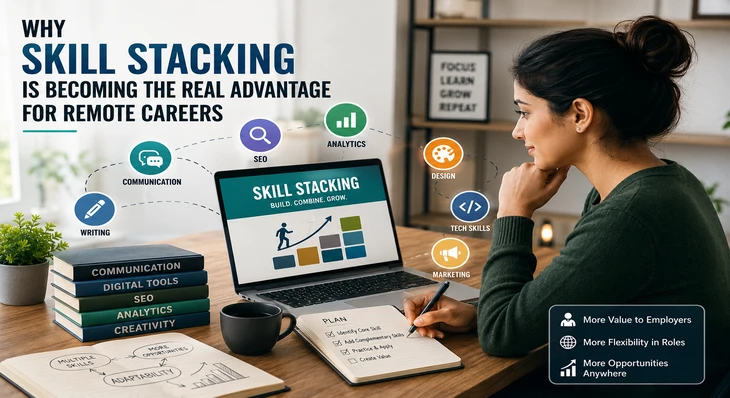
Skill stacking simply means building a mix of skills that work well together in real situations. Not random learning. Not collecting certificates. But creating a combination that actually improves how you work. Think about it like this. One strong skill gets your foot in the door. But a combination of skills helps you stay in the room and grow inside it. For example, someone who writes well can get freelance work. But if that same person also understands SEO, knows how to structure content for search intent, and can use basic design tools, their value increases instantly. They are no longer just a writer—they become someone who can manage content from idea to execution. This is what makes skill stacking so powerful in remote jobs. It builds independence.Why Skill Stacking Fits Perfectly with Remote Work
Remote jobs are different from traditional office roles. There is less supervision, fewer layers of communication, and more responsibility placed on individuals. Because of that, companies naturally prefer people who can handle multiple responsibilities without needing constant direction. When you look closely at remote employability skills, a pattern appears. Employers are not only hiring for technical ability. They are hiring for adaptability. A few real reasons this approach is gaining importance:Work is more fluid than before
Job roles in remote teams often overlap. A content person may also handle basic analytics. A developer might also participate in client discussions. Flexibility matters more than strict specialization.Output matters more than titles
No one cares how many titles you have. What matters is whether you can deliver results across tasks. Skill stacking directly improves output quality.Global competition has increased
You are no longer competing locally. You are competing with professionals from different countries, time zones, and experience levels. Having multiple skills gives you a clearer edge.The Skills That Work Best When Combined
Not every skill needs to be added to your stack. The real strength comes from choosing skills that naturally support each other. Let’s look at some combinations that work especially well in remote work environments.Communication + Digital Tools
Remote work runs on communication. But communication alone is not enough. When combined with tools like Google Workspace, Notion, Slack, or Trello, it becomes a practical execution. This combination helps you manage tasks, collaborate smoothly, and avoid misunderstandings in distributed teams.Writing + SEO + Content Strategy
This is one of the most in-demand combinations in digital roles. Writing helps you create. SEO helps you get visibility. Content strategy helps you decide what to create and why. Together, they turn a simple writer into a content professional who understands business goals.Design + User Understanding + Basic Tech Awareness
Even basic design knowledge becomes powerful when paired with user thinking and some technical awareness. It allows you to create work that is not just visually appealing but also functional and user-friendly.Marketing + Analytics + Creativity
Marketing alone can feel guesswork-heavy. But when you combine it with analytics, you start making informed decisions. Add creativity, and you can build campaigns that actually perform.How People Actually Build a Strong Skill Stack
Most people overcomplicate this process. In reality, it grows step by step, not all at once. It usually starts with one core strength. Something you are already comfortable doing. Writing, designing, managing, coding—anything. From there, you slowly add supporting skills that make your main skill more effective. For example, a content writer might start learning the basics of SEO. Once that feels natural, they may explore analytics to understand performance. Later, they might pick up basic design tools to improve presentation. This layered growth is what creates a real skill stack, not random learning. The key is application. Every new skill should be tested in real work—freelance projects, personal experiments, or even practice assignments. Without usage, skills stay theoretical.What Skill Stacking Looks Like in Real Life
It is easier to understand when you see it in action. A freelance content creator today is rarely just a writer. Many of them manage keyword research, write SEO blogs, create thumbnails, and schedule posts. They handle the full content cycle rather than just one small piece. A remote project coordinator is not just tracking tasks. They are communicating with teams, organizing workflows, and often solving small operational issues without escalation. Even in tech roles, developers who understand user experience and can communicate directly with clients are far more effective in remote settings than those who only code. These are not rare cases anymore. They are becoming the expected norm.Where People Go Wrong with Skill Stacking
Skill stacking sounds simple, but many people approach it in ways that slow them down rather than help. One common mistake is trying to learn too many unrelated skills at once. This creates confusion and weakens focus. Another issue is ignoring depth. A shallow understanding of many skills is less useful than a strong foundation in a few connected ones. Some people also fall into the trap of chasing trending skills without thinking about long-term value or personal direction. That often leads to burnout and inconsistency. The strongest approach is always intentional. Each new skill should have a clear reason behind it.The Future of Remote Employability and Skill Stacking
Remote work is moving toward a model where fewer people do more work across broader areas. Companies are becoming leaner, and expectations are becoming higher. This doesn’t mean working more—it means working smarter with better skill combinations. In the coming years, professionals who understand skill stacking will naturally adapt faster. They will move between roles more easily and find better opportunities in global markets. The demand is clearly shifting toward people who can combine:- Technical and creative thinking
- Communication and execution
- Strategy and delivery