📚 Table of Contents
- Introduction
- A New Career Reality in Emerging Cities
- Why Digital Upskilling Is Becoming Essential
- What’s Driving Growth in Digital Learning
- Affordable Internet Everywhere
- Learning Anytime, Anywhere
- Remote Work Becoming Normal
- Awareness Through Social Media
- Skills That Are Shaping the Future
- Digital Marketing Skills
- Data and Analytics
- Web and App Development
- AI and Automation Basics
- Design and User Experience
- How Online Learning Platforms Are Changing Lives
- Challenges That Still Exist
- Lack of Awareness
- Language Barriers
- Practice Gap
- Infrastructure Differences
- Real Stories That Show the Change
- What the Future Looks Like
- Personalized Learning Paths
- Skill-Based Hiring
- Regional Language Learning Growth
- Blended Learning Models
- How to Start Your Own Learning Journey
- Conclusion
- FAQs
- 1. What does digital upskilling mean in simple terms?
- 2. Why is digital upskilling important in smaller cities?
- 3. Can beginners really learn digital skills online?
- 4. What are the most useful skills to learn today?
- 5. How long does it take to become job-ready?
- 6. Do online certificates help in getting jobs?
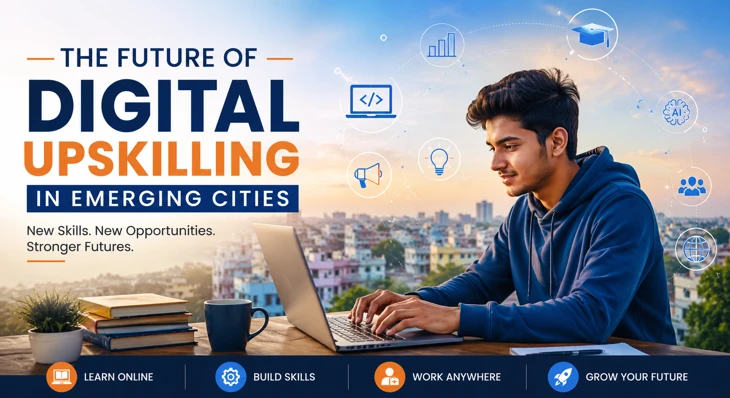
The Future of Digital Upskilling in Emerging Cities
Introduction
Something interesting is happening in smaller cities today. A few years ago, career growth often meant moving to big metros. But now, things are shifting quietly but powerfully. A student in a small town can learn to code, build projects, and land remote work without ever leaving home. This change is being driven by digital upskilling in emerging cities, where people are learning new-age skills through online learning platforms, mobile apps, and community-driven programs. It is no longer just about formal degrees. It is about what you can actually do with your skills. And honestly, this shift is rewriting career rules for an entire generation.A New Career Reality in Emerging Cities
Work is no longer tied to location the way it used to be. Companies are hiring talent based on skills, not geography. That alone has changed everything for emerging cities. Earlier, opportunities felt limited outside metro areas. Now, the same industries that once focused only on urban hubs are actively hiring in tier-2 and tier-3 cities. Whether it’s customer support, digital marketing, software development, or data-related roles, companies are open to remote collaboration. This has created a mindset shift. Young professionals are no longer asking “Where should I move?” Instead, they are asking, “What should I learn?” That small change in thinking is powerful.Why Digital Upskilling Is Becoming Essential
There was a time when basic computer knowledge was enough. That time is gone. Today, digital skills are part of almost every job. Even traditional roles now require familiarity with tools, platforms, and online communication systems. Digital upskilling matters because:- Jobs are evolving faster than traditional education systems
- Companies expect job-ready candidates
- Remote and hybrid work models are expanding
- Freelancing opportunities are increasing globally
What’s Driving Growth in Digital Learning
The rise of digital education in emerging cities is not accidental. It is being pushed by real, everyday changes.Affordable Internet Everywhere
Cheap mobile data has completely changed access. A student in a small town now has the same access to learning as someone in a metro city. That was not the case even a decade ago.Learning Anytime, Anywhere
Online learning platforms have made it possible to study at your own pace. Whether it is late at night or early morning, learning is no longer restricted by classroom schedules.Remote Work Becoming Normal
As remote jobs become more common, people are motivated to learn skills that allow them to work online. This includes everything from communication tools to advanced technical skills.Awareness Through Social Media
Many learners are discovering new career paths through YouTube, Instagram, and professional networks. Real-life success stories are inspiring others to start.Skills That Are Shaping the Future
Not all skills are equal in today’s job market. Some are clearly in higher demand and are shaping career growth in emerging cities.Digital Marketing Skills
Businesses now depend heavily on online visibility. Skills like SEO, content creation, social media management, and paid advertising are extremely valuable.Data and Analytics
Companies want to make smarter decisions using data. This has created demand for people who can understand patterns and turn numbers into insights.Web and App Development
From small businesses to global startups, everyone needs websites and apps. Learning programming languages opens doors to global opportunities.AI and Automation Basics
Even beginners are exploring artificial intelligence tools. You don’t always need to be an expert—understanding how AI works is becoming enough to stay relevant in many roles.Design and User Experience
Good design is no longer optional. Whether it is an app or a website, user experience plays a huge role in success.How Online Learning Platforms Are Changing Lives
One of the biggest reasons for this transformation is the rise of accessible online learning platforms. They have made quality education available without the need for expensive college fees or relocation. What makes them powerful is flexibility. A learner can start from scratch, practice regularly, and build real projects that actually matter in job applications. Many people in emerging cities are now:- Switching careers after online certifications
- Building freelance careers from home
- Starting small digital businesses
- Working with global clients remotely
Challenges That Still Exist
Even with all this progress, the journey is not completely smooth.Lack of Awareness
Many people still don’t know what opportunities exist in digital careers. Traditional career paths are still dominant in many families.Language Barriers
A large portion of advanced learning content is still in English, which makes it difficult for some learners in smaller towns.Practice Gap
People often learn concepts but struggle to apply them in real-world scenarios. Practical exposure is still missing in many cases.Infrastructure Differences
While internet access has improved, not everyone has access to good devices or stable connectivity. These challenges are real, but they are slowly reducing with time.Real Stories That Show the Change
Across emerging cities, stories are becoming more common. A college student learns web development through free tutorials and starts freelancing within months. A homemaker learns social media management and begins helping small local businesses grow online. A graduate who couldn’t find a job in his field learns data analytics and switches careers entirely. These are not rare stories anymore. They are becoming normal.What the Future Looks Like
The next few years will bring even bigger changes in digital upskilling in emerging cities.Personalized Learning Paths
Courses will adapt based on each learner's progress. No two learning journeys will look the same.Skill-Based Hiring
Companies will care less about degrees and more about real skills and portfolios.Regional Language Learning Growth
More platforms will offer courses in Hindi and other regional languages, making learning more inclusive.Blended Learning Models
Online learning combined with offline workshops will create a better hands-on experience.How to Start Your Own Learning Journey
Starting is often the hardest part, but it doesn’t have to be complicated. You can begin with small steps:- Choose one skill you are curious about
- Start with beginner-friendly free content
- Practice every day, even if only for 30 minutes
- Build small projects instead of only watching lessons
- Keep improving gradually instead of rushing