
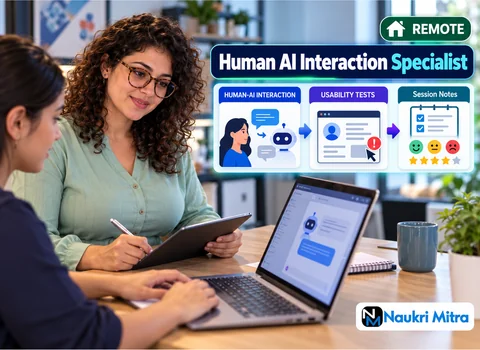
A user types: "My dad is in hospital and I am barely sleeping, but quick question, how do I set an out-of-office reply in my email?" The chatbot replies with five tidy steps for setting an auto-reply. Every step is accurate. Not one word acknowledges the father, the hospital or the lack of sleep. A fact-checker would pass it. You would not, because the person reading it at midnight feels processed rather than helped, and one line of acknowledgement would have cost the model nothing. Catching that, and explaining why it matters, sits at the heart of online human ai interaction specialist jobs. The role is part-time, remote from any country, and pays $20 per hour (USD). You hold multi-turn conversations with chatbots, rate replies for helpfulness, tone and safety, compare alternatives, and write brief notes on why one conversation worked better.
Nobody is paid to chat aimlessly. A session usually starts with a task card: who you are, what you want, and sometimes how you talk. One card makes you a nervous first-time traveller booking a visa appointment; another, a retired teacher who distrusts technology and writes in short, grumpy lines. You stay inside that person for the whole exchange.
Good testers plan the second and third turns before sending the first. If the bot suggests a budget, you will ask what happens when it is halved. Multi-turn dialogue evaluation only works when follow-ups probe something specific, so each conversation is a small experiment with a question behind it.
Real people reverse themselves constantly. They ask for a vegetarian recipe, then mention their partner eats fish after all. You do the same on purpose and watch what the model does with the new information.
A strong reply adjusts without fuss and without pretending the earlier request never happened. A weak one clings to the original plan, over-apologises for several lines, or silently drops a detail that still applies. You note which of those happened, and at what turn.
After a conversation, or after every turn, you score the bot against a project rubric:
The rubric decides what each score means, so reread it every session. Psychology training shows up quietly here: you learn to separate how a reply made you feel from what it actually did, and to score the second.
Many tasks show you two candidate responses to the same moment in a chat and ask which is better, and by how much. Often both are fine. One might be warmer but vaguer; the other precise but brisk. Compress the human ai interaction specialist job description to one line and it is this: your preference has to rest on reasons you could defend to another rater, not on which one you happened to read first. Rereading them in reverse order catches a surprising amount of bias.
A rating without a reason is hard for a model team to use. Most projects want two to four sentences that say what tipped the balance. Something like: "Response B noticed the user said they were short on time and cut its answer to the essentials. Response A was more complete but buried the one step the user needed under background they had not asked for." That note is specific, refers to the conversation itself, and avoids vague praise such as "B felt nicer." Clear, plain English writing matters more here than anywhere else in the role.
Short chats hide memory problems. Long ones expose them. You might tell the bot early on that you are allergic to peanuts, then fifteen turns later ask for a snack idea and see whether it offers peanut butter. You check whether it keeps your name, your stated budget and your city straight, and whether it contradicts advice it gave earlier without explaining the change.
Many testers keep a side note of the facts they planted, so they can check them without scrolling.
Some projects ask you to probe how a model handles sensitive requests: a user who sounds distressed, a question edging towards dangerous instructions, an attempt to coax out private information. You do this strictly inside the guidelines you are given. You never improvise beyond the agreed test scenarios, and you never try to extract genuinely harmful material for its own sake.
If a model produces something seriously harmful, you follow the escalation process set by the project rather than scoring it and moving on. Look after yourself too; if a task type is affecting you, tell the project lead.
Before any paid work, you pass an online assessment, which works like a practical version of the usual interview questions: a writing sample, conversations to rate and a side-by-side comparison to justify. Go slowly through the instructions before you begin.
Once accepted, the human ai interaction specialist salary per hour here is $20 (USD), paid for tracked time on tasks. Like most part time human ai interaction specialist jobs, the schedule is flexible but weekly hours are not fixed, so think of it as extra income on top of something steadier. For human ai interaction specialist work from home, you need a computer, stable internet and somewhere quiet.
You need a graduate degree in any field. Psychology, linguistics, communications or UX helps, because those subjects train you to notice how wording lands and where a conversation stalls. Required for everyone: excellent written English, empathy and analytical judgement. Those are the core human ai interaction specialist skills, and since the assessment measures them directly, this is one of the better routes into human ai interaction specialist jobs for freshers.
On a human ai interaction specialist resume, list concrete things: user interviews you ran, usability sessions, coding open-ended survey answers. No single recognised certification exists; a short course in UX research can sharpen your eye, but it does not replace the assessment.
A conversation designer builds the flows, prompts and fallback paths a chatbot follows, usually before launch. This role sits at the other end. You meet the live bot as a user would, push it through messy exchanges, and report how it behaves. Designers decide what the bot should say; you find out what it does say, and whether a person would be glad it said it.
Conversation-testing projects have turned up on Outlier and Turing, among other places; check their current terms yourself. Freelance human ai interaction specialist jobs there are contract work, and you usually cover your own internet and equipment. Paying to join, paying to register and handing over an OTP have no place in a legitimate project, although an entry assessment is entirely ordinary.
Anyone asking how to become a human ai interaction specialist can practise on any public chatbot: pick a persona, change your mind mid-chat, and write a three-sentence note on what the bot did well and badly.
As for the future, tasks are shifting from simple ratings towards longer, subtler conversations, which favours people with judgement about human behaviour. Nobody can promise how long any project runs, and some checks will be automated. What stays hard to automate is the opening scene: noticing that a correct answer still left someone unheard.