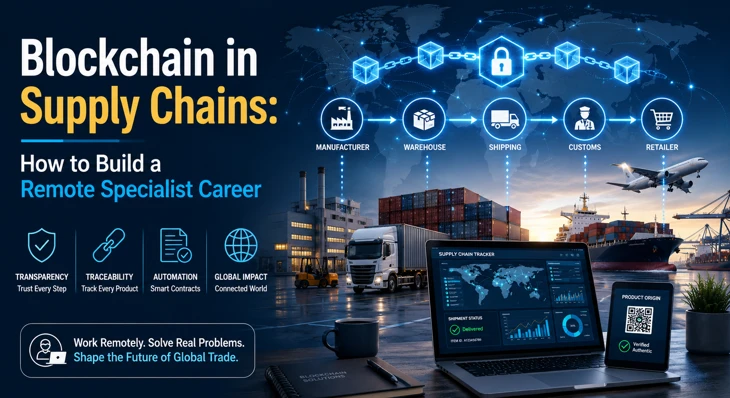
Blockchain in Supply Chains: How to Build a Remote Specialist Career
Introduction
A few years ago, most people outside logistics had never even heard of blockchain. Today, it is quietly sitting at the center of how products move around the world. From the coffee you drink in the morning to the phone in your hand, almost every item passes through a supply chain that is slowly becoming more digital, more transparent, and far more connected.
What is changing everything is not just technology, but trust. Businesses no longer want systems where data can be lost, edited, or disputed too easily. They want records that stay consistent across borders, companies, and systems. That is exactly where blockchain fits in.
For professionals looking for a future-ready career, this shift is opening doors that did not exist before. One of the most interesting paths is working remotely as a blockchain supply chain specialist. It blends logistics thinking with modern digital systems, allowing you to work with global teams without being tied to a single location.
How Blockchain Fits Into Modern Supply Chains
At its core, blockchain is simply a shared record system. The difference is that once information is added, it cannot be quietly changed. Everyone involved in the network sees the same version of events.
In supply chains, this becomes incredibly useful. Instead of relying on scattered spreadsheets or isolated company databases, all participants can view a single shared information flow. That includes manufacturers, shipping partners, warehouses, and retailers.
Imagine a shipment of medicine moving across countries. Each checkpoint adds a record to the system. If something goes wrong, it becomes easy to trace exactly where the issue started, rather than guessing or manually checking multiple systems.
That kind of clarity is what makes blockchain more than just a buzzword in logistics.
Why Companies Are Paying Attention
Most traditional supply chains were not built for speed or transparency. They were built for control and internal reporting. But global trade today moves much faster than those old systems can handle.
Blockchain helps solve some of those long-standing frustrations.
One of the biggest improvements is visibility. Everyone involved in the process can see the same information without waiting for updates or reconciliation reports. That alone reduces confusion and delays.
Another important shift is automation. Agreements between companies can be written into smart contracts that automatically execute when conditions are met. For example, payment can be released as soon as goods are confirmed as delivered.
There is also a strong push from industries that cannot afford mistakes. Food safety, pharmaceuticals, and luxury goods all rely heavily on knowing exactly where products come from and whether they are genuine.
Real Uses You Can See in Action
This is not theoretical anymore. Companies are already applying blockchain in practical ways.
In food supply chains, it helps trace contaminated products to their origin within minutes rather than days. That speed can prevent widespread health risks.
In fashion and luxury goods, it is being used to prove authenticity. Customers can verify where a product was made and confirm it is not a counterfeit.
In logistics, blockchain is helping reduce paperwork. Instead of signing and emailing documents across multiple parties, records are shared instantly and securely.
Even global shipping is becoming smoother. Customs processes and cross-border verification are becoming faster because data is already available in a trusted format.
What Skills Actually Matter for This Career
People often assume this field is only for developers. That is not true. While technical knowledge helps, the real demand is for people who understand how supply chains and blockchain systems connect.
On the technical side, understanding how blockchain works is important. You do not need to be an expert engineer, but you should know how transactions are recorded, what smart contracts do, and how decentralized systems function.
Basic programming knowledge is helpful, especially if you want to move toward development roles. Languages like Python or JavaScript are commonly used.
On the supply chain side, knowledge of logistics is equally important. You should understand how products move from suppliers to customers, how inventory is managed, and how procurement decisions are made.
Soft skills matter more than people expect. Clear communication, problem-solving, and the ability to work across time zones are essential, especially in remote roles where collaboration happens online.
Building Experience Without Overcomplicating It
Many people delay entering this field because they think they need advanced degrees or complex certifications. In reality, most employers value practical understanding more than formal credentials.
A good starting point is simply learning how blockchain systems work in real life. Once that makes sense, the next step is understanding supply chain basics and how companies operate behind the scenes.
From there, small hands-on projects help a lot. Even something simple like simulating product tracking or building a basic record system can give you clarity on how everything fits together.
As you grow, start observing how existing companies use these technologies. Many global brands publish case studies showing how they integrate blockchain into their operations.
Over time, you naturally build a portfolio that shows your thinking, not just your theory.
Remote Roles You Will Commonly Find
This field has created a mix of job roles that are well-suited for remote work.
Blockchain analysts often focus on reviewing supply chain data and identifying inefficiencies or inconsistencies in tracking systems.
Smart contract specialists work on automating agreements between different parties in the supply chain.
Supply chain data professionals handle the flow of information between systems and ensure accuracy across platforms.
Consultants guide businesses on how to move from traditional systems into blockchain-based infrastructure.
There are also hybrid roles where logistics and technology intersect, especially in companies undergoing digital transformation.
What makes these roles interesting is that most of them do not require you to be physically present in an office. Work is usually collaborative, but location-independent.
If you look at job descriptions in this space, certain tools appear again and again.
Ethereum is one of the most widely used blockchain platforms for building applications and smart contracts.
Hyperledger is popular in enterprise environments where companies need permissioned blockchain systems.
SAP and Oracle supply chain tools are often integrated with blockchain layers to manage logistics operations.
On the technical side, Solidity is used for smart contract development, while Python is commonly used for data analysis and automation tasks.
Understanding how these tools work together is more important than mastering any single one in isolation.
Challenges You Should Be Aware Of
Like any emerging field, this one is not without difficulties.
The learning curve can feel steep at first because blockchain introduces new ways of thinking about data and ownership.
Many companies still rely on older systems, so integration can be slow and complex.
Regulations also vary across countries, which can make global implementations inconsistent.
There is also a gap between demand and skilled professionals, which creates opportunity but also means expectations are high for capable candidates.
Despite this, the long-term direction of the industry continues to move toward more digital and transparent systems.
Where This Career Is Heading
Supply chains are becoming more connected every year. The combination of blockchain, artificial intelligence, and IoT devices is creating systems that can track goods in real time with very little manual effort.
This means fewer delays, fewer errors, and much better visibility for companies.
Remote work is also becoming the default for many roles in this space. Teams are spread across countries, and collaboration happens through digital platforms.
As adoption grows, professionals who understand both logistics and blockchain will be in a strong position for years to come.
FAQs
What does blockchain actually do in supply chains?
It creates a shared and secure record of product movement that all participants can trust without needing separate systems.
Do I need a technical background for this career?
Not always. Some roles are technical, but many focus on analysis, coordination, or process improvement.
Is this field good for remote work?
Yes. Many companies operate globally, so remote roles are becoming very common.
Which industries use blockchain in logistics?
Food, pharmaceuticals, retail, luxury goods, and international shipping are leading adopters.
How long does it take to learn the basics?
Most people can understand core concepts in a few months with consistent learning.
Conclusion
Blockchain is quietly reshaping how global supply chains function. It is not happening overnight, but the direction is clear. Systems are becoming more transparent, more automated, and far more connected than before.
For professionals, this shift is creating real opportunities to build meaningful careers that do not depend on geography. Whether you come from a technical background or logistics experience, there is space to grow in this field.
What matters most is understanding how the pieces fit together and staying open to continuous learning. Those who start now will have a strong advantage as the industry continues to evolve.