📚 Table of Contents
- Introduction
- How Aerospace Engineering Slowly Became Remote-Friendly
- Why Global Aerospace Firms Are Hiring Remote Engineers
- What You Actually Need to Succeed in Aerospace Engineering Online
- The technical side
- The practical side
- Learning Aerospace Engineering Online Without Getting Overwhelmed
- The Real Path to a Remote Aerospace Engineering Career
- Tools That Quietly Power Remote Aerospace Work
- A Simple Real-World Scenario
- Challenges You Should Expect Along the Way
- What Actually Helps You Stand Out
- Where This Field Is Headed
- FAQs
- Is aerospace engineering online actually a real career path?
- Do I need a degree to work in remote aerospace engineering jobs?
- What should I focus on first?
- Are aviation engineering online careers competitive?
- Can beginners really enter this field online?
- Conclusion
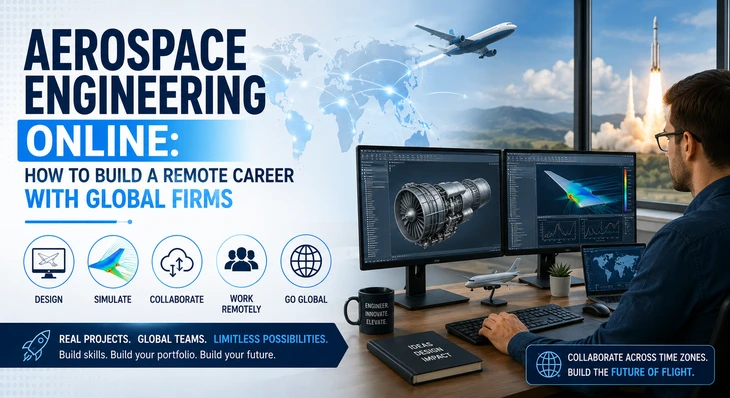
Aerospace Engineering Online: How to Build a Remote Career With Global Firms
Introduction
Aerospace engineering used to feel like one of those careers that only existed inside massive buildings, surrounded by machines, test labs, and strict security doors. If you weren’t physically there, you weren’t really part of it. That idea no longer fully holds. A surprising shift has happened over the last few years. A growing part of aerospace engineering online work is now done through screens, shared models, and cloud-based simulation tools. Engineers are still solving serious, complex problems—but they’re doing it from home offices, co-working spaces, and sometimes even different countries altogether. This change has opened the door for remote aerospace engineering jobs in a way that didn’t feel realistic a decade ago. Global firms are now hiring talent based more on skill than location, especially for design, analysis, and simulation-focused roles. If you’re exploring an aviation engineering online career or aiming to become a work-from-home aerospace engineer, the path is already there. It just looks different from the traditional one.How Aerospace Engineering Slowly Became Remote-Friendly
For a long time, aerospace engineering was tied to physical reality—wind tunnels, prototype testing, and lab-based validation. You had to touch and test things to move forward. But the industry quietly changed direction. Now, a large part of the work starts in the digital space. Aircraft parts are modeled in CAD software before anything physical exists. Airflow is tested through simulations. Stress analysis is performed using computational tools rather than physical stress rigs. This is where online aerospace engineering started becoming practical rather than theoretical. A typical modern workflow might involve:- Designing components in a CAD environment
- Running simulations to test performance
- Sharing models through cloud systems
- Reviewing changes in real time with global teams
Why Global Aerospace Firms Are Hiring Remote Engineers
There’s a very practical reason behind the rise of remote aerospace engineering jobs—it simply works better for certain types of work. Instead of limiting hiring to one region, companies can now look at global talent. That matters a lot in a field where highly specific skills can be rare. Another big factor is speed. When teams are spread across time zones, work doesn’t necessarily stop when one region sleeps. A simulation started in Europe can be reviewed in Asia and refined again in North America within the same day. And then there’s the technology itself. Cloud-based CAD tools, simulation platforms, and digital twin systems allow engineers to collaborate without being in the same building—or even the same country. For global aerospace companies, this flexibility has become too valuable to ignore.What You Actually Need to Succeed in Aerospace Engineering Online
One of the biggest misunderstandings about this field is that it’s only about degrees. While education matters, remote aerospace engineering roles depend heavily on how you apply knowledge in digital environments.The technical side
Most engineers working remotely in aerospace today are comfortable with tools such as CAD modeling software, CFD simulation platforms, and programming environments such as MATLAB or Python. You don’t need to master everything at once, but you do need depth in at least one area—design, simulation, or systems analysis.The practical side
This is where many people struggle. Remote teams expect you to explain your work clearly, document decisions, and work independently without constant supervision. If something breaks in a simulation or a model doesn’t behave as expected, you’re expected to investigate, not just report. That mindset is what separates casual learners from professionals in aviation engineering online careers.Learning Aerospace Engineering Online Without Getting Overwhelmed
Starting out can feel like standing in front of a very large machine with no instruction manual. There’s a lot to learn, and it’s easy to jump between topics without building real depth. A better approach is to think in layers. First, build your foundation—things like fluid mechanics, basic thermodynamics, and structural behavior. These don’t change whether you’re working in a classroom or remotely. Then move into tools. CAD software, simulation platforms, and basic coding for engineering applications become your daily instruments. After that, start building small projects. A drone wing design. A simple airflow simulation. A stress test on a basic structure. These aren’t just practice—they become your portfolio. That portfolio often matters more than anything else when applying for remote aerospace engineering jobs.The Real Path to a Remote Aerospace Engineering Career
There’s no single entry point, but most successful engineers follow a similar pattern without even realizing it. It usually starts with learning core engineering principles and getting comfortable with digital tools. Then comes experimentation—small projects, trial and error, fixing mistakes, improving designs. At some point, those projects start to look like real work. That’s when portfolios begin to matter. From there, opportunities open up in stages:- Internship or trainee-level remote roles
- Simulation or design assistant positions
- Specialized engineering roles in global teams