Remote Construction Project Management: Skills and Global Career Insights
Introduction
A construction site used to mean one thing: boots on the ground, hard hats, and long days spent managing teams face-to-face. But that picture is changing quickly. Today, a large part of construction coordination happens through screens, dashboards, and real-time updates shared across continents.
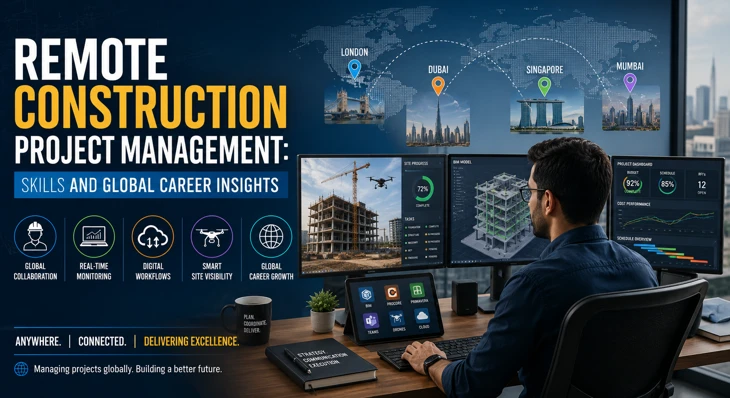
Imagine a project manager sitting in India, reviewing structural progress of a residential tower being built in Dubai, while the design team works from London and the contractor operates from Singapore. This is no longer unusual—it’s becoming the norm.
Remote construction project management is reshaping how buildings, infrastructure, and large-scale developments are planned and delivered. It allows professionals to stay connected to projects without being physically present at every stage, while still ensuring precision, safety, and efficiency.
This article explores how the field works, what skills truly matter, and how professionals can build a strong global career in this evolving space.
How Remote Construction Project Management Actually Works
At its core, remote construction project management is about control through information. Instead of physically inspecting every stage of a project, managers rely on structured data, live updates, and digital coordination tools.
Daily site progress is shared through photos, drone footage, and reporting apps. Engineers on-site act as the physical presence, while project managers interpret data, solve problems, and guide decisions remotely.
Think of it as running a construction site like a digital command center. Every moving part—materials, labor, timelines, and safety checks—is tracked in real time.
For example, on a high-rise project in the Middle East, a delay in concrete supply might be flagged instantly through a project dashboard. The remote manager can then adjust schedules, coordinate with suppliers, and prevent a chain reaction of delays—all without setting foot on the site that day.
Why the Industry Is Moving Toward Remote Management
Construction has traditionally been slow to adopt digital transformation, but that is changing fast.
One major reason is global collaboration. Modern projects rarely involve a single company or location. Architects, consultants, and contractors often work in different countries, and remote systems enable coordination without constant travel.
Another driver is efficiency. Travel time, site visits, and manual reporting used to slow down decision-making. Now, real-time data allows faster responses and fewer delays.
Technology has also made a huge difference. Tools like Building Information Modeling (BIM), cloud dashboards, and drone surveys give managers a level of visibility that was impossible a decade ago.
There is also a practical financial reason. Companies save significantly on operational costs when senior managers can oversee multiple sites without being physically present all the time.
A Day in the Life of a Remote Construction Project Manager
To better understand the role, consider a typical workday.
The morning often starts with reviewing updates from different sites. These may include progress reports, safety logs, and visual updates from site engineers.
Midday is usually dedicated to coordination calls—speaking with architects about design changes, discussing timelines with contractors, or resolving supply chain issues.
In the afternoon, attention shifts to documentation. This includes updating schedules, reviewing budget performance, and approving changes requested from the field.
What stands out most is not physical presence, but constant communication. The job is less about standing on-site and more about ensuring every part of the project stays aligned.
Skills That Truly Matter in Remote Construction Management
Success in this field depends on more than technical knowledge. It requires a balance of construction expertise, digital fluency, and strong judgment.
Technical Understanding
A solid grasp of construction processes is essential. You need to understand sequencing, materials, safety standards, and structural logic to make informed decisions remotely.
Digital Confidence
Modern project managers work with platforms such as Procore, Autodesk Construction Cloud, or Primavera. Comfort with dashboards, data tracking, and virtual collaboration tools is no longer optional.
Clear Communication
In remote environments, clarity becomes everything. Instructions must be precise, updates must be structured, and assumptions must be avoided. Miscommunication can easily turn into costly delays.
Decision-Making Under Pressure
Often, decisions must be made quickly based on incomplete but reliable data. Strong judgment becomes a defining skill.
Time and Coordination Management
Working across time zones means balancing multiple schedules. Prioritizing tasks and maintaining alignment across teams is critical.
Behind every successful remote construction project is a stack of digital tools working quietly in the background.
Building Information Modeling (BIM) is one of the most important. It creates a digital version of the structure, allowing teams to visualize every detail before and during construction.
Project management platforms like Procore and Autodesk Construction Cloud help track tasks, issues, and approvals in real time.
Drones have also changed the game. Instead of relying on manual site visits, managers can now review aerial footage to understand progress and identify issues.
Communication tools such as Microsoft Teams and Google Workspace keep everyone connected, while scheduling systems like Primavera help ensure timelines remain realistic and controlled.
Together, these tools create a virtual control room for construction projects.
Challenges That Come With Remote Construction Work
While the benefits are clear, the role is not without its challenges.
One of the greatest difficulties is limited physical visibility. Even high-quality data cannot always replace being on-site and seeing conditions firsthand.
Communication delays can also create friction, especially when teams are spread across different time zones. A simple clarification may take hours instead of minutes.
Another challenge is dependency on technology. Poor connectivity or system errors can interrupt workflows and delay decisions.
There is also the human factor—trust. Remote managers must rely heavily on on-site teams to report accurately and follow instructions precisely.
Global Career Opportunities in This Field
Remote construction project management is opening doors to international careers in ways that were previously impossible.
Professionals can now manage infrastructure projects in multiple countries without relocating permanently. This flexibility is especially valuable in large consulting firms and multinational construction companies.
There is also growing demand for specialized roles such as digital construction coordinators, BIM managers, and remote site supervisors.
Freelance opportunities are expanding as well. Experienced professionals are increasingly hired on a project basis to support planning, audits, or technical oversight.
The global nature of the industry means that talent is no longer limited by geography—skills and experience matter far more than location.
Practical Advice for Building a Strong Career
Those entering this field benefit from a mindset of continuous learning.
Staying updated with new construction technologies is essential. Tools evolve quickly, and professionals who adapt early often gain a competitive edge.
Building strong communication habits is equally important. Clear reporting structures and consistent updates reduce confusion and improve trust across teams.
It also helps to think in systems rather than tasks. Instead of focusing on isolated issues, successful managers look at how everything connects—time, cost, materials, and labor.
Finally, exposure to international projects can be a major advantage. Understanding different construction standards and working styles prepares you for global roles.
Frequently Asked Questions
Can construction project management really be done remotely?
Yes, many parts of it can be handled remotely using digital tools, although on-site teams still play a crucial role.
What makes remote construction management different from traditional methods?
The biggest difference is reliance on digital communication and real-time data instead of constant physical presence.
Platforms like BIM software, Procore, Primavera, and cloud communication tools are widely used.
Is this a good career path for the future?
Yes, demand is growing as companies adopt digital-first construction practices and global collaboration increases.
What is the biggest challenge in this role?
Maintaining clear communication and accurate on-site reporting is often the most difficult part.
Conclusion
Remote construction project management is fundamentally changing the way the industry operates. It blends traditional construction expertise with modern digital systems, allowing projects to be managed across cities, countries, and continents.
While it requires strong communication, technical understanding, and adaptability, it also opens doors to global opportunities that were once limited by geography.
As construction continues to evolve, professionals who learn to work confidently in remote environments will find themselves at the center of the industry’s future—where decisions are made faster, teams are more connected, and projects are delivered with greater precision than ever before.