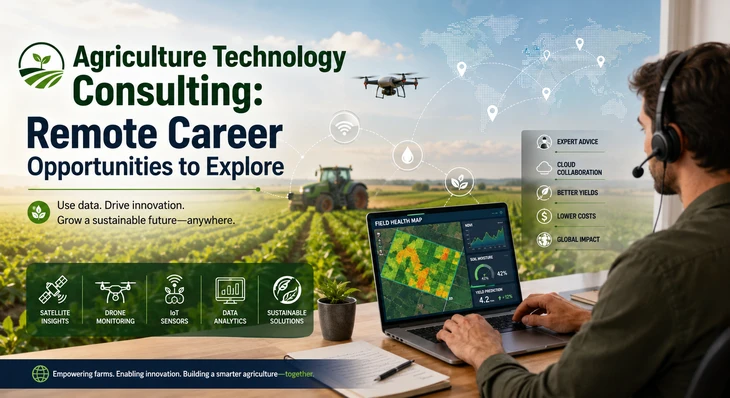
Agriculture Technology Consulting: Remote Career Opportunities to Explore
Introduction
Agriculture is going through a quiet but powerful transformation. Fields are no longer managed only through experience and instinct—today, decisions are increasingly supported by data, sensors, satellite images, and smart farming platforms.
In this changing landscape, agricultural technology consulting has become a practical and fast-growing remote career option. It brings together farming knowledge and digital tools, enabling professionals to support farms, agribusinesses, and agri-startups from anywhere in the world.
What makes this shift even more interesting is how naturally remote work fits into it. A consultant can now analyze crop data from one country while advising a farm in another, all through cloud platforms, dashboards, and virtual communication tools. This is why remote agritech consulting careers are gaining serious attention across the industry.
What Agriculture Technology Consulting Actually Involves
At its core, agriculture technology consulting is about helping farming businesses make smarter decisions using modern technology.
Instead of relying only on traditional farming methods, consultants introduce tools that improve efficiency, reduce losses, and support sustainable production.
These solutions often revolve around:
- Precision farming systems that optimize inputs
- Smart irrigation setups that save water
- Drone-based field observation for crop monitoring
- AI-driven yield prediction tools
- Digital platforms for managing farm operations
A remote agricultural technology consultant typically reviews available farm data, identifies performance gaps, and suggests practical improvements. Most of this work happens digitally through reports, video discussions, and online dashboards rather than physical visits.
Why Remote Agritech Consulting Careers Are Expanding
There is a clear reason why more professionals are exploring remote agritech consulting careers today—the entire agriculture ecosystem is becoming more connected and data-driven.
Farming is now data-powered
Modern farms generate continuous data through sensors, satellites, and automated systems. This information is valuable, but only if someone knows how to interpret it correctly.
Expertise is needed across regions
Not every farming region has access to advanced agricultural knowledge. Remote consulting bridges this gap by connecting experts with farms regardless of location.
Companies prefer flexible expertise
Many agribusinesses and startups prefer hiring consultants on a project basis rather than maintaining large in-house teams. It is flexible, cost-effective, and scalable.
Agritech innovation is accelerating
New companies working on smart irrigation, vertical farming, and soil monitoring technologies often rely on external consultants to validate and refine their systems.
Sustainability has become essential
With changing climate conditions affecting crop cycles and soil health, sustainable farming practices supported by technology are no longer optional—they are necessary.
Skills That Shape a Strong Agritech Consultant
Success in agriculture technology consulting comes from blending practical agricultural understanding with modern digital capability.
A consultant is expected to understand how farming works in real conditions—soil behavior, crop cycles, irrigation needs, and pest challenges. Without this foundation, even advanced tools lose their value.
On the technical side, familiarity with digital systems plays a big role. Tools such as GIS mapping platforms, remote sensing applications, farm analytics dashboards, and IoT-based monitoring systems are commonly used.
But technical knowledge alone is not enough. The real strength lies in interpretation—turning raw agricultural data into simple, actionable insights that farmers can actually use.
Clear communication also matters more than people expect. Since most interactions occur remotely, explaining complex findings in a simple, practical way has become a daily requirement.
Finally, adaptability plays a big role. Every farm behaves differently depending on climate, soil type, and available resources, so solutions cannot be identical everywhere.
Remote Career Opportunities in Agriculture Technology Consulting
The growth of agritech has created several career paths that can be done remotely, depending on interest and experience level.
Remote Agritech Consultant
Works directly with farms and agricultural businesses to introduce and optimize technology-based solutions that improve productivity and efficiency.
Precision Agriculture Analyst
Focuses on analyzing satellite images, drone data, and sensor readings to understand crop conditions and recommend targeted actions.
Agricultural Data Specialist
Works with structured farm data collected via digital tools, converting it into insights that support decision-making.
Sustainability and Climate Advisor
Helps agricultural organizations adopt eco-friendly practices that improve soil health, reduce water usage, and support long-term environmental balance.
Digital Farming Consultant
Guides farms in choosing and integrating the right digital platforms for daily operations and long-term management.
Agritech Product Advisor
Collaborates with startups building agricultural technologies by testing solutions, identifying gaps, and improving product performance before market launch.
Most remote agriculture consulting work depends heavily on digital systems that collect, process, and visualize agricultural data.
Data analysis tools like spreadsheets and visualization platforms help break down complex information into understandable formats.
GIS and remote sensing technologies provide geographic and environmental insights crucial to understanding land conditions.
Drone imaging and satellite systems offer real-time visibility into crop health, even without physical farm visits.
Communication tools such as video conferencing platforms and cloud storage systems keep collaboration smooth and consistent across locations.
Real Challenges in Remote Agriculture Technology Consulting
Even though the field is growing fast, it still comes with real-world limitations.
One of the biggest challenges is the lack of physical presence. Not being on-site can sometimes make it harder to fully understand local farming conditions.
Data quality is another concern. If sensors or tracking systems provide incomplete or inaccurate information, it can affect recommendations.
There is also the human factor—some farmers and businesses are still cautious about adopting new technology due to cost or unfamiliarity.
In many rural areas, limited internet connectivity can also slow down communication and data sharing, making remote work less smooth than expected.
Despite these challenges, the industry continues to improve as technology becomes more accessible and reliable.
Practical Impact of Agritech Consulting in Real Situations
The value of agriculture technology consulting becomes clear when seen in real-world scenarios.
In one situation, drone data from a farm is analyzed remotely to detect early signs of pest infestation. Instead of applying large amounts of pesticide across the entire field, the consultant recommends targeted treatment, saving cost and reducing environmental impact.
In another case, an agritech company developing smart irrigation systems uses remote consultants to test how their product performs under different soil and climate conditions. The feedback helps refine the system before it reaches the market.
These examples show how remote expertise directly improves efficiency, reduces waste, and supports better farming outcomes.
Future Outlook of Remote Agritech Consulting Careers
The future of agriculture technology consulting is closely tied to how quickly farming continues to modernize.
Artificial intelligence will play a bigger role in predicting crop health and optimizing farming decisions. Autonomous machines will reduce manual effort in many agricultural tasks. Blockchain may improve transparency in food supply chains, and climate-focused farming solutions will continue to expand.
Professionals who stay connected with these changes will find strong long-term opportunities in remote agritech consulting careers.
FAQs
What does a remote agriculture technology consultant do?
They analyze farm data and recommend technology-based solutions to improve productivity and efficiency remotely.
Is an agricultural background required for this career?
It helps, but people from data science, engineering, and environmental fields also enter this industry successfully.
Are remote agritech consulting roles growing?
Yes, demand is increasing due to the adoption of smart farming and the expansion of agritech startups globally.
What skills are most useful in this field?
Agricultural understanding, data analysis, GIS tools, and strong communication skills are essential.
Can this become a long-term career?
Yes, as agriculture continues to digitize, consulting roles will become even more important.
Conclusion
Agriculture technology consulting is quietly becoming one of the most important roles in modern farming. It connects traditional agricultural knowledge with advanced digital systems to improve productivity and sustainability.
With the rise of remote agritech consulting careers, professionals are no longer limited by geography. They can now contribute to global farming systems from anywhere, using data and technology as their primary tools.
As agriculture continues to evolve, this career path offers not just stability but also long-term relevance in a world that increasingly depends on smarter, more efficient food production systems.