📚 Table of Contents
- The Growing Role of Data in Everyday Work Life
- Understanding Data Skills in Simple Terms
- Core Data Skills You’ll Commonly Hear About
- Why Learning Data Skills for Future Careers Matters So Much
- 1. Almost Every Industry Now Depends on Data
- 2. Better Career Opportunities Open Up Naturally
- 3. You Start Making Smarter Decisions (Not Guessing)
- 4. You Stand Out in a Crowded Job Market
- 5. You Stay Relevant in a Tech-Driven Future
- Real-Life Ways Data Skills Are Used Every Day
- Marketing That Feels Personal
- Healthcare That Becomes More Accurate
- Online Shopping That Feels Smart
- Education That Adapts to Students
- How You Can Start Learning Data Skills Without Stress
- Start with Excel (Don’t Skip This)
- Understand the “Why” Behind Data
- Explore Visualization Tools
- Learn SQL for Real-World Data Work
- Practice with Real Examples
- Career Paths You Can Explore After Learning Data Skills
- Data Analyst
- Business Analyst
- Data Scientist
- Marketing Analyst
- Financial Analyst
- Challenges You Might Face (And How to Deal With Them)
- “This Feels Technical”
- Lack of Practice
- Too Many Tools at Once
- The Future of Data Skills in Careers
- FAQs
- 1. Why are data skills important for future careers?
- 2. Do I need a technical background to learn data skills?
- 3. What is the easiest way to start learning data skills?
- 4. Can data skills increase my salary potential?
- 5. How long does it take to become comfortable with data skills?
- Conclusion
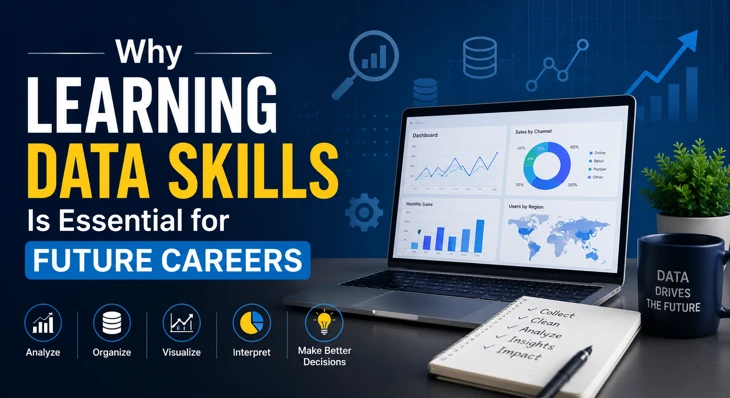
Why Learning Data Skills Is Essential for Future Careers
In today’s digital-first world, data isn’t just something companies store in spreadsheets anymore—it quietly shapes almost every decision we see around us. From the videos recommended on your phone to the way businesses set prices or hire employees, everything is influenced by data in some form. That’s exactly why learning data skills for future careers has become one of the most practical steps anyone can take right now. Whether you’re just starting out, planning a career switch, or looking to stay relevant in your current role, data skills are no longer a “nice-to-have”—they’re becoming a core requirement. And the interesting part? You don’t need to be a tech expert to get started.The Growing Role of Data in Everyday Work Life
Not too long ago, many business decisions were based on experience, instinct, or simple observation. That’s changing fast. Today, organizations rely on data to understand what is actually happening—not what they assume is happening. Every click on a website, every customer purchase, every app interaction creates information that can be studied and used. Think about it:- A healthcare hospital tracks patient data to improve treatment accuracy.
- A retail store studies buying patterns to decide what to stock more.
- A bank monitors transactions to detect unusual or suspicious activity.
Understanding Data Skills in Simple Terms
Before we go deeper, let’s clear something up—what exactly are data skills? In simple words, data skills are the ability to work with information in a meaningful way. That includes collecting it, organizing it, analyzing it, and turning it into something useful for decision-making. Instead of staring at raw numbers, you learn how to see patterns and stories hidden inside them.Core Data Skills You’ll Commonly Hear About
You don’t need all of these on day one, but these are the most in-demand ones:- Working with spreadsheets like Excel or Google Sheets
- Understanding basic data analysis and trends
- Creating dashboards using tools like Power BI or Tableau
- Using SQL to manage and extract data from databases
- Learning basic statistics for better interpretation
- Cleaning and organizing messy datasets
Why Learning Data Skills for Future Careers Matters So Much
Here’s the reality of the modern job market—it is becoming increasingly data-driven. And that’s not slowing down anytime soon. Companies today don’t just want employees who can “do the work.” They want people who can understand what’s working, what’s not, and why. Let’s break down why this matters in a practical way.1. Almost Every Industry Now Depends on Data
Whether you work in healthcare, finance, education, marketing, or logistics, data plays a role somewhere in the background. Even roles that didn’t need data earlier are evolving. For example, a marketing executive now tracks campaign performance using analytics, and HR teams use data to improve hiring decisions. This means learning data skills for future careers is no longer limited to analysts or engineers—it’s becoming a universal skill.2. Better Career Opportunities Open Up Naturally
Once you start building data skills, your career options don’t just improve—they expand. You may find opportunities such as:- Higher-paying job roles
- Remote and freelance projects
- Faster career progression
- Opportunities in global companies
3. You Start Making Smarter Decisions (Not Guessing)
One of the biggest mindset shifts that comes with data skills is this: you stop relying on guesswork. Imagine you’re running a small online business. Instead of wondering why sales dropped, you can actually check customer behavior, traffic sources, and conversion rates. This ability to “see the why behind the what” is what makes data skills so powerful in real life.4. You Stand Out in a Crowded Job Market
Let’s be honest—many candidates have similar degrees and qualifications. What often separates them is skill depth. When you can confidently talk about data, analyze trends, or explain insights, you instantly become more valuable to employers. It’s a quiet but strong competitive advantage that continues to grow over time.5. You Stay Relevant in a Tech-Driven Future
Automation, artificial intelligence, and machine learning are changing how work is done. But here’s the key point—they all depend heavily on data. Instead of replacing humans entirely, these technologies are shifting the type of work we do. If you understand data, you’re not just watching the change happen—you’re part of it.Real-Life Ways Data Skills Are Used Every Day
Sometimes, data sounds abstract until you see it in action. But once you notice it, you realize it’s everywhere.Marketing That Feels Personal
Ever wondered how ads seem to “know” what you’re interested in? That’s data at work. Companies analyze behavioral patterns to show relevant content rather than random promotions.Healthcare That Becomes More Accurate
Doctors use patient data over time to predict risks, suggest preventive care, and improve diagnosis speed. It’s not just treatment anymore—it’s prediction and prevention.Online Shopping That Feels Smart
Platforms like e-commerce websites suggest products based on what you’ve viewed or purchased. That recommendation system runs entirely on data analysis.Education That Adapts to Students
Online learning platforms now track student progress and adjust difficulty levels to match individual learning speeds. That’s personalized learning powered by data.How You Can Start Learning Data Skills Without Stress
One of the biggest myths is that data skills are hard to learn. They’re not—but they do require consistency. Here’s a simple way to begin without feeling overwhelmed.Start with Excel (Don’t Skip This)
Excel is still one of the most widely used tools in the world. Learn how to organize data, use basic formulas, and create simple charts.Understand the “Why” Behind Data
Instead of rushing into tools, focus on understanding:- What kind of problem does data solve?
- How is information structured?
- What does a pattern actually mean?