📚 Table of Contents
- How Remote Education Evolved Into a Career Ecosystem
- Instructional Design: Where Learning Becomes Structured Experience
- E-Learning Content Creation: Building Digital Learning Experiences
- Virtual Academic Coordination: Supporting Learning Behind the Scenes
- Learning Experience Design: Designing How Students Feel While Learning
- Curriculum Development in a Remote Environment
- EdTech Operations and Support Roles
- Academic Content Strategy and Educational Writing
- Skills That Shape Success in Remote Education Careers
- The Future of Remote Education Work
- Conclusion
Remote Education Careers: Beyond Tutoring and Online Classes
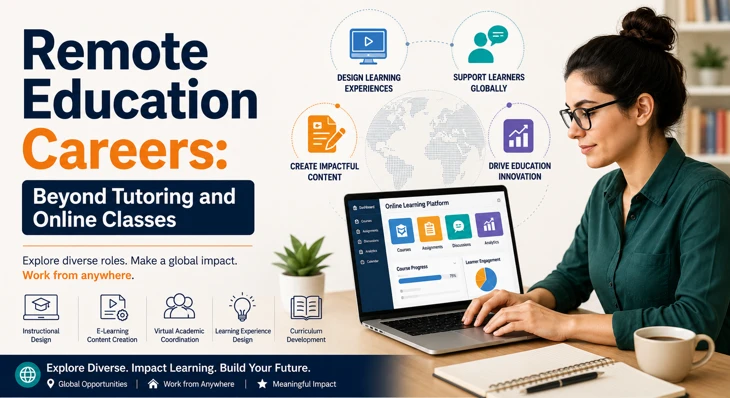
Remote education has quietly moved far beyond virtual tutoring sessions and scheduled online classes. What once felt like a narrow niche has now expanded into a full-scale professional ecosystem powered by digital learning platforms, global classrooms, and EdTech innovation. For professionals exploring remote education careers, working from home, this shift has opened doors to roles that are more strategic, creative, and impactful than ever before. Today’s education industry is no longer defined only by teaching. It is shaped by design, technology, content strategy, learner experience, and systems that support millions of students learning remotely. This transformation has created a strong demand for online education careers beyond tutoring, where professionals contribute to how learning is built, delivered, and improved at scale.How Remote Education Evolved Into a Career Ecosystem
A few years ago, remote education mostly meant online tutoring or live virtual classrooms. Now, it includes an entire infrastructure that supports digital learning at schools, universities, and global EdTech companies. This expansion has created steady demand for high-paying remote education jobs that don’t always require direct teaching. Instead, these roles focus on designing learning systems, managing digital content, and improving student engagement through technology. Professionals entering this space often discover that their skills—whether in writing, design, analysis, or coordination—can be applied in ways they never expected. That is what makes this industry especially attractive for those seeking work-from-home education jobs with long-term stability.Instructional Design: Where Learning Becomes Structured Experience
Among the most established remote education careers, instructional design stands out as a core function. Instructional designers do not simply create lessons—they build structured learning journeys that help students understand complex topics step by step. Instead of focusing solely on subject matter, they consider how people learn, how attention is sustained, and how digital tools can make learning more effective. In many organizations, instructional design jobs that work from home involve collaborating with subject experts, converting traditional training materials into interactive modules, and shaping entire online courses used by thousands of learners. A typical project might involve turning a textbook chapter into a multimedia learning experience with videos, quizzes, and simulations. The goal is not just information delivery, but retention and engagement.E-Learning Content Creation: Building Digital Learning Experiences
Another important path in remote education careers, beyond tutoring and online classes, is e-learning content creation. This role sits at the intersection of education, creativity, and technology. Instead of standing in front of a classroom, professionals design content that lives inside learning platforms. This includes video lessons, interactive exercises, assessments, and scenario-based learning modules. The demand for e-learning content creator jobs has increased significantly as institutions shift toward scalable digital learning models. Schools and companies now prefer structured online content that can be reused, updated, and delivered globally. What makes this role interesting is its creative flexibility. A single concept can be transformed into multiple formats—visual explainers, gamified quizzes, or case-based learning activities—depending on the learner’s needs.Virtual Academic Coordination: Supporting Learning Behind the Scenes
Not all impactful education roles involve creating content. Many professionals contribute by ensuring that learning systems run smoothly. Virtual academic coordinator roles are a strong example of this. These professionals act as the backbone of online education programs. They manage schedules, support students, coordinate with instructors, and ensure that academic processes stay organized in a fully digital environment. In many cases, this work requires strong communication skills and attention to detail rather than technical expertise. It is especially suited for individuals seeking remote education careers that work from home, that offer structure without traditional classroom teaching. A typical day might include responding to student queries, tracking course progress, updating records, and helping faculty manage digital tools. While less visible, this role is essential for maintaining a smooth learning experience.Learning Experience Design: Designing How Students Feel While Learning
Learning experience design (LXD) takes education beyond structure and into emotional engagement. Instead of focusing solely on content delivery, it asks a deeper question: how does the learner feel during the process? This field blends psychology, design thinking, and technology to create intuitive and meaningful learning journeys. Professionals in LXD often work alongside instructional designers and EdTech teams to improve usability and engagement. As organizations invest more in user-friendly learning platforms, remote curriculum development careers, and LXD roles are becoming increasingly important. Skills in UX principles, learner behavior analysis, and digital interaction design are especially valuable here. The goal is to make learning feel natural, not forced.Curriculum Development in a Remote Environment
Curriculum development remains one of the most structured and impactful areas within online education careers that remote professionals can pursue. Unlike short-term course design, curriculum developers work on broader learning frameworks. They decide what should be taught, in what order, and how it aligns with academic or industry standards. In a remote setup, this work involves constant collaboration with educators, institutions, and industry experts. The focus is on building long-term learning pathways that remain relevant as industries evolve. For example, a digital marketing curriculum might be updated regularly to reflect new tools, platforms, and trends. This ensures learners are always prepared for real-world applications.EdTech Operations and Support Roles
As digital education platforms scale, technical and operational support becomes critical. EdTech support roles ensure that learning systems function without disruption. These positions are often part of high-growth remote education careers because they directly impact user experience. Roles in this category may include learning platform support specialists, customer success managers for EdTech tools, and digital operations coordinators. Their responsibilities range from resolving technical issues to improving platform performance and supporting both educators and learners. While not always visible, these roles directly influence how smoothly online education is delivered.Academic Content Strategy and Educational Writing
Strong communication skills can open doors to academic content strategy, another flexible path in remote education. Professionals in this space create structured educational material, write course content, and develop knowledge-based resources for online platforms. This includes everything from blog-style educational content to full course scripts and research-based learning materials. Many organizations rely on these professionals to maintain clarity and consistency across digital learning programs. For writers and researchers, this is one of the most accessible work-from-home education jobs with strong long-term potential.Skills That Shape Success in Remote Education Careers
Success in this industry depends on a combination of educational understanding and digital adaptability. Some of the most valuable skills include:- Ability to communicate complex ideas clearly
- Familiarity with learning management systems
- Understanding of digital learning behavior
- Content structuring and instructional clarity
- Project coordination in remote environments