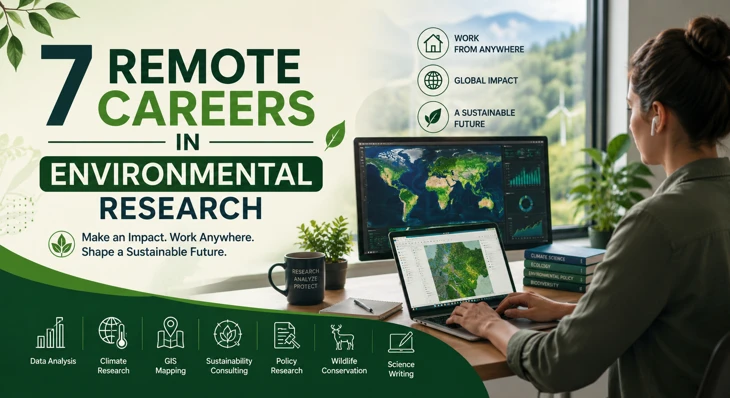
7 Remote Careers in Environmental Research
Environmental research is no longer limited to labs, field stations, or academic campuses. Over the last few years, it has quietly shifted toward a remote-work ecosystem, driven by digital tools, the global climate urgency, and data-heavy research systems accessible from anywhere. What used to require boots on the ground now often requires strong analytical thinking, reliable internet access, and the ability to interpret environmental patterns from a screen.
For professionals who care about sustainability and want meaningful work without geographic limits, this field offers surprising flexibility. Remote roles in environmental research are not only growing but also becoming more specialized and data-driven, opening doors for people with backgrounds in science, analytics, writing, and even tech.
Below are seven remote careers in environmental research that are actively shaping how we understand and respond to environmental challenges today.
1. Remote Environmental Data Analyst
At the center of modern environmental research is data. Climate trends, pollution levels, biodiversity shifts, and energy usage patterns are all tracked through massive datasets. Remote environmental data analysts work behind the scenes to make sense of it all.
Instead of collecting samples in the field, much of their time is spent working with datasets from satellites, sensors, and global research databases. They clean the data, look for patterns, and turn numbers into insights that scientists and policymakers can actually use.
This role often overlaps with skills in programming and statistics, particularly with tools such as Python, R, and GIS platforms. Many professionals searching for remote environmental data analyst jobs or climate data analyst work-from-home opportunities find this career path highly rewarding because it blends science with problem-solving.
What makes this role especially valuable is its direct impact. A well-interpreted dataset can influence environmental policies, conservation strategies, and even corporate sustainability decisions.
2. Remote Climate Change Research Assistant
Climate change research assistants support ongoing studies that examine how global temperatures, weather patterns, and ecosystems are shifting over time. Unlike traditional lab assistants, many of these roles are now fully remote.
Their work often includes gathering academic sources, organizing climate datasets, summarizing scientific papers, and assisting senior researchers in preparing reports or publications.
This is one of the most accessible entry points into environmental science careers, especially for graduates looking for remote climate research jobs or online environmental research assistant roles.
While the tasks may seem supportive, they play a critical role in keeping research organized and scientifically accurate. Without strong research assistants, many large-scale climate studies would move much more slowly.
3. Remote GIS Specialist
Geographic Information Systems, or GIS, have become one of the most powerful tools in environmental research. A remote GIS specialist works with spatial data to understand how land, water, forests, and urban areas are changing over time.
They create digital maps that show deforestation patterns, flood risks, wildlife movement, and urban expansion. These visualizations help researchers and governments make informed decisions about land use and environmental protection.
Professionals in this field often explore remote GIS jobs or work-from-home GIS analyst roles, as many organizations now rely on cloud-based mapping tools.
It is a technical role, but also a highly visual one. The ability to turn complex spatial data into clear maps is what makes this job so impactful in environmental planning.
4. Remote Sustainability Consultant
Sustainability consulting has moved far beyond corporate offices. Today, many consultants work remotely with businesses around the world, helping them reduce their environmental footprint.
They assess energy usage, waste management systems, supply chain practices, and overall environmental impact. Based on their analysis, they suggest practical improvements that align with sustainability goals.
Searches for remote sustainability consulting jobs or online environmental consultant roles have increased as companies face growing pressure to meet environmental standards.
What makes this role interesting is its balance between strategy and impact. It is not just about data; it is about changing how organizations operate in real-world settings.
5. Remote Environmental Policy Researcher
Behind every environmental law or regulation lies research. Environmental policy researchers study how governments and organizations respond to climate issues, pollution, and conservation challenges.
Working remotely, they analyze policy documents, compare international regulations, and prepare reports that help shape future environmental laws.
Many professionals enter this field through roles like remote environmental policy research jobs or climate governance analyst positions.
Strong writing and analytical thinking are essential here. The work is less about field data and more about interpreting how decisions are made and how they affect ecosystems and communities.
6. Remote Wildlife Conservation Data Specialist
Wildlife conservation has become increasingly dependent on technology. Remote sensors, drone imagery, and camera traps generate constant streams of data about animal populations and habitats.
A wildlife conservation data specialist works with this information to track biodiversity trends, migration patterns, and habitat loss.
Many of these professionals look for remote wildlife conservation jobs online or biodiversity data analyst roles that allow them to support conservation efforts without being physically present in the field.
It is a unique mix of technology and environmental protection. The insights generated often help NGOs and conservation groups prioritize endangered species and protect fragile ecosystems.
7. Remote Environmental Content Researcher
Not all environmental research happens in scientific labs. A growing part of it is communication-based. Environmental content researchers focus on turning complex scientific information into clear, engaging, and accurate content.
They work on blogs, reports, educational materials, and awareness campaigns that help the public understand environmental issues.
This role is often found in searches such as remote environmental writing jobs or sustainability content researcher careers.
The work requires strong research skills and the ability to simplify complex ideas without sacrificing accuracy. In many ways, these professionals act as a bridge between science and society.
Skills That Support Remote Environmental Research Careers
Although each role is different, there are a few shared skills that consistently matter across the field.
Strong analytical thinking is essential, especially when working with environmental datasets or policy documents. Familiarity with tools such as GIS software, spreadsheets, and programming languages can also make a big difference in career growth.
Equally important is the ability to communicate findings clearly. Whether it is a map, report, or article, environmental research only becomes valuable when others can understand and act on it.
Why Remote Environmental Careers Are Growing
The shift toward remote environmental research is not just a trend; it is a structural change. Organizations are now dealing with global-scale problems that require global collaboration. Much of the data used in environmental science is already digital, making remote work a natural fit.
At the same time, companies and governments are investing heavily in sustainability. This has created steady demand for professionals who can interpret environmental information and support decision-making from anywhere in the world.
Final Perspective
Remote careers in environmental research offer a rare combination of flexibility and purpose. They allow professionals to contribute to climate action, biodiversity protection, and sustainable development without being tied to a single location.
From data analysis and GIS mapping to policy research and content creation, each role plays a part in understanding and protecting the planet. As environmental challenges continue to grow, so does the need for skilled professionals who can work across borders, systems, and disciplines.
For anyone looking to build a meaningful remote career, this field is quietly becoming one of the most important spaces to explore.