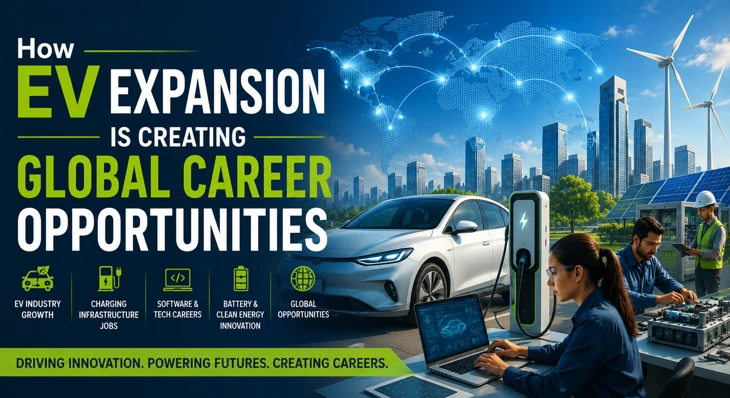
How EV Expansion Is Creating Global Career Opportunities
The shift toward electric vehicles is no longer a future idea tucked into policy papers or tech forecasts. It’s happening in real time—quietly at first, and now at full speed. If you look at what’s changing across automotive plants, energy systems, and even software teams, it becomes obvious that electric mobility is reshaping not just transport, but the kind of work people do for a living.
What’s interesting is how quickly this has moved from “emerging trend” to “mainstream career direction.” A few years ago, EV-related roles were limited to niche engineering circles. Today, they show up in job boards, startup hiring pipelines, government programs, and even mid-career transition plans.
The EV Industry Isn’t Just Growing—It’s Rewriting Job Markets
There’s a noticeable shift happening across global industries. Governments are tightening emissions targets, fuel prices keep pushing consumers toward alternatives, and automakers are under pressure to redesign everything from scratch. All of this is feeding directly into the electric mobility space.
But the real story isn’t just about vehicles—it’s about employment.
Work tied to growth in the electric vehicle industry is spreading across entirely different domains. You’ll find it in design studios, software companies, battery labs, logistics firms, and energy startups. Countries like India, China, Germany, and the United States are building entire ecosystems around EV development, which naturally brings a steady rise in hiring across technical and non-technical roles.
What makes this shift stand out is how mixed the demand for skills has become. Mechanical engineering still matters, but so does coding. Electrical systems are important, but so is data interpretation. It’s a blend rather than a single-track profession.
Manufacturing Work Is Changing Shape, Not Shrinking
There’s a common fear that automation reduces jobs. The EV space tells a slightly different story.
Yes, production lines are more automated now. But instead of eliminating work, they are changing what kind of work exists.
Traditional engine assemblies are slowly being replaced by electric drivetrain systems, battery modules, and digital control units. That shift alone has created demand for technicians who understand robotics systems, engineers who can work with battery architecture, and quality teams that can manage highly precise electronic components.
Gigafactories—large-scale battery production sites—are especially important here. These facilities aren’t small upgrades of old factories. They are entirely new industrial setups that need everything from safety specialists to logistics planners.
For many workers from traditional automotive backgrounds, this isn’t a dead end. It’s more of a sideways move that requires learning new tools rather than starting over completely.
Charging Networks Are Quietly Becoming a Massive Job Engine
Electric vehicles don’t work in isolation. They depend heavily on infrastructure, and that’s where a lot of new job creation is happening.
Across cities and highways, EV charging infrastructure jobs are growing fast. Every new charging station requires planning, installation, electrical setup, and ongoing maintenance. It’s not just hardware either—there’s software involved in managing energy flow and user access.
This has opened space for electrical engineers, field technicians, grid planners, and even energy consultants who focus on how charging systems connect with local power grids.
What’s also interesting is how local this job growth is. Unlike some tech sectors that concentrate in a few hubs, charging infrastructure work spreads across regions, towns, and transportation corridors.
Software Is Now Driving the EV Experience
Modern electric vehicles behave more like computers on wheels than traditional machines. That shift has pulled software right into the center of the industry.
Everything from battery efficiency to navigation systems depends on code. Even performance tuning is increasingly data-driven.
This is why opportunities in the electric mobility workforce now extend far beyond automotive backgrounds. Developers, AI specialists, cybersecurity experts, and cloud engineers are all finding entry points into this sector.
Roles like mobility software developer or AI systems engineer didn’t really exist in traditional automotive environments. Now they are becoming standard job titles in EV companies.
Battery and Clean Energy Careers Are Growing Side by Side
If there’s one area that sits at the heart of EV expansion, it’s battery technology.
Better batteries mean longer driving range, faster charging, and lower costs. That’s why research in lithium-ion improvements, solid-state batteries, and recycling systems is expanding so quickly.
At the same time, renewable energy is becoming part of the same conversation. Solar and wind energy are increasingly used to power EV charging networks, which creates overlap between energy and mobility careers.
This crossover is important because it means jobs are no longer isolated to a single industry. Energy engineers, materials scientists, and environmental researchers are all working in connected spaces now.
Global Supply Chains Are Creating Cross-Border Careers
Behind every EV is a complex supply chain that spans continents.
Raw materials come from one region, components from another, and final assembly somewhere else entirely. This creates constant demand for people who can manage logistics, procurement, and international coordination.
Countries rich in minerals like lithium and cobalt have become key players in this ecosystem, while manufacturing hubs continue to expand across Asia, Europe, and North America.
For professionals, this means career paths are no longer locked to one geography. Many roles now involve working across time zones, suppliers, and international teams.
Engineering Roles Are Becoming More Hybrid Than Ever
One of the biggest changes in EV careers is the degree to which technical roles have become blended.
Engineers today aren’t just mechanical or electrical—they often need to understand both, along with software basics.
Some of the emerging roles include EV integration engineer, battery systems specialist, drivetrain technician, and autonomous systems developer.
What ties all of these together is flexibility. The industry rewards people who can adapt rather than stay within a single narrow specialization.
Newcomers Have More Entry Points Than Ever Before
Unlike older industries that required very linear career paths, the EV space is more open.
Fresh graduates in engineering, computer science, and environmental fields are entering EV-related roles directly. At the same time, professionals from automotive, IT, and manufacturing backgrounds are switching careers through upskilling programs.
This mix is helping the industry grow faster because talent is coming from multiple directions at once.
Policy Support Is Fueling Job Growth Behind the Scenes
Government policies are playing a quieter but very important role in this expansion.
Subsidies for electric vehicles, investment in charging networks, and stricter emission standards are all pushing companies to hire more aggressively in EV-related areas.
Many countries are also investing in training programs to prepare workers for these new roles, which helps bridge the gap between traditional skills and new industry needs.
Where EV Careers Are Heading Next
The EV industry is still in a build-out phase, which means the career landscape will continue to expand for years.
As technology advances, new areas like autonomous driving, smart energy grids, and connected mobility services will continue to create roles that don’t yet exist.
It’s widely expected that millions of jobs will be created globally as electric mobility becomes the default form of transport.
Conclusion
Electric vehicles are not just changing how people travel. They are quietly reshaping how work itself is structured across industries.
From factories to software labs, from energy grids to global supply chains, new opportunities are opening up in places that didn’t exist a decade ago.
Whether someone is just starting out or thinking about a career shift, the EV ecosystem is becoming one of the most active and future-focused job markets in the world. And it’s still only in the early stages of its growth curve.