📚 Table of Contents
- Introduction: A Shift You Can Actually Feel in the Job Market
- EV Infrastructure: More Than Just Charging Stations
- How EV Growth Is Quietly Creating Entire Career Ecosystems
- Engineering Roles: The Backbone of EV Systems
- Software and Digital Skills: The Invisible Engine
- Renewable Energy and EV Infrastructure: A Natural Connection
- Manufacturing and Supply Chains: The Hidden Workforce Behind EV Growth
- Field Jobs That Keep Everything Working on the Ground
- Policy, Planning, and the Bigger Picture
- A Global Job Market That Keeps Expanding
- Skills That Matter More Than Ever
- What the Future of EV Careers Looks Like
- Conclusion: A Career Landscape That Is Still Taking Shape
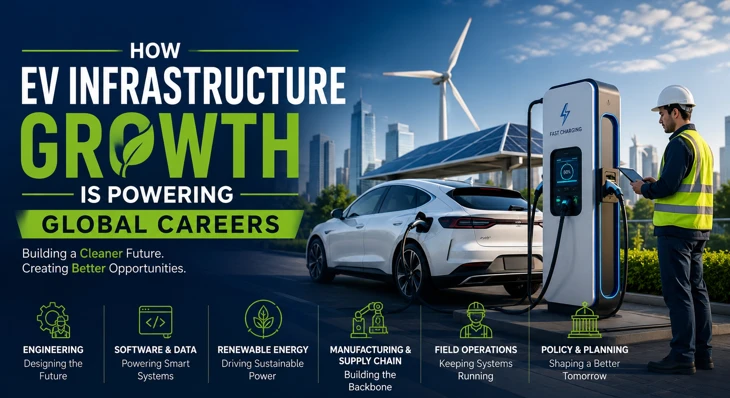
How EV Infrastructure Growth Is Powering Global Careers
Introduction: A Shift You Can Actually Feel in the Job Market
Electric vehicles are no longer something people talk about as “the future.” They are already on the roads, in parking lots, and slowly becoming part of daily life in cities and towns across the world. And whenever a big shift like this happens in transportation, something else changes quietly in the background—jobs. Not just a few jobs here and there, but entire career paths start forming around the new system. That’s exactly what’s happening with EV infrastructure. It’s not only about cars. It’s about the network that supports them—charging points, energy systems, software platforms, battery ecosystems, and the people who build and maintain all of it. What makes this moment interesting is that opportunities are not limited to one type of professional. Engineers, technicians, software developers, energy specialists, and even planners are all finding space in this growing ecosystem.EV Infrastructure: More Than Just Charging Stations
When people hear “EV infrastructure,” they usually picture a charging station on a highway or inside a mall parking lot. That’s part of it, but the real system is much bigger and more interconnected. Behind every charging point, there is a mix of energy distribution networks, digital monitoring tools, and sometimes even renewable power sources feeding the grid. Many modern stations are now linked with solar or wind energy systems to reduce dependency on traditional power sources. Countries such as India, China, the United States, and Germany are expanding this infrastructure rapidly. At the same time, private companies are competing to build faster charging systems and smarter energy networks. This competition is what is accelerating job creation globally.How EV Growth Is Quietly Creating Entire Career Ecosystems
The interesting part about this shift is that it is not creating just one type of job—it is creating clusters of jobs that support each other. For example, when a new charging network is planned, engineers are needed first. Then, software teams come in to build the system that manages usage. After that, technicians must install and maintain everything. Even after launch, analysts monitor performance and improve efficiency. So instead of a single job role, you get an entire chain of employment opportunities linked to a single project.Engineering Roles: The Backbone of EV Systems
At the core of EV infrastructure are engineers. Without them, nothing really moves forward. These professionals design charging systems, plan electrical layouts, and ensure safety standards are met. Some focus on battery systems, working to improve how energy is stored and delivered. Others specialize in integrating renewable energy sources into charging networks to make the system more sustainable over time. What’s changing here is not just the demand, but the nature of engineering work itself. It is becoming more cross-disciplinary, combining electrical knowledge with digital systems and environmental awareness.Software and Digital Skills: The Invisible Engine
If engineering builds the physical structure, software runs the entire experience. Every time someone plugs in an EV, a digital system tracks the session, calculates energy usage, processes payments, and manages availability. That’s where software professionals come in. From mobile apps that help drivers locate charging stations to cloud platforms that manage thousands of devices in real time, the demand for developers is growing steadily. Data is also becoming a big part of this space. Companies are analyzing how people charge their vehicles, when demand spikes, and how energy can be distributed more efficiently. This is opening up roles for data analysts and AI specialists in the energy sector.Renewable Energy and EV Infrastructure: A Natural Connection
One of the most important connections in this entire ecosystem is between EV infrastructure and renewable energy. Charging stations are increasingly being powered by solar panels or wind energy. This reduces pressure on traditional electricity grids and makes the entire system cleaner. Because of this integration, new job opportunities are emerging in the renewable energy sector. People working in solar installation, energy storage, and grid optimization are now directly connected to EV growth. In many ways, these two industries—electric mobility and renewable energy—are becoming increasingly inseparable.Manufacturing and Supply Chains: The Hidden Workforce Behind EV Growth
While technology often gets attention, manufacturing is what keeps everything running. Every charging station, every battery, and every component needs to be built, tested, shipped, and installed. This has created strong demand in the manufacturing and logistics sectors. Battery production alone is becoming a major global industry. From raw material processing to final assembly, each stage requires skilled workers and engineers. Supply chain professionals also play a critical role in ensuring that materials move smoothly across countries and production plants. Without this backbone, EV infrastructure would simply not scale at the speed it is growing today.Field Jobs That Keep Everything Working on the Ground
Not all EV jobs are behind screens or inside labs. A large part of this ecosystem depends on people working in the field. Charging stations need to be installed, tested, repaired, and upgraded regularly. This creates steady demand for technicians and electrical workers who understand real-world systems. These roles are especially important in regions where EV adoption is just beginning. A single installation project can lead to multiple long-term maintenance opportunities in that area.Policy, Planning, and the Bigger Picture
Behind every EV rollout, there is also planning at the government and policy levels. Cities need to decide where to place charging stations. Governments need to create regulations for safety and energy use. Urban planners need to think about how electric mobility fits into future transportation systems. This has opened up roles for policy analysts, sustainability consultants, and mobility planners who work at the intersection of environment and infrastructure. Their decisions often shape how fast EV adoption grows in a region.A Global Job Market That Keeps Expanding
One of the most interesting aspects of EV infrastructure growth is how global it has become. This is not limited to one region or a few developed countries. Emerging economies are also investing heavily in electric mobility. That means professionals are finding opportunities across borders. Remote monitoring roles, international engineering projects, and global supply chain coordination are becoming more common. In many cases, a professional in one country may be working on a project that is physically located in another part of the world.Skills That Matter More Than Ever
As the industry grows, so does the need for people who can adapt. Technical knowledge is important, but it is no longer enough on its own. Employers are looking for individuals who can work across systems and understand how different parts of the EV ecosystem connect. Some of the most valuable skills include:- Understanding of electrical systems and energy flow
- Familiarity with software tools and digital platforms
- Ability to work with data and interpret trends
- Strong problem-solving mindset