📚 Table of Contents
- Climate Tech Is a Global Problem That Demands Global Teams
- Why Remote Hiring Fits the Climate Tech Model So Well
- Talent Is Spread Across the World, Not One City
- Faster Execution Without Physical Boundaries
- Leaner Operations, More Focus on Impact
- High-Demand Remote Roles in Climate Tech Startups
- Software Engineers Building Climate Infrastructure
- Data Scientists Turning Climate Data into Decisions
- ESG and Sustainability Specialists
- Product Managers Shaping Climate Solutions
- Renewable Energy and Systems Experts
- How Remote Work Strengthens Climate Innovation Instead of Weakening It
- Collaboration Across Time Zones Creates Momentum
- Diverse Thinking Improves Climate Solutions
- Digital Infrastructure Makes Location Less Relevant
- Investor Confidence Is Accelerating Remote Hiring Trends
- Challenges That Climate Tech Startups Must Manage in Remote Hiring
- Communication Gaps Across Regions
- Complex Regulatory Environments
- High Competition for Skilled Professionals
- The Future of Remote Work in Climate Tech Is Already Taking Shape
- How Professionals Can Position Themselves for Remote Climate Tech Roles
- Build Relevant Technical and Analytical Skills
- Understand Climate and Sustainability Fundamentals
- Strengthen Remote Work Capabilities
- Contribute to Real Climate Projects
- Conclusion
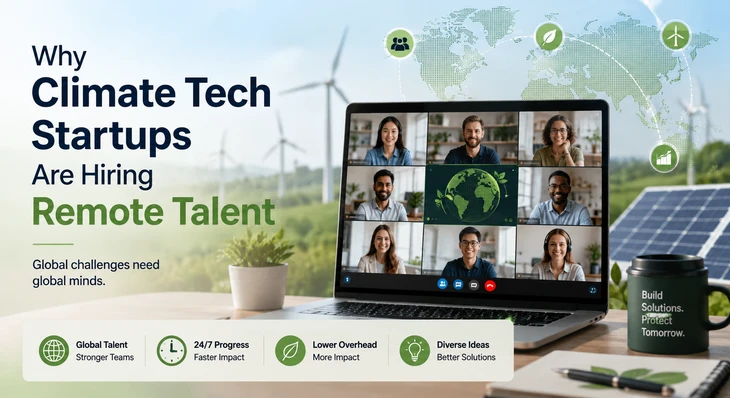
Why Climate Tech Startups Are Hiring Remote Talent
Climate tech has quietly moved from a promising niche into one of the most active hiring spaces in the global startup ecosystem. What makes it even more interesting is not just the technology being built, but the way these companies are choosing to build their teams. Instead of concentrating talent in one geography, climate tech startups are increasingly hiring remotely—and in many cases, it’s becoming their default approach. This shift is not driven by trend-following. It is tied to how climate problems behave in the real world: globally distributed, regionally complex, and deeply interconnected.Climate Tech Is a Global Problem That Demands Global Teams
Climate challenges do not sit inside national borders. Rising temperatures, shifting weather patterns, energy transitions, and carbon reduction goals affect every region differently yet simultaneously. Because of this, climate tech startups rarely design solutions for a single market. A carbon accounting platform, for example, might be used in Europe for compliance, in India for industrial tracking, and in the United States for corporate reporting—all at once. That global demand naturally pushes companies toward global hiring. Search trends reflecting this shift include:- remote climate tech jobs for global professionals
- International green technology careers work from home
- Sustainability startups hiring remote engineers
Why Remote Hiring Fits the Climate Tech Model So Well
Remote work in climate tech is not just about convenience. It is tightly connected to how these startups operate, build, and scale.Talent Is Spread Across the World, Not One City
The skills needed in climate tech are highly specialized—data modeling, energy systems engineering, environmental science, AI forecasting, and policy analysis. These professionals are not clustered in a single tech hub. They are distributed across universities, research labs, and industries worldwide. Remote hiring allows startups to reach talent that would otherwise be inaccessible. This is especially true for roles such as:- remote clean energy software engineering jobs
- ESG and sustainability analyst remote positions
- climate data science and machine learning remote roles
Faster Execution Without Physical Boundaries
Climate tech startups often operate under a sense of urgency. Whether it’s emissions tracking or renewable energy optimization, delays can reduce impact. With distributed teams working across different time zones, development cycles naturally overlap. While one team finishes its day, another begins work elsewhere. Over time, this creates a continuous production loop that speeds up delivery.Leaner Operations, More Focus on Impact
Most early-stage climate tech companies are capital sensitive. Maintaining large physical offices can consume resources that could otherwise be allocated to research or product development. Remote hiring helps redirect spending toward what matters most:- building better climate solutions
- scaling environmental impact
- improving product accuracy and reach
High-Demand Remote Roles in Climate Tech Startups
As the industry matures, the hiring landscape has expanded far beyond traditional environmental roles. Today, climate tech startups look like a blend of software companies, research labs, and policy-driven organizations.Software Engineers Building Climate Infrastructure
Software engineers are at the center of most climate platforms. They design systems that measure emissions, manage renewable energy data, and simulate environmental outcomes. Search-driven demand is growing for:- remote software engineer climate tech startups jobs
- full-stack developer, green energy, remote opportunities
Data Scientists Turning Climate Data into Decisions
Climate-related data is massive, messy, and constantly changing. Data scientists help transform this complexity into usable insights. They work on forecasting emissions, modeling climate risks, and improving sustainability reporting accuracy.ESG and Sustainability Specialists
Regulatory pressure and investor expectations have made ESG expertise essential. Remote ESG professionals help companies stay compliant and build long-term sustainability strategies. Common search intent includes:- remote ESG analyst jobs climate startups
- sustainability consulting remote roles green companies
Product Managers Shaping Climate Solutions
Product managers ensure that climate solutions are not only functional but also practical and scalable. They coordinate between engineering, design, and business strategy—often across multiple countries.Renewable Energy and Systems Experts
From solar optimization to smart grid design, energy specialists are increasingly working remotely to support global clean energy deployment.How Remote Work Strengthens Climate Innovation Instead of Weakening It
There is a common assumption that remote work slows down collaboration. In climate tech, the opposite is often true. When teams are distributed across regions, they bring different environmental realities into the same discussion. A flooding problem in Southeast Asia is not the same as a drought issue in Africa or a wildfire challenge in North America. Yet all of these perspectives can coexist within a single product team.Collaboration Across Time Zones Creates Momentum
Instead of waiting for a single working day to end, teams hand off progress across regions. This creates a natural rhythm where development continues almost continuously.Diverse Thinking Improves Climate Solutions
Climate problems are not uniform, so solutions cannot be either. Remote teams introduce varied thinking styles, technical approaches, and regional knowledge that improve product design.Digital Infrastructure Makes Location Less Relevant
Modern climate startups rely heavily on cloud platforms, simulation tools, and shared dashboards. Work is tracked by output and data—not physical presence.Investor Confidence Is Accelerating Remote Hiring Trends
Venture capital and impact investors are increasingly supportive of remote-first climate startups. The reasoning is simple: global hiring leads to greater access to talent and faster scaling potential. Investors are now paying attention to:- How distributed a startup’s team is
- how effectively it manages remote collaboration
- whether its model can scale across countries
Challenges That Climate Tech Startups Must Manage in Remote Hiring
Remote-first models are powerful, but they are not without friction.Communication Gaps Across Regions
Different time zones and cultural expectations can slow down decision-making if communication is not structured properly.Complex Regulatory Environments
Climate solutions often need to comply with multiple regional laws. Remote teams must stay aligned with evolving environmental regulations across countries.High Competition for Skilled Professionals
The demand for experienced climate tech talent is outpacing supply. This makes retention a serious challenge for startups. Companies that succeed usually invest heavily in:- strong remote culture
- meaningful mission alignment
- flexible but structured work systems
The Future of Remote Work in Climate Tech Is Already Taking Shape
Looking ahead, the connection between climate tech and remote work will only deepen. We are already seeing early signals of what’s coming next:- AI-driven climate modeling systems built by global engineering teams
- decentralized renewable energy networks managed remotely
- real-time sustainability tracking platforms developed across continents
- future remote climate tech careers trends
- global sustainability jobs remote work future
- distributed green technology, innovation teams
How Professionals Can Position Themselves for Remote Climate Tech Roles
For individuals aiming to enter this field, an opportunity exists—but it requires focused preparation.Build Relevant Technical and Analytical Skills
Strong candidates often develop expertise in:- data analysis and machine learning
- software engineering and cloud systems
- environmental science and ESG frameworks