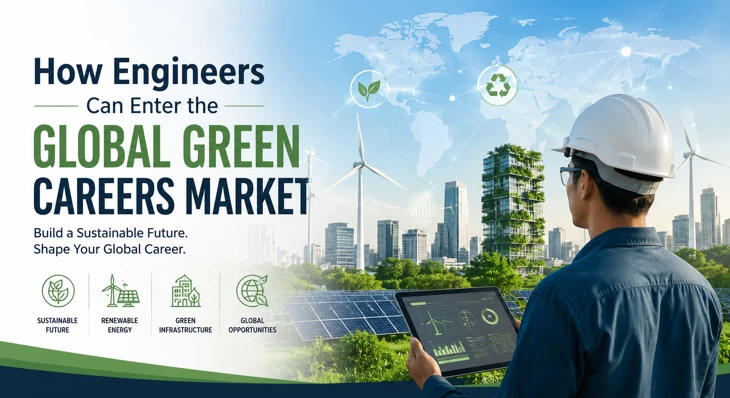
How Engineers Can Enter the Global Green Careers Market
The engineering profession is going through a quiet but powerful shift. Not long ago, most engineers planned careers around traditional industries like construction, manufacturing, or oil and gas. Today, that path is expanding in a very different direction. The global push toward sustainability has opened up a new kind of career space—one where engineering skills are being used to solve environmental problems, redesign energy systems, and reshape how cities and industries operate.
For many engineers, this transition is not about starting over. It is about redirecting existing skills into industries that are growing faster than ever. Renewable energy, climate technology, sustainable infrastructure, and ESG-driven business models are no longer niche areas. They are becoming core parts of the global economy.
This shift has created strong demand for professionals who understand both technical systems and environmental responsibility. Engineers who recognize this early are placing themselves in a strong position for international opportunities and long-term career stability.
The Rise of Green Engineering Careers Worldwide
The global economy is steadily moving toward lower emissions and more efficient use of resources. Governments are introducing stricter environmental policies, while companies are under pressure to reduce carbon footprints. As a result, industries are actively seeking talent that can bridge engineering expertise and sustainability goals.
This demand is especially visible in areas such as renewable energy engineering careers, sustainable infrastructure development jobs, and climate-focused technology roles. These are no longer limited to a few countries. They are emerging across Europe, the Middle East, North America, and parts of Asia.
What makes this shift significant is that it is not temporary. It is tied to long-term climate commitments and structural changes in how industries operate.
Why Engineers Have a Natural Advantage
Engineering and sustainability are closely connected. At its core, engineering is about solving problems using systems, design, and efficiency. Green industries simply apply those principles to environmental challenges.
For example, improving energy efficiency in industrial systems, designing low-emission buildings, or optimizing renewable energy storage all require engineering thinking. That is why employers increasingly look for professionals with technical backgrounds who can adapt to sustainability-focused work.
There is also a growing need for engineers in ESG-related roles, where companies track environmental impact and redesign processes to meet compliance standards. These roles require both analytical ability and practical engineering experience.
Growing Career Paths in the Green Sector
Engineers entering this field often find multiple directions to explore, depending on their specialization and interests.
One of the most visible areas is renewable energy. Solar, wind, hydro, and emerging hydrogen technologies are expanding across continents. Engineers in these roles work on system design, installation planning, performance optimization, and maintenance of large-scale energy systems.
Another strong area is environmental engineering. This includes water treatment systems, pollution control technologies, and waste management solutions. Many governments are investing heavily in infrastructure upgrades, which is increasing demand for professionals in this field.
Climate technology is another rapidly developing area. Startups and research-driven companies are building tools for carbon tracking, emissions reduction, and energy intelligence systems. Engineers working here often combine software, data analysis, and hardware design.
Sustainable construction is also evolving quickly. Civil and structural engineers are now expected to design buildings that reduce energy consumption, use eco-friendly materials, and meet green certification standards.
Skills That Matter in Green Engineering Careers
Transitioning into sustainability-focused roles does not always require a complete career change. In many cases, it requires upgrading and reframing existing skills.
Technical knowledge still forms the foundation. Skills such as energy system design, environmental modeling, CAD and BIM tools, and data analysis are highly relevant.
Alongside this, understanding sustainability frameworks is becoming increasingly important. Concepts like carbon footprint analysis, circular economy principles, and environmental regulations are now part of everyday engineering discussions.
Digital skills are also playing a larger role. Technologies such as IoT-based monitoring systems, AI-driven energy optimization, and smart grid analytics are being integrated into modern infrastructure projects. Engineers who are comfortable working with data and digital tools often adapt more easily to green roles.
Practical Steps to Enter the Global Green Careers Market
Moving into green engineering roles is less about sudden change and more about gradual positioning.
A good starting point is identifying transferable experience. Many engineers already work on efficiency improvements, resource optimization, or system upgrades without labeling them as sustainability projects. Framing this experience correctly can make a strong difference when applying for roles.
Upskilling is another important step. Short courses in renewable energy systems, environmental engineering basics, or ESG reporting can help bridge knowledge gaps without requiring full-time study.
Building a focused portfolio is also useful. Documenting projects where energy savings, environmental improvements, or process efficiency were achieved can make applications more credible.
Job searching should also be more targeted. Instead of general searches, terms like sustainable engineering careers abroad, international renewable energy engineering jobs, or climate tech engineering roles can lead to more relevant opportunities.
Networking also plays a quiet but powerful role. Many opportunities in this space are shared through professional communities, industry events, and sustainability-focused groups rather than traditional job boards.
Regions Where Green Engineering Opportunities Are Expanding
Different parts of the world are moving at different speeds, but the overall trend is upward everywhere.
In Europe, countries like Germany, Denmark, and the Netherlands continue to lead in renewable energy and sustainable infrastructure development. Engineering roles here often focus on advanced energy systems and green building standards.
The Middle East is undergoing a transformation as well. Large-scale renewable energy projects and hydrogen initiatives are creating new demand for engineering expertise in regions traditionally associated with fossil fuels.
North America remains strong in both clean energy infrastructure and climate tech innovation, especially through startups and private sector investment.
Asia-Pacific is also rapidly expanding its renewable capacity. Countries like India, China, and Australia are investing heavily in solar, wind, and smart city projects.
Challenges in Transitioning to Green Careers
While opportunities are growing, the transition is not without challenges. One of the main difficulties is the speed of change. Technologies and standards in this sector evolve quickly, which requires continuous learning.
Another challenge is competition. As awareness grows, more engineers are entering the sustainability space, increasing competition for global roles.
There are also regional differences in regulations and standards, which means engineers working internationally need to adapt to different frameworks and compliance requirements.
Despite these challenges, the long-term direction remains strong, and early adaptation often leads to better career positioning.
The Future of Engineering in a Sustainable Economy
The role of engineers is expanding beyond traditional problem-solving. In the coming years, engineering will be closely tied to environmental performance, energy transformation, and climate resilience.
Technologies like hydrogen energy systems, carbon capture solutions, and AI-based environmental monitoring are expected to become more common. At the same time, industries will continue integrating sustainability into everyday operations rather than treating it as a separate function.
For engineers, this means the profession is becoming more interdisciplinary and globally connected than ever before.
Final Thoughts
The global green careers market is not a temporary shift. It is a structural change in how industries operate and how economies grow. Engineers who adapt early will find themselves in a strong position to access international roles, contribute to meaningful projects, and build long-term career stability.
What matters most is not abandoning existing skills, but evolving them. The same engineering principles that have always driven innovation are now being applied to one of the most important challenges of this generation—building a more sustainable world.