📚 Table of Contents
- Introduction: Healthcare Is Changing Faster Than Ever
- A New Foundation for Healthcare Work
- Clinical Diagnosis: When Technology Supports Medical Judgment
- Nursing Careers in the Age of Smart Monitoring
- Administrative Work: From Manual Tasks to Smart Systems
- Research and Drug Development: Faster Discovery, Smarter Science
- The Rise of Hybrid Healthcare Professionals
- Ethical Questions That Cannot Be Ignored
- Looking Ahead: What Healthcare Careers Will Become
- Conclusion: A Career Landscape in Transition
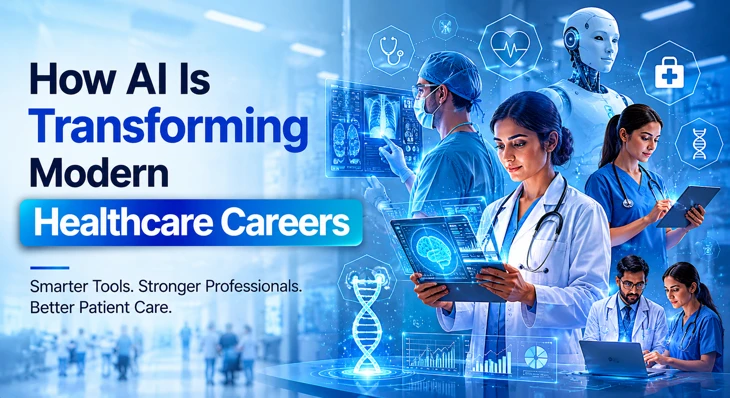
How AI Is Transforming Modern Healthcare Careers
Introduction: Healthcare Is Changing Faster Than Ever
Healthcare has never been static, but the pace of change today feels different. Hospitals, clinics, labs, and even small diagnostic centers are now working alongside technologies that didn’t exist in mainstream medicine a decade ago. Artificial intelligence is one of the strongest forces behind this shift. When we look at how AI is transforming modern healthcare careers, it becomes clear that this is not just a technology upgrade. It is a structural change in how healthcare professionals think, work, and grow in their careers. Doctors are not just diagnosing based on experience anymore. Nurses are not only relying on manual monitoring. Administrators are not only managing paperwork. Across the system, intelligent tools are quietly reshaping responsibilities and expectations. But instead of replacing people, AI is pushing healthcare professionals into more informed, more specialized, and often more meaningful roles.A New Foundation for Healthcare Work
The healthcare industry has always depended on accuracy, timing, and judgment. What AI brings into this system is scale and speed. Machines can process thousands of medical records in seconds, identify patterns in scans, and flag risks that might take humans much longer to notice. This shift is sparking new conversations about the impact of artificial intelligence on healthcare professionals' career growth, especially in hospitals rapidly adopting digital systems. Institutions like the entity["organization", "World Health Organization", "global health agency"] and leading hospitals such as the entity["organization", "Mayo Clinic", "US medical research hospital"] have already highlighted how digital intelligence will play a central role in strengthening healthcare delivery in the coming years. What matters most now is not whether AI will be part of healthcare, but how deeply professionals will integrate it into their daily work.Clinical Diagnosis: When Technology Supports Medical Judgment
One of the most visible changes is happening in diagnostics. AI tools are now capable of analyzing medical images like X-rays and MRIs with impressive accuracy. However, the real transformation is not in the tool itself but in how it changes specialists' roles. Radiologists, for example, are now working with systems that highlight possible concerns before they even begin analysis. This allows them to focus more on complex interpretations rather than spending time on routine scanning. This has led to growing interest in AI-based medical diagnosis career opportunities for healthcare workers, especially among professionals who want to upgrade their skills without leaving their clinical background. New hybrid roles are emerging, such as:- Clinical imaging reviewers working with AI assistance
- Diagnostic quality analysts
- Medical data interpretation specialists
Nursing Careers in the Age of Smart Monitoring
Nursing is one of the most human-centered professions in healthcare, and it is also one of the areas most enhanced by AI. Modern hospitals now use real-time monitoring systems that continuously track patient vitals. Instead of waiting for manual checks, nurses receive alerts when something unusual happens. This improves response time and reduces risk. The question many professionals are asking is how artificial intelligence is changing the nursing profession and patient care responsibilities. The answer is simple but important: nurses are becoming more proactive and less reactive. They are no longer just recording patient conditions; they are interpreting system-generated insights and making quicker decisions based on data. In practice, this means:- Less time on repetitive documentation
- More focus on patient interaction
- Better prioritization of critical cases
Administrative Work: From Manual Tasks to Smart Systems
Behind every hospital is a complex system of scheduling, billing, reporting, and compliance. These tasks have traditionally taken a huge amount of time and effort. Now, AI automation is quietly but powerfully changing healthcare administration. Processes like insurance claims, patient scheduling, and data entry are increasingly handled by intelligent systems that reduce errors and save time. This shift is opening up AI automation career growth opportunities in healthcare administration for professionals who are comfortable working with digital tools. Instead of focusing on repetitive work, administrative professionals are now moving toward:- Data analysis for hospital performance
- Patient experience improvement roles
- Digital operations coordination
Research and Drug Development: Faster Discovery, Smarter Science
Medical research is one of the most exciting areas where AI is making a real difference. Drug discovery used to be a long, expensive process that could take years. Today, AI can analyze biological data and suggest potential compounds in a fraction of the time. This is why artificial intelligence in pharmaceutical research career opportunities and future scope is becoming a major area of interest for science graduates and researchers. AI helps researchers:- Identify disease patterns in large datasets
- Simulate drug interactions before physical trials
- Reduce time spent on early-stage testing
The Rise of Hybrid Healthcare Professionals
One of the biggest changes in the job market is the demand for hybrid skills. Healthcare professionals are no longer expected to only understand medicine. They are increasingly expected to understand data and digital systems as well. The most in-demand skills now include:- Understanding basic machine learning concepts
- Ability to work with healthcare data systems
- Interpreting AI-generated insights correctly
- Maintaining ethical standards in digital environments
Ethical Questions That Cannot Be Ignored
As AI becomes more involved in healthcare, important ethical questions are also emerging. Who is responsible when an AI system gives the wrong recommendation? How is patient data protected in large digital systems? Can bias in algorithms affect treatment outcomes? These are not theoretical concerns. They are real challenges that healthcare systems are actively working on. The ethical challenges of artificial intelligence in the healthcare profession and medical decision-making are shaping policies across hospitals and governments. Key concerns include:- Protecting patient privacy
- Ensuring fairness in algorithms
- Keeping human oversight in critical decisions
Looking Ahead: What Healthcare Careers Will Become
The future of healthcare careers will not be defined by technology alone, but by how well professionals adapt to it. We are already seeing early signs of what is coming:- More predictive healthcare models
- Growth of remote and digital care systems
- Expansion of data-driven decision-making roles
- Increased collaboration between clinicians and AI systems