📚 Table of Contents
- Introduction: A New Way of Working in Education
- How EdTech Startups Changed the Meaning of Work
- Why EdTech Is One of the Fastest-Growing Remote Work Industries
- Learning Happens Online by Default
- Global Learners Need Global Educators
- Technology Drives Everything
- Types of Global Remote Opportunities in EdTech Startups
- Online Teaching and Virtual Tutoring Roles
- Curriculum Design and Content Development
- Software Development and Product Innovation
- Student Support and Engagement Teams
- Benefits of Working in Global EdTech Remote Roles
- Freedom to Work from Anywhere
- Exposure to International Work Culture
- Flexible Work Structures
- Skill Growth and Career Development
- Challenges in the Remote EdTech Ecosystem
- Communication Across Time Zones
- Dependence on Digital Infrastructure
- Increased Competition for Roles
- Skills That Help You Succeed in EdTech Remote Careers
- Technical Skills
- Soft Skills
- Future of Global Remote Opportunities in EdTech
- Growth of AI-Based Learning Systems
- Expansion of Hybrid Learning Models
- Rising Demand in Emerging Markets
- Conclusion: A Career Path Without Borders
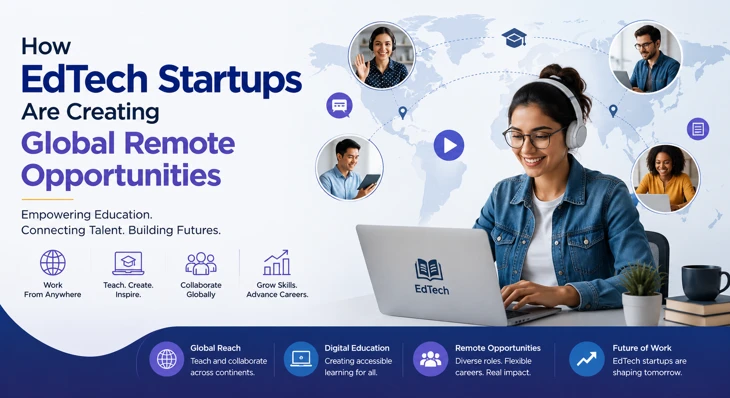
How EdTech Startups Are Creating Global Remote Opportunities
Introduction: A New Way of Working in Education
Education is no longer tied to classrooms, cities, or even countries. Over the past few years, EdTech startups have quietly reshaped how people learn and how professionals build careers in education. What started as simple online learning tools has now become a global ecosystem where teachers, developers, designers, and content creators collaborate from around the world. This shift is not just about technology. It is about opportunity. Today, someone sitting in a small town can teach students in another continent, while a software developer in one country builds learning platforms used globally. Searches like “remote EdTech jobs for teachers worldwide” and “global online education careers work from home” show how quickly this new career path is gaining attention. What makes this change even more powerful is that it feels natural for the industry. Education has become digital, and digital work has become borderless.How EdTech Startups Changed the Meaning of Work
A decade ago, most education-related jobs required physical presence. Teachers stood in classrooms, trainers worked in institutions, and content creators operated within office spaces. That structure has shifted completely. EdTech startups now operate in a fully digital environment. Lessons are created online, delivered via apps or platforms, and accessible to learners anytime. Because of this setup, hiring no longer depends on geography. Instead of asking “Where are you located?”, companies now focus on “What can you contribute?” This simple shift has opened doors to global remote hiring in EdTech companies, especially in areas such as online tutoring, curriculum design, and educational technology development.Why EdTech Is One of the Fastest-Growing Remote Work Industries
Not every industry adapts to remote work as smoothly as EdTech. The nature of this sector makes it uniquely suited for distributed teams.Learning Happens Online by Default
Unlike traditional industries, EdTech products are already built for digital use. Whether it is a language-learning app, a virtual classroom, or an AI-based learning platform, everything runs online. This removes the need for physical offices and enables flexible hiring models.Global Learners Need Global Educators
Students using EdTech platforms come from different countries, cultures, and learning backgrounds. To support them effectively, companies hire educators and trainers from diverse regions. This leads to more inclusive and flexible remote teaching jobs in EdTech startups.Technology Drives Everything
Behind every learning platform is a strong tech foundation. Developers, UX designers, data analysts, and product managers all contribute remotely. Many companies now actively search for candidates using phrases like “remote software developer jobs in EdTech companies” or “global EdTech product manager careers.”Types of Global Remote Opportunities in EdTech Startups
The range of roles available in this sector has expanded significantly. It is no longer limited to teaching alone.Online Teaching and Virtual Tutoring Roles
One of the most visible opportunities is online teaching. Educators can now work with platforms that connect them to students worldwide. These roles often include flexible scheduling and subject-based specialization. Long-tail search terms such as “work from home online teaching jobs for international students” and “remote tutoring careers in EdTech companies” are increasingly popular among educators exploring this field.Curriculum Design and Content Development
Behind every successful learning platform is well-structured content. Curriculum designers and instructional writers play a key role in shaping how lessons are delivered. These professionals often work remotely to develop engaging learning materials, assessments, and structured courses for global audiences. Demand is growing for “remote curriculum design jobs in EdTech startups” and “online educational content creation opportunities.”Software Development and Product Innovation
EdTech platforms rely heavily on technology, which creates consistent demand for developers and product teams. These roles are fully remote in most cases. From building learning management systems to integrating AI-driven tools, tech professionals help shape the future of digital education. Companies often hire globally to access diverse technical expertise.Student Support and Engagement Teams
A strong learning experience goes beyond content. Students often need guidance, technical support, and motivation throughout their learning journey. Remote support teams handle queries, provide onboarding assistance, and ensure smooth platform usage across time zones. This makes EdTech one of the most active sectors for remote customer success roles.Benefits of Working in Global EdTech Remote Roles
Freedom to Work from Anywhere
One of the biggest advantages is location independence. Professionals are no longer restricted by local job markets. A qualified candidate can work for a startup based in another country without relocating.Exposure to International Work Culture
Working with global teams naturally improves communication skills and cultural understanding. This exposure helps professionals grow faster and develop a broader perspective on education and technology.Flexible Work Structures
Many EdTech startups offer flexible schedules instead of rigid working hours. This allows individuals to balance personal commitments while contributing to meaningful projects.Skill Growth and Career Development
Because the industry is fast-moving, professionals continuously learn new tools, platforms, and teaching methods. This creates strong long-term career growth opportunities in the EdTech space.Challenges in the Remote EdTech Ecosystem
While opportunities are growing, the shift to global remote work also comes with challenges.Communication Across Time Zones
Working with teams spread across multiple regions can sometimes cause communication delays. Proper planning and coordination are essential.Dependence on Digital Infrastructure
Stable internet access and familiarity with digital tools are required for most roles. In some regions, this can be a limitation.Increased Competition for Roles
Since opportunities are open globally, candidates often compete with professionals from different countries. Strong skills and experience are important to stand out.Skills That Help You Succeed in EdTech Remote Careers
Success in this field depends on both technical knowledge and soft skills.Technical Skills
Professionals often benefit from understanding:- Online learning platforms and LMS tools
- Basic digital content creation tools
- Data interpretation and reporting
- Collaboration software used in remote teams
Soft Skills
Equally important are:- Clear communication in virtual environments
- Adaptability to different teaching or working styles
- Time management in flexible schedules
- Problem-solving in digital workflows