The message usually lands on WhatsApp in the evening: "Ghar baithe kaam, daily payment, sirf 2 ghante." It sounds like the break you have been waiting for. Often it is the first step of a scam, and one line exposes it: a genuine employer pays you, never the other way round.
This guide is about genuine work from home jobs without investment, and about the fakes that copy them. Being careful is now normal. LinkedIn's 2026 Job Search Safety Pulse, reported by People Matters on 6 May 2026, found that 82% of Indian professionals check whether a job is a scam before they apply.
Below are the roles that pass that test, sourced pay figures, who hires and how to apply, a red-flag checklist, and the 1930, cybercrime.gov.in and Chakshu steps if money has already gone. Naukri Mitra also carries more than 1,500 live work from home listings, and each one deserves the same checks.
On this page
- Roles that pass the test
- Pay per month, per hour and per task
- Who hires and how to apply safely
- For housewives, students and freshers
- How to spot a fake offer
- How the Telegram task scam works
- Reporting on 1930, cybercrime.gov.in and Chakshu
- Getting your money back
- Frequently asked questions
Genuine Work From Home Jobs Without Investment: Roles That Pass the Test
Genuine work from home jobs without investment are quieter than those WhatsApp forwards. They come with a job description, an interview and a company you can look up.
The one-line test: who pays whom
A genuine employer pays you. You never pay the employer. That single rule removes most scams before you read another word of the offer.
Large companies say this in writing. Amazon India's recruitment-fraud notice states that it "does not charge a fee at any stage of its recruitment process" and never asks candidates for a security deposit, training fee or laptop fee. It also warns that fraudsters contact people through WhatsApp or Telegram and send mail from free accounts like gmail.com. The same LinkedIn survey quoted above, reported by People Matters, found that 90% of reported scam attempts try to move the chat off the job platform and onto a personal messaging app.
So the test has two parts. Is anyone asking you for money, in any name? And is the conversation leaving the official platform for WhatsApp or Telegram? If either answer is yes, stop.
Non-voice process and back-office roles
A non-voice process job means you help customers in writing, not on calls. You answer emails, reply in a website chat window or update tickets in a support tool. Companies hire for this as "chat support", "email support" or "customer support executive (non-voice)".
Back-office work sits next to it: checking orders, updating records or tagging products in an online catalogue. These are usually salaried jobs with fixed shifts and a proper offer letter. The company gives you a login to its own system and never asks you to buy software, a "starter kit" or an ID card.
Data entry, typing and transcription
Data entry is real work. Businesses need people to move information from forms, invoices and scans into spreadsheets or software. If you want to know what a data entry operator actually does day to day, our older guide covers the basic skills.
The trouble is the label. A genuine data entry role is normally a back-office job with a salary. A "typing job" that pays per page, sends you scanned files on WhatsApp and asks for a registration fee is the most common fake in this category. The next section checks those per-page promises against real pay data.
Transcription means listening to audio and typing what people say. Platforms usually test you first and set clear equipment rules. TranscribeMe, for example, says its work platform "is not compatible with phones or mobile devices" and needs a computer with the Chrome browser and a stable connection.
Online tutoring, content and freelancing
If you are good at a school subject or spoken English, online tutoring is a genuine option: live video classes for an ed-tech company or your own students. Content work covers articles, product descriptions, social media posts and simple design or video editing.
Freelancing is the umbrella for most of this. You find clients, agree on a price and deliver the work. QA testing (checking apps and websites for bugs) also fits here, and some companies hire freshers for it as remote staff. If you are new, read how to start freelancing with no experience before you pitch your first client.
Jobs you can do with only a mobile phone
Yes, but the list is shorter than the WhatsApp forwards suggest. A phone works well for some tasks:
- managing social media pages for a small shop or local business
- replying to customer messages for a business on its official account
- finding freelance clients and chatting with them (Upwork's app, for example, lets freelancers search jobs, send proposals and message clients, though Upwork says some features still need a browser)
- short writing, caption or translation jobs that you can type comfortably on a phone
Most full-time remote jobs need a laptop or desktop. Several chat-process listings on Indeed India in November 2026 ask for "your own laptop with a stable internet connection", and one asks for broadband of at least 40 Mbps. Treat any "mobile-only job, big daily earnings" message with extra suspicion.
Real vs fake: the side-by-side table
Save or screenshot this table and check any offer against it before you reply.
| Check | Genuine work from home job | Fake work from home job |
|---|---|---|
| Who pays | The company pays you a salary or agreed fee | You pay first: registration, training, kit, "security deposit" or a task top-up |
| Contact channel | Job portal, company careers page, official email domain | Unknown WhatsApp or Telegram number, gmail or yahoo "HR" address |
| Interview | A test or interview, often on video, with real questions | No interview, or a two-minute chat followed by "you are selected" |
| Offer letter | Sent from the company's own email or HR portal, with clear role, pay and joining date | A PDF on WhatsApp, sent before any interview, often with a fee attached |
| Pay mode | Monthly salary to your bank account, or platform payouts with records | "Daily payment" that grows only after you deposit more money |
| Company traceability | Real website, careers page and public company details you can check | No website, a copied logo, or a famous brand name with a mismatched contact |
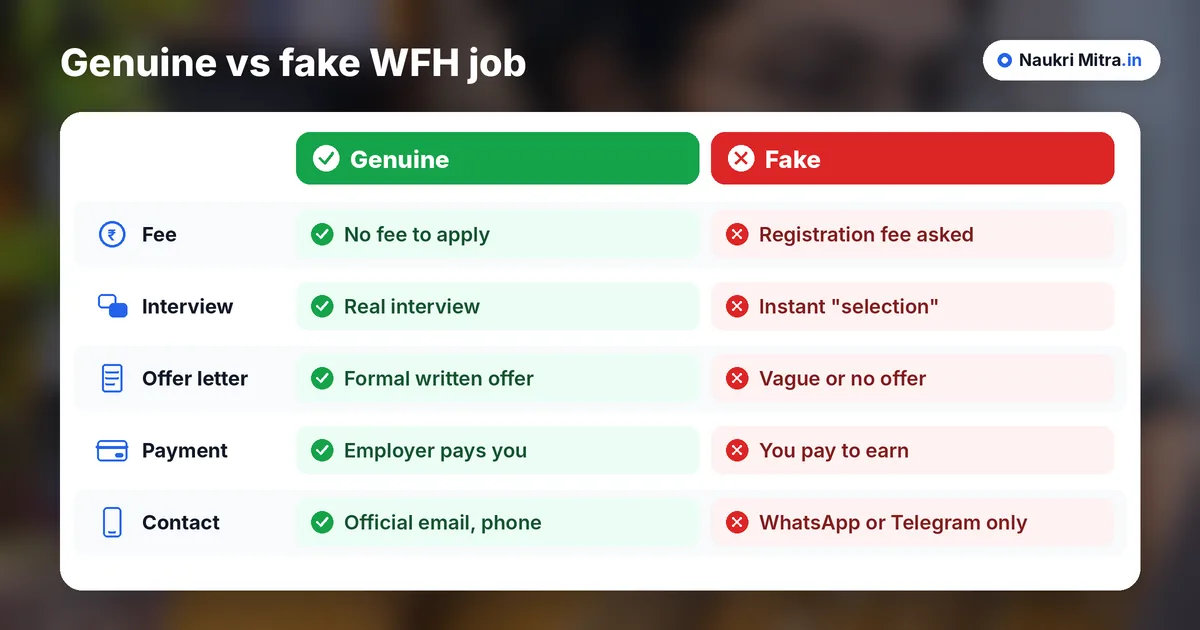
If an offer passes every row, it is worth applying. The next two sections show what these roles really pay and which employers hire for them.
Work From Home Jobs Salary per Month in India: A Sourced Pay Table
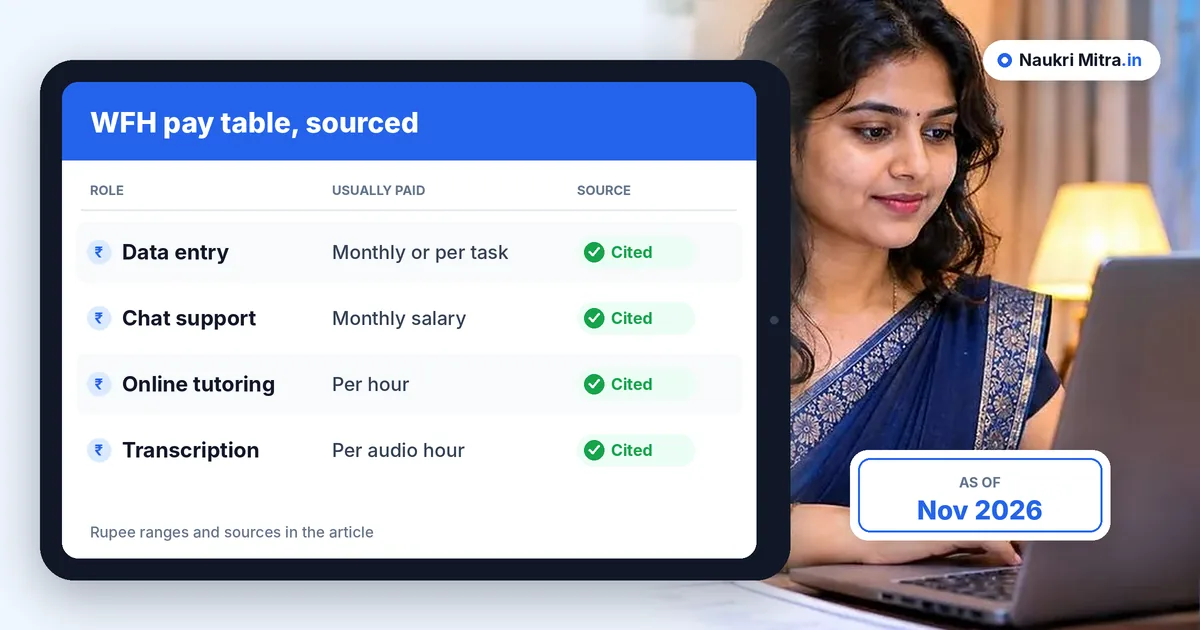
Most WhatsApp ads quote a number with no source. The figures below come from salary sites and live pages, and each one says where it came from. They show what real work from home jobs salary per month in India looks like for entry-level roles, so you can test any offer against them before you reply.
Monthly pay for full-time remote roles
The monthly ranges are AmbitionBox's yearly ranges divided by 12 and rounded. They cover people with zero to a few years of experience, and they include office staff as well as home-based staff. The sample size matters: a range built from 28 salaries is far weaker than one built from 3,900.
| Role | Monthly range (₹) | Hourly or per-task rate | Source |
|---|---|---|---|
| Data entry operator and typist | 10,000 to 33,000 | Mostly paid as monthly salary | AmbitionBox, ₹1.2 to 4 lakh a year, 28 salaries, as of November 2026 |
| Non-voice process executive | 9,200 to 31,700 | Mostly paid as monthly salary | AmbitionBox, ₹1.1 to 3.8 lakh a year, 83 salaries, as of November 2026 |
| Chat support executive | 12,500 to 35,000 | Mostly paid as monthly salary | AmbitionBox, ₹1.5 to 4.2 lakh a year, 3,900 salaries, as of November 2026 |
| Chat and email support executive | 13,300 to 40,000 | Mostly paid as monthly salary | AmbitionBox, ₹1.6 to 4.8 lakh a year, 720 salaries, as of November 2026 |
| Online tutor | 5,000 to 50,000 | ₹200 to ₹500 an hour for basic school subjects; ₹800 to ₹3,000+ for JEE/NEET coaching | AmbitionBox, ₹0.6 to 6 lakh a year, 2,600 salaries; hourly rates from FindMyGuru's 2026 platform comparison (user-reported), as of November 2026 |
| Transcriptionist | 8,300 to 41,700 | Up to US$1.75 per audio minute (top rate) | AmbitionBox, ₹1 to 5 lakh a year, 87 salaries; per-minute rate from GoTranscript's jobs page, as of November 2026 |
| Content writer | 8,300 to 57,500 | Often per article or per word on freelance work | AmbitionBox, ₹1 to 6.9 lakh a year, 24,800 salaries, as of November 2026 |
So how much can you earn per month? A fresher in a full-time support or data role should expect roughly ₹10,000 to ₹15,000 at the start, with ₹30,000 and above coming after a few years. Once you build a skill, the higher-paying remote roles open up. When an offer arrives, read up on how to negotiate pay for a remote role before you accept the first number.
Hourly and per-task pay for part-time work
Part-time work is usually paid by the hour, the task or the audio minute. Online tutoring has the clearest rates: FindMyGuru reports ₹200 to ₹500 an hour for school subjects on open marketplaces such as UrbanPro and Superprof, and ₹80 to ₹150 per answered question on Chegg India. In transcription, GoTranscript advertises earnings of "up to $1.75 per minute" of audio, and says pay varies with language, speed and accuracy. The word "up to" matters, because beginners rarely earn the top rate.
To turn a monthly salary into an hourly figure, divide it by the hours you work. Take an illustration: ₹15,000 a month for 8 hours a day, 26 days a month, is 208 hours, or about ₹72 an hour. Any part-time offer that pays many times that for simple copy-typing deserves a hard look.
Online Data Entry and Typing Jobs Real or Fake? What the Pay Tells You
The maths exposes most typing scams. A Lilach Bullock explainer (updated 13 November 2026) notes that ₹200 a page at 15 to 20 pages a day would come to ₹90,000 to ₹1,20,000 a month. A real full-time data entry role, it says, typically pays ₹10,000 to ₹18,000. That matches the AmbitionBox range above.
The same explainer says the ₹200 rate is roughly ten to twenty times what genuine data entry or transcription pays per unit of work. Its example victim was asked for a ₹1,500 "refundable security deposit" and then a ₹500 top-up. In its words, "The fee is the product, not the job." Real data entry pays modestly, so a high per-page rate combined with a fee gives the game away.
Daily payment: what is normal and what is bait
Salaried remote jobs pay once a month into your bank account, with a payslip. Freelance platforms pay on a fixed cycle too. Upwork's help page says fixed-price funds are released five days after the client approves a milestone, and hourly earnings become available ten days after the weekly billing period ends.
"Daily payment" ads work the other way. A Free Press Journal report on a Mumbai cyber police warning (3 November 2025) describes victims being paid ₹50 to ₹500 per task at first "to build trust" before deposits are demanded. Those small credits are bait.
Is work from home income taxable?
Yes. Working from home does not change how income is taxed. A monthly salary from an employer is taxed as salary, while fees from clients or platforms count as income from business or profession. Since 1 April 2026, the Income-tax Act, 2025 has replaced the 1961 Act and uses a single "tax year", as ClearTax explains.
Under the new regime, the Income Tax Department lists nil tax on income up to ₹4 lakh, and a rebate of up to ₹60,000 when taxable income does not exceed ₹12 lakh. Business Today adds that salaried people also get a ₹75,000 standard deduction. It also warns that once income crosses ₹4 lakh you must still file an ITR to claim the zero-tax benefit.
Freelancers in specified professions, such as technical consultancy, can use the presumptive scheme, now in Section 58 of the new Act (formerly 44ADA). Under it, 50% of receipts is treated as profit for eligible professionals with receipts up to ₹50 lakh, or ₹75 lakh if cash receipts stay within 5%, according to TaxGuru. Per Business Today, people using the presumptive scheme file ITR-4, and those who do not file ITR-3. Ask a chartered accountant before your first return.
Companies Hiring for Work From Home Jobs in India and How to Apply Safely
The safest place to find genuine work from home jobs without investment is the employer's own careers page. Big firms post remote roles there with a job ID, a location tag and a clear process. Below are companies hiring for work from home jobs in India that we checked on their official sites as of November 2026. Openings change every week, so treat these as places to look, not a promise of a vacancy.
Who actually hires remote staff in India
Most home-based jobs come from three kinds of employers: customer service and BPO companies, online tutoring platforms, and large tech or e-commerce firms that run "virtual" teams. A few examples, each checked on the company's own website:
- Amazon. A search of amazon.jobs for India in November 2026 showed many roles tagged "IND (Virtual)", such as transportation representative, brand specialist and vendor consultant posts, several of which need a foreign language like French or Arabic.
- Concentrix. Its India careers site, jobs.concentrix.com/india, lists some jobs with the location "IND Work-at-Home". Its recruitment fraud alert says it will never ask for money and never interviews over WhatsApp or Telegram chat.
- TP (formerly Teleperformance). The TP India careers page has an "Only Work-from-home" filter, and its work-from-home page includes India and says TP will never ask you to pay for equipment.
- Cuemath. This online maths platform recruits tutors for what it calls a work-from-home job on its online tutoring jobs page, with flexible hours, using your own laptop and internet.
BPO roles usually carry titles like customer support executive, email support associate or chat support agent. Chat and email roles are the non-voice kind, which suits people who type well but prefer not to take calls. If a role is not on the company's own site, ask the recruiter for the job ID and search for it there yourself.
Where to find verified listings
Use job boards that publish employer details and do not charge you to apply.
- National Career Service (NCS). The government portal at ncs.gov.in says it "does not charge any fee at any stage of registration, job application, or interview processing". Its helpline is 1514.
- Internshala. Its work from home internships page listed more than 1,800 openings in November 2026, and its FAQ says applying is free. It also sells an optional paid plan, which you do not need to apply.
- Naukri Mitra. Our live work from home job listings are free to browse and apply to.
For a longer comparison, see our guide to the remote job boards Indian candidates use, including international ones.
How to apply safely, step by step
- Start from the source. Find the role on the company's careers site or a known job board, not from a forwarded WhatsApp message.
- Note the job ID and location tag. Look for words like "Virtual", "Work-at-Home" or "Remote" in the official listing.
- Apply through the official form. Upload your CV there. Do not email it to a personal Gmail or send it on chat.
- Expect a real selection process. Genuine employers run an online test, a voice or typing assessment, or a video interview. It helps to prepare for a video interview with a quiet room and a charged phone or laptop.
- Get the offer in writing from the company domain. Amazon's India fraud alert page, for example, says its recruiters write from addresses ending in @amazon.com and that offer documents can only be downloaded from its own joining portal.
- Pay nothing at any stage. If anyone asks for money, stop and run the offer through the red-flag checklist below.
Equipment, internet speed and documents you need
Requirements vary by role, so read each listing. One Amazon virtual customer service posting on amazon.jobs asked for a wired broadband connection with at least 20 Mbps download and 8 Mbps upload, and said Wi-Fi would not do. The same posting said new joiners receive an equipment package. Tutoring roles such as Cuemath's ask for your own laptop or computer and a stable connection.
A practical starter kit for most customer support and chat support roles:
- A laptop or desktop (many roles do not work on a phone alone)
- A wired broadband line, plus mobile data as a backup
- A headset with a microphone for voice roles
- A quiet corner where you can work through a full shift
Our equipment checklist for working from home covers budget options.
On documents, employers usually need ID, address proof, PAN and a bank account for salary, but only after you are selected. Share them only through the company's official onboarding portal or HR email after you have a written offer.
A masked Aadhaar, which hides the first eight digits and is downloaded from UIDAI's myAadhaar portal, is often enough for ID. Never share an OTP, UPI PIN, net banking password or ATM PIN. No employer needs these to pay you.
Work From Home Jobs for Housewives and Students Without Investment
The roles above suit everyone. What changes is how many hours you have, which device you own and what you can show an employer.
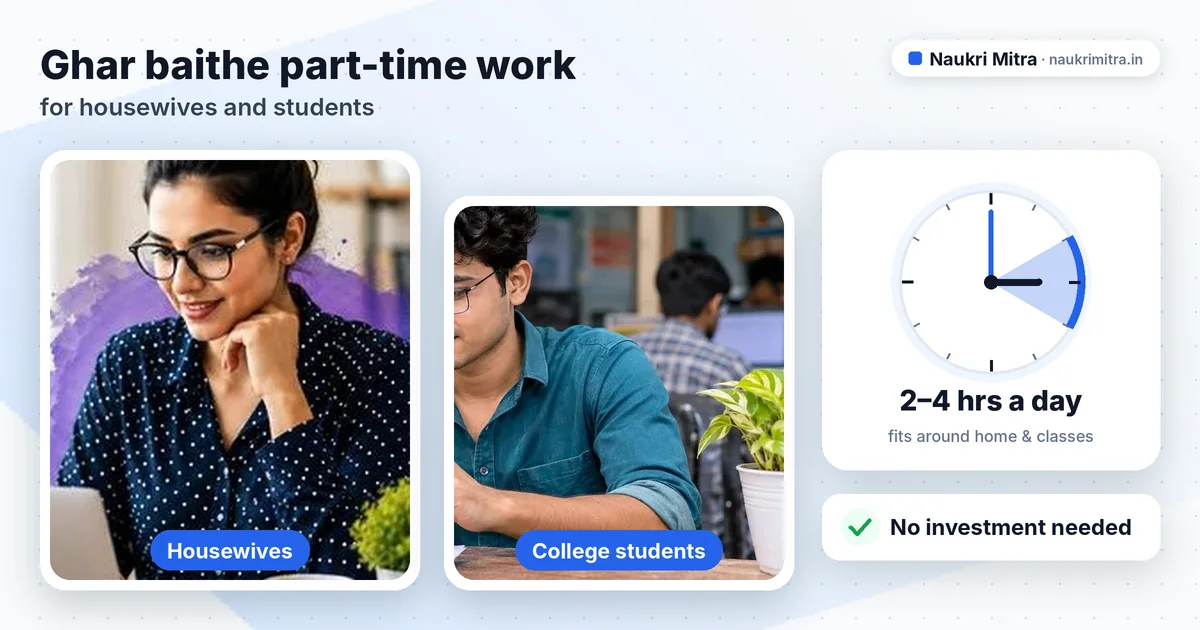
One rule holds for every reader here. Work from home jobs for housewives and students without investment exist, but they never begin with a payment from your side. If a ghar baithe job asks you for a "kit fee" or "ID charge" before training, treat it as a scam and move on.
For housewives with a few hours a day
You are not alone in needing flexibility. In an Indeed survey of 1,141 women in India, reported by Business Today on 14 May 2026, more than eight in ten said they chose not to apply for a job because it clashed with caregiving. 53% named flexible hours as their top priority and 48% ranked hybrid or remote work as a priority.
If you have two to four hours a day, look for work you can do in blocks that you choose:
- Task-based or per-hour work such as data entry, transcription or proofreading, where the deadline matters more than the hour you log in.
- Online tutoring in a subject you already know well, scheduled after school hours or on weekends.
- Freelance writing, translation or design gigs, where you accept only as much work as your week allows.
- Shift-based chat support, only if the shift is fixed and fits your home routine. Avoid rotating night shifts if you cannot keep them.
Telecalling is worth a look too. A WorkIndia report on hiring across about 9.9 lakh employers, covered by PTI on 15 January 2026, found that telecalling leads hiring for women. Many such listings are office-based, so check that the post clearly says remote before you apply. For more ideas, read our guide to remote jobs for mothers returning to work.
For college students: part-time online work
Students have two assets: comfort with apps and time between classes. Your best fit is part-time work with flexible hours that will not clash with exams. Online tutoring for school children, content writing, social media help for small shops, data entry and basic testing tasks all suit this pattern. You can find more options in our piece on part-time remote work for college students.
Be extra careful. LinkedIn's Job Search Safety Pulse (research by Censuswide, published 6 May 2026) found that 49% of Indian Gen Z professionals said they had nearly fallen for a job scam, against 36% of Gen X professionals. The traps aimed at students usually look like "like and earn" tasks on Telegram or paid internship certificates. A genuine part-time role will never ask you to deposit money to reach "higher level" tasks.
For freshers and 12th pass candidates
Yes, a fresher or 12th pass candidate can get a work from home job in India. Entry-level chat support and non-voice process roles often list Class 12 as the minimum. For example, a TeamLease listing for a work from home chat support role says that anyone who has passed Class 12 and has good typing skills can apply for the training. What employers test at this level is typing speed, written English or Hindi, and reliability.
Without a work history, show proof instead of claims:
- A typing test result (words per minute and accuracy) saved as a screenshot.
- Two or three short writing samples, such as a sample customer reply or a product description.
- Free online course certificates in spreadsheets, email etiquette or customer service.
- A simple, one-page resume with your mobile number, email and the hours you can work.
Our step-by-step guide on how to land a first remote job without experience covers resumes and interviews in more detail. When you compare offers, stick to the companies hiring for work from home jobs in India listed earlier, and to verified job portals.
A simple weekly plan to get your first offer
Genuine work from home jobs without investment are usually won through steady, small effort, not one lucky message. This plan needs about an hour a day:
- Day 1: Choose one role family that fits your hours and device. Write down your available hours honestly.
- Day 2: Build your proof: take a typing test, write one sample and update a one-page resume.
- Day 3: Make an email ID with your real name and complete one job portal profile.
- Day 4: Browse today's work from home openings and shortlist five that state the employer name and role clearly.
- Day 5: Check each employer's website and LinkedIn page. Drop any that contact you only on WhatsApp or Telegram.
- Day 6: Apply to the remaining jobs with a short, specific message for each.
- Day 7: Follow up once on earlier applications and practise a short video interview with a friend.
Repeat the cycle every week, and keep a note of where you applied and who replied.
How to Identify Fake Work From Home Jobs Before You Reply
Learning how to identify fake work from home jobs takes about ten minutes, and those ten minutes are best spent before you send your first reply. Scammers move fast once you answer. The LinkedIn survey quoted earlier, as reported by MediaInfoline on 7 May 2026, found that more than half of the attempts to pull job seekers onto personal messaging apps came in the very first message.
Real cases follow the same script. On 4 August 2026, IANS reported that Delhi's Central District cyber police had arrested seven people for running a fake placement agency in Uttam Nagar. The gang listed openings on job portals, then rang applicants on WhatsApp while pretending to be HR. Each person heard they were "selected" and was asked for ₹3,000 to ₹4,000 in registration, processing or account-opening charges, supposedly refundable after joining, and nobody got a job or a refund.
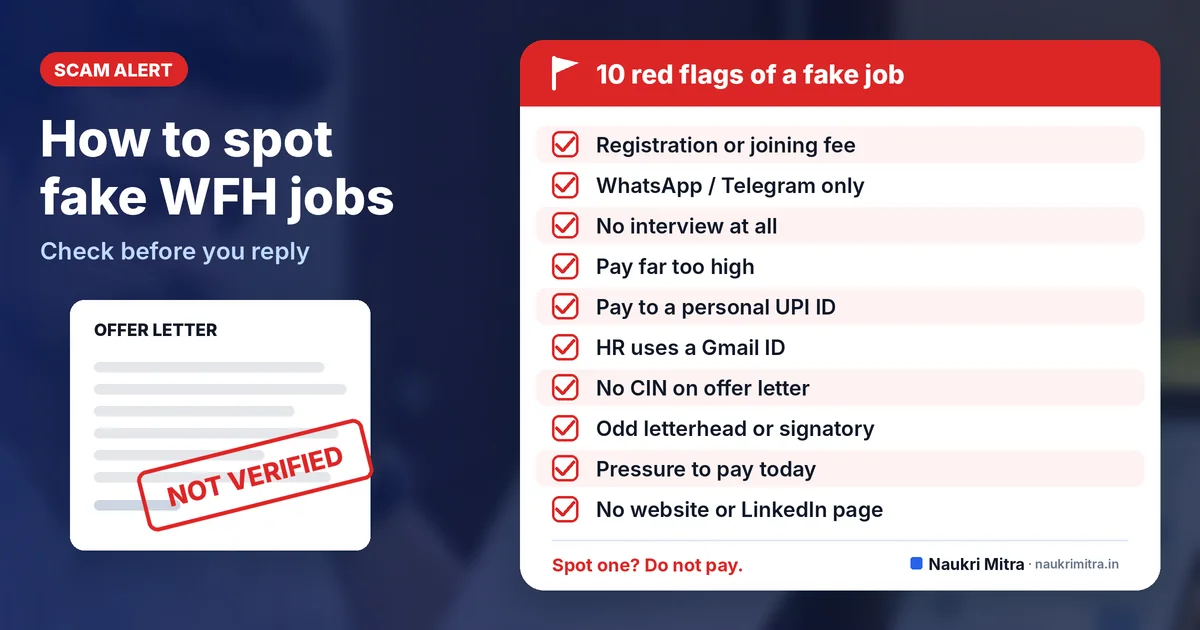
The red-flag checklist
Tick every line that matches the offer in front of you. One tick means slow down. Two or more means walk away.
- They ask for money first. Registration, training, kit, ID card, "security deposit" or "refundable" fee. Genuine work from home jobs without investment have no registration fee at any stage.
- Contact is only on WhatsApp or Telegram. No company email, no website, no landline.
- There is no real interview. You are "selected" after a two-line chat or a form.
- The pay is too high for the work. Thousands a day for liking videos, typing pages or rating products.
- Payment goes to a personal UPI ID or a person's bank account, not a company account.
- HR writes from a free email address such as Gmail, Yahoo or Outlook, with a big company's name in the display name.
- They rush you. "Only 2 seats left", "confirm in 30 minutes".
- They ask for OTPs, UPI PIN, net banking passwords or remote screen-sharing apps.
- They want to use your bank account or SIM to "receive company payments".
- The job description is vague, with no team, no manager name and no office address.
- The company name does not match across the message, the website and the offer letter.
- They will not let you call the company on its official number before joining.
For more examples of fake remote offers and how they are worded, read our guide on spotting fake remote work offers. The next section shows how the most common trap, the Telegram task scam, works from the inside.
Verify the company on MCA, GST and LinkedIn
These checks are free and need no login.
- MCA company check. Open mca.gov.in, go to MCA Services and choose "View Company/LLP Master Data". Enter the company name or CIN (Corporate Identification Number) with the captcha. The result shows the date of incorporation, company status, registered address, email ID and the directors. A company that claims to hire hundreds of people but was registered a few months ago, or whose name does not appear at all, is a warning.
- GST search. On gst.gov.in, click Search Taxpayer, enter the GSTIN from the offer letter or invoice, fill the captcha and search. You will see the legal name, trade name, date of registration, constitution of business, principal place of business and return filing details. The legal name should match the company that is "hiring" you. If a GSTIN is printed but returns nothing, treat it as fake.
- LinkedIn. Check that the company page has real employees and a posting history. LinkedIn advises users to check company pages, recruiter profiles and verification badges, and to be careful when someone pushes the chat off LinkedIn quickly. A recruiter profile created last month with no connections is a warning.
- Domain check. Type the company's website yourself instead of clicking a link in the message. Run a WHOIS lookup on the domain. A site registered only weeks ago, or one that copies a big brand with a small spelling change, is a common trick.
How to check a work from home offer letter
A PDF on a letterhead proves nothing, because anyone can make one in minutes. In May 2026, Business Today reported an internship offer letter shared on X that promised ₹23,000 a month in hand but asked the candidate to pay ₹1,594 as "internship fees" through a form link. A real employer does not charge you to accept its offer.
Check these points on any offer letter before you sign or share documents:
- Letterhead and CIN: the company name, CIN and registered address should match what MCA shows.
- Signatory: the person who signed should exist on LinkedIn or the company website with that job title.
- Email domain: the letter should come from the company's own domain, not a free email account.
- Job details: a genuine letter states your role, salary structure, joining date, reporting manager and work location.
- Money: any line asking for fees, deposits or "refundable" charges cancels the letter's value.
- A phone call: find the company's number on its official website or MCA record, not on the letter, and call HR to confirm the offer exists.
If a company passes these checks, continue. If it fails even one, stop replying and keep the chats and numbers saved as evidence.
Telegram Task Scam and Part Time Job Fraud: How the Trap Works
The Telegram task scam and part time job fraud follow one script, and police across states keep describing the same steps. In December 2023 the Ministry of Home Affairs said its I4C threat analytics unit had flagged over 100 websites, run by overseas operators, for task-based part-time job fraud, and MeitY blocked them. Their ads used phrases like "ghar baithe job".
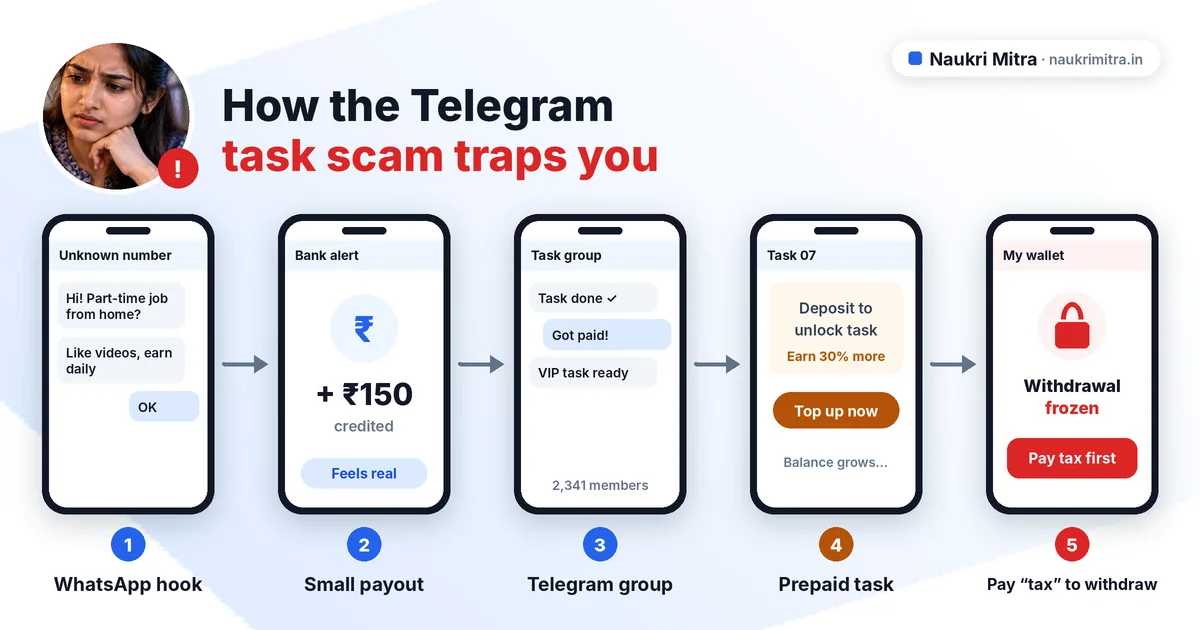
The task scam, stage by stage
These stages come from MHA's description and police case reports.
- The hook. A WhatsApp message or online ad offers easy part-time work: like YouTube videos, follow channels, rate hotels or write Google reviews.
- The small payout. The first tasks are paid. In a case described by Goa's Cyber Crime Police in January 2025, the first payment was ₹150 by UPI.
- The Telegram group. You are moved to a Telegram task group with a "receptionist" or "teacher" and "members" who post their earnings. In a July 2025 Goa case where a woman lost ₹2.31 lakh, the group was called "Merchant Welfare Task".
- The prepaid task. Now you pay first to earn more, such as ₹1,000 for a promised ₹1,200. The amounts keep rising, and your "earnings" show only on an app or website, never in your bank.
- The frozen withdrawal. When you try to withdraw, new conditions appear: a wrong withdrawal option, a freeze fee or a tax. In the January 2025 Goa case, the victim was asked for a "Merchant Protection Freeze" fee of ₹2,35,000 plus a 25% "tax".
Every fee is just another deposit. A Pune tax consultant lost ₹2.72 crore over 33 transactions in about two months through Google review tasks (Outlook Money, June 2026). The MHA says such money moves through mule accounts, crypto and card networks, which makes it hard to trace.
Money mule jobs: why "just receive payments" is illegal
A money mule is a person whose bank account is used to receive and pass on stolen money. When I4C and the Reserve Bank Innovation Hub signed an agreement in May 2026, mule accounts were described as accounts "used by criminals to illegally receive, transfer and launder the proceeds of cybercrimes". Scam money has to land somewhere, so gangs recruit account holders through fake remote jobs.
The Week (4 August 2026), reporting on a 2026 Asia Pacific Group on Money Laundering report, described recruiters posing as HR executives. Applicants were asked to open new bank accounts and hand over passbooks, debit cards and SIM cards, which were couriered to Manila. Eighteen such accounts in Punjab moved about ₹2.99 crore between February and June 2025.
Saying you only lent the account will not protect you. I4C has told citizens not to sell or rent their bank accounts, warning that illicit funds in them "can lead to legal consequences, including arrest" (October 2024).
Banks are hunting these accounts too, using MuleHunter.AI, now fed by I4C's Suspect Registry. Any "job" that pays you to receive money, share your UPI ID or post a card or SIM is a money mule offer. Our earlier guide covers other remote job scam patterns.
The same networks also recruit for scam compounds abroad with high-pay data entry and customer support offers. The FAQ at the end of this guide sets out the official warnings on jobs in Thailand, Myanmar, Laos and Cambodia.
Quick self-check: are you inside a scam right now?
Answer yes or no. A single yes means stop sending money today.
- Did the job start with an unknown WhatsApp or Telegram message?
- Were you paid small amounts before any interview or offer letter?
- Has anyone asked you to deposit money to open a task, level or bonus?
- Can you see your balance only on an app, not in your bank account?
- Are you asked for a fee, tax or "unfreeze" charge before withdrawing?
- Has anyone asked you to receive money for them, share your UPI ID or open a new bank account?
- Has anyone asked you to post your debit card, passbook or SIM?
- Is the job abroad, on a tourist visa, with high pay for a simple typing test?
A yes in the first five means a task scam, and paying more will not release your balance. A yes in the last three means mule recruitment or trafficking risk, so refuse and tell your bank. Then follow the first-hour reporting steps in the next section.
How to Report Job Fraud on 1930, Cybercrime.gov.in and Chakshu
This section shows how to report job fraud on 1930, cybercrime.gov.in and Chakshu, in the order that gives you the best chance of stopping the money. The 1930 helpline and the portal deal with money you have already lost, while Chakshu is for scam calls and messages that have not cost you anything yet. Menu labels below are as of November 2026.
Lost money? Do this in the first hour
Screenshot this box and share it with family. If you have already paid a scammer, start at step 1 now and read the rest later.
Lost money to a job scam? The first hour, step by step
- Call 1930. This is the national cyber fraud helpline. Tell the operator the amount, the date and time, your bank or UPI app, and the transaction ID or UTR number. You will get an SMS with an acknowledgement number. Keep it.
- Call your bank. Use the number printed on your card or shown inside your bank's official app, never one from a Google search. Ask them to block your card, UPI and net banking, and to note your fraud complaint.
- Save the proof. Take screenshots of the chats, the Telegram or WhatsApp group, the payment screens, the scammer's UPI ID and phone number, and any website link. Do not delete the chat.
- Complete the complaint on cybercrime.gov.in. Use the acknowledgement number from the 1930 SMS and add your proof. Do it the same day.
- Stop paying. Do not send any "tax", "unfreeze fee" or "withdrawal charge". Ignore anyone who calls offering to recover your money for a fee. Reporting on 1930 and the portal is free.
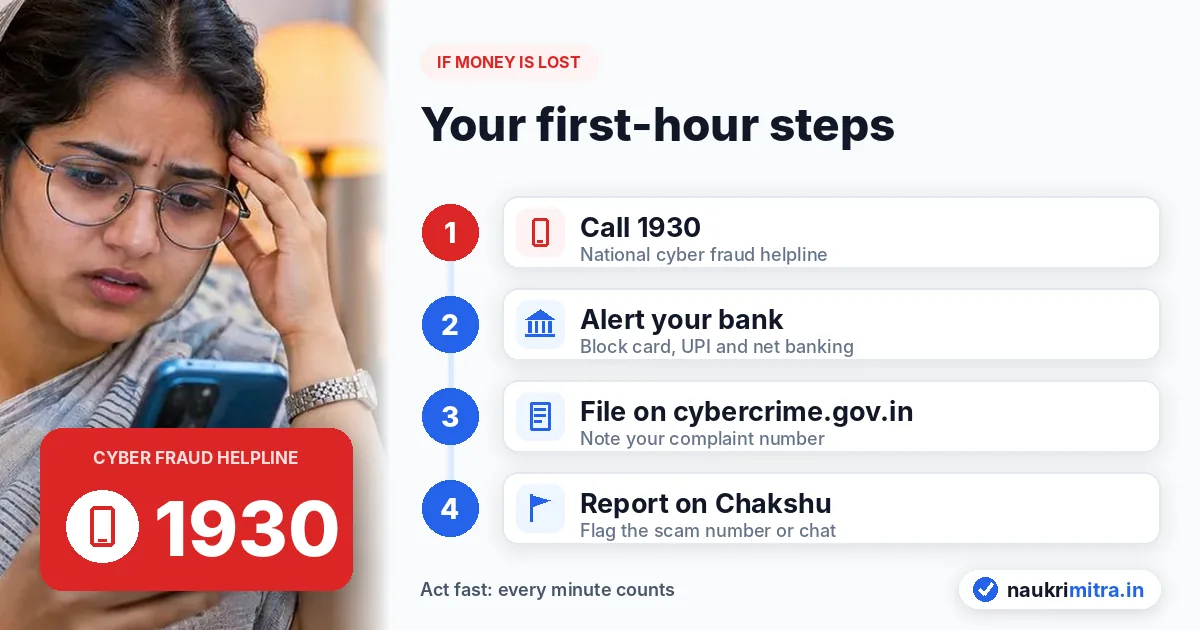
Police call the first few hours the golden hour. Hyderabad police told Telangana Today that reporting within one to three hours gives the best chance, since stolen money is shifted between accounts fast. Once you report, the bank where the money landed is alerted and can put a hold on it. If the money has already moved on, the alert follows it to the next bank.
The helpline feeds the Citizen Financial Cyber Fraud Reporting and Management System (CFCFRMS), which the Government launched in 2021 (All India Radio News). In a Rajya Sabha reply on 12 August 2026, the Ministry of Home Affairs said more than ₹11,158 crore had been saved across over 32.8 lakh complaints up to 30 June 2026, as reported by Outlook Money. That figure is national and says nothing about any single case.
Filing a complaint on cybercrime.gov.in
The National Cyber Crime Reporting Portal (NCRP) at cybercrime.gov.in is run under the Indian Cyber Crime Coordination Centre (I4C) of the Ministry of Home Affairs. You can file directly on it, or complete the complaint you started by calling 1930:
- Open cybercrime.gov.in and click File a Complaint. Read the terms and tick I Accept.
- Choose the option for financial fraud. Recent guides call it Financial Fraud, and older MHA manuals call it Report Other Cyber Crime.
- Log in with your mobile number. Click Get OTP, enter the code and the captcha, and submit. The portal may also ask for your state and email.
- Under incident details, pick the category Online Financial Fraud and the sub-category closest to how the money left you, such as UPI, internet banking, card or e-wallet. Enter the date, time, amount and transaction ID or UTR for every payment, not only the first one.
- Upload evidence: screenshots, bank statements and chat exports. Older MHA manuals set a 5 MB limit per file, so crop large images.
- Add suspect details: the scammer's phone numbers, UPI IDs, bank account numbers, Telegram usernames and website links.
- Click Preview, check everything, accept the declaration and click Confirm & Submit.
- Save the complaint ID or acknowledgement number shown on screen. It also comes by SMS and email, and you can download the complaint as a PDF.
A complaint ID is a registration of your complaint, not an FIR. Keep it safe, because police, your bank and any refund request will ask for it.
Reporting a fraud call or WhatsApp message on Chakshu
Chakshu is a facility on the Department of Telecommunications' Sanchar Saathi portal for reporting suspected fraud calls, SMS, WhatsApp messages and WhatsApp calls. "Online job, gift, lottery or loan offers" is one of its listed categories, so a "ghar baithe kaam, ₹3,000 daily" message fits. Sanchar Saathi states clearly that Chakshu is not for money already lost.
- Open sancharsaathi.gov.in, or the Sanchar Saathi app from the Play Store or App Store.
- Under Citizen Centric Services, select Chakshu - Report Suspected Fraud Communication.
- Choose the medium (call, SMS or WhatsApp) and the category, such as the online job offer option.
- Enter the sender's number, the date and time, and any link they sent. Add a screenshot if you have one.
- Verify your own mobile number with the OTP, enter your name and the captcha, and submit.
Report within 30 days, because Sanchar Saathi says reports in that window are taken up for action. If DoT confirms the number was misused, it can re-verify or disconnect it, which protects the next person it would have messaged.
How to Get Money Back After Online Job Fraud
How to get money back after online job fraud depends mostly on one thing: whether your money was stopped before the scammer moved it on. The sooner your complaint reached 1930 or the portal, the better your chances. Money already withdrawn or passed through many accounts is very hard to bring back, and nobody, including the police, can promise a full refund.
What happens to your money after you complain
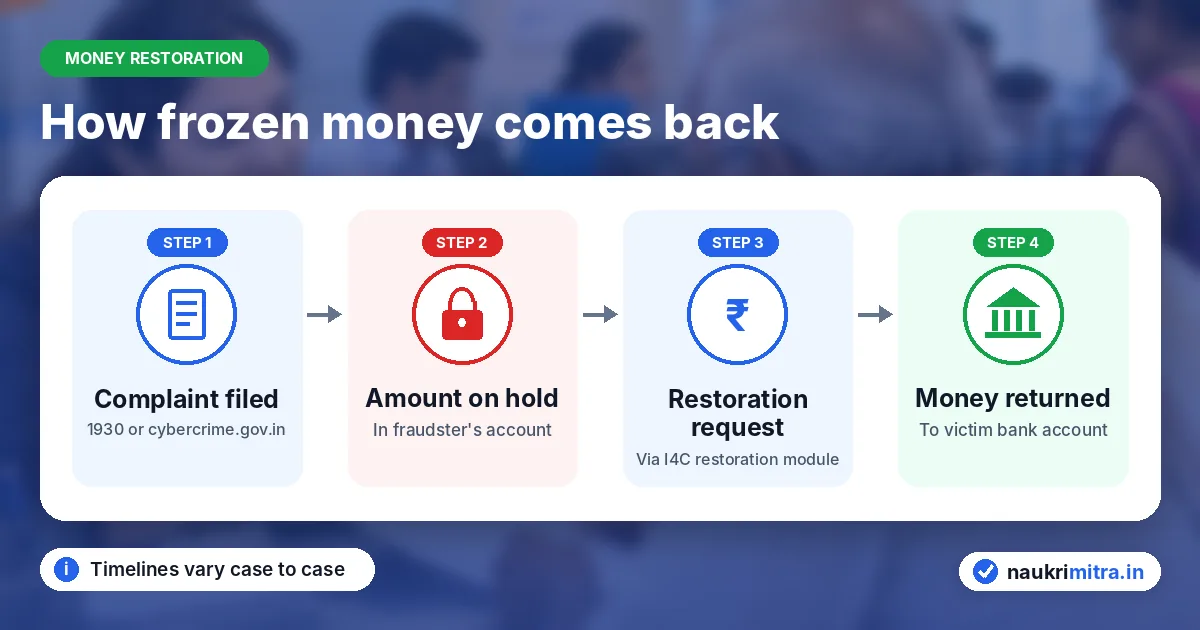
Your complaint goes to the bank that received your money. If the amount is still in the fraudster's account, that bank puts a hold (a lien) on it until the police or a court decide who it belongs to. Keep your 14-digit acknowledgement number safe, because it links you to that hold.
A Ministry of Home Affairs (MHA) standard operating procedure (SOP) issued in January 2026 lets a held amount below ₹50,000 be returned without a court order. The police verify your claim, you sign an indemnity bond, and the bank is directed to release the money within 15 calendar days. Reports on the SOP also say banks must lift a freeze within 90 days if no court or restoration order exists, so follow up quickly.
Larger amounts take longer. If more than ₹50,000 is held in a single account, an FIR is required, and release often needs an order from the court handling the case. Lok Adalats are another route: in June 2026, Telangana's Cyber Security Bureau reported that a statewide Lok Adalat helped return ₹45.21 crore to 6,303 cyber fraud victims.
RBI's 2017 rules give zero liability for unauthorised electronic transactions reported within three working days, but job scam payments are usually ones you made yourself, so those rules rarely apply. Revised RBI directions from 1 January 2027 also cover payments approved "under coercion or duress", and give eligible victims compensation, once in a lifetime, of 85% of the net loss or ₹25,000, whichever is lower, for losses up to ₹50,000. You must report to 1930 or the portal and to your bank within five calendar days, so always tell your bank too.
The I4C Money Restoration Module, explained
The Money Restoration Module (MRM) is an online portal from I4C, the Indian Cyber Crime Coordination Centre under MHA. It lets victims ask for frozen money back without going from office to office. PTI reported its launch in June 2026, and ANI explained the process on 20 August 2026. It works only if you complained on 1930 or the portal and some money is still on hold.
- Open the module (reported address: mrm-ncrp.mha.gov.in; type it yourself) and log in with your complaint's mobile number.
- Click "Raise Refund Request", enter your acknowledgement number and verify the OTP.
- Add your refund bank account, your PAN card and any court order you have.
- Save the request ID sent by SMS and email. When an eligible amount is found, confirm it and note the tracking number.
- Give the police the indemnity bond they ask for. The bank credits the money after checks.
Wrong account details can delay or reject a request. Delhi Police said in June 2026 that 22 of 70 requests stalled because victims did not respond, so answer when the cyber cell calls.
Beware of 'refund recovery' scams
After you report a fraud, you may get calls from "police", "bank staff" or "recovery experts" offering to get your money back for a fee. The Telangana Cyber Security Bureau has said no fee is charged for a refund request, and has warned against fake officials promising faster refunds. Never share an OTP, password or your screen with anyone. Real help comes only from your police station, your investigating officer, your bank's official channels and the MRM.
Genuine work from home jobs without investment do exist. When you are ready, go back to the employers and job boards listed earlier, and walk away from any offer that asks for money first.
Frequently asked questions
Is it safe to pay a registration fee for a work from home job?
No. A genuine employer never charges you to apply, train or join. Amazon India says it charges no fee at any stage of its recruitment process, and the government's National Career Service portal is free for registration, applications and interviews. In August 2026, Delhi police arrested seven people who took ₹3,000 to ₹4,000 from job seekers as "registration" fees.
Are Rs 200 per page typing jobs real?
No, and the maths shows why. At 15 to 20 pages a day, ₹200 a page would mean ₹90,000 to ₹1,20,000 a month, while real full-time data entry pays about ₹10,000 to ₹18,000, according to a Lilach Bullock explainer updated in November 2026. Search "online data entry and typing jobs real or fake" and many such offers appear. The real ones pay modestly and never ask for a deposit.
Do genuine work from home jobs pay daily?
Rarely. Salaried remote roles pay once a month into your bank account, and freelance platforms such as Upwork pay on fixed cycles. For a fresher, a realistic figure for work from home jobs salary per month in India is about ₹10,000 to ₹15,000. Small daily credits of ₹50 to ₹500 per task are a known hook that task scammers use to build trust.
Is the Amazon work from home job message on WhatsApp real?
Treat it as fake. Amazon India warns that fraudsters use its name on WhatsApp and Telegram and write from free email accounts such as Gmail. Its real recruiters use addresses ending in @amazon.com, offer documents come only from its own joining portal, and it charges no fee at any stage. Find the job ID on amazon.jobs and apply only there.
Can I get my money back after a Telegram task scam?
Sometimes, if you act fast. How to get money back after online job fraud depends on whether the money is still in a fraudster's account when your complaint arrives. Call 1930 or file on cybercrime.gov.in at once so the receiving bank can hold it. Held money can then be claimed through the I4C Money Restoration Module, but money already withdrawn is very hard to recover.
How long does it take to get a refund after a 1930 complaint?
There is no fixed official timeline. Under a Ministry of Home Affairs procedure issued in January 2026, a held amount below ₹50,000 can be returned without a court order, within 15 calendar days of the investigating officer's order to the bank. Larger amounts usually need an FIR and a court order. Answer calls from the cyber cell promptly, because unanswered requests stall.
Do I need to visit a police station to report online job fraud?
Not to start. You can call the 1930 helpline or file on cybercrime.gov.in from your phone, and the complaint is passed to the police. A portal complaint ID is not an FIR, though. If more than ₹50,000 is held in one account, an FIR is required, and the police may ask you to sign an indemnity bond before money is released.
Is captcha typing a genuine way to earn money?
Treat captcha typing offers on WhatsApp as a warning sign. In February 2024, Deccan Chronicle reported that Cyberabad police had arrested four people over "captcha typing work" offered on WhatsApp, after victims got fake legal notices and one woman paid ₹6,17,660. Police linked the gang to 358 complaints on cybercrime.gov.in. Genuine data entry pays a salary and never threatens you.
Are overseas data entry jobs in Thailand, Cambodia or Myanmar safe?
They carry a high risk. In July 2026, Karnataka Cyber Command warned against high-paying IT, customer support and data entry jobs that need travel to Thailand, Myanmar, Laos or Cambodia. In March 2025, India brought back 549 citizens from scam centres in Myanmar. The Ministry of External Affairs asks job seekers to "verify credentials of foreign employers through Missions abroad" and to distrust tourist-visa offers with only a typing test.
Which job apps in India are safe for finding work from home jobs?
Use platforms that name the employer and never charge you to apply. The government's National Career Service portal (ncs.gov.in, helpline 1514) is free at every stage, Internshala says applying is free, and LinkedIn lets you check company pages and recruiter profiles. Genuine work from home jobs without investment are also listed free on Naukri Mitra. Stop if anyone moves you to WhatsApp.
Search today's work from home jobs on naukrimitra.in, pick two or three that match your hours, and check each one against the table and checklist above before you apply. Applying through Naukri Mitra is free for job seekers, so if anyone asks you to pay in our name, report it on 1930 or Chakshu.
Every figure here was checked against its source as of November 2026. Pay, menus and listings change, so confirm on the official site before you act.
Key official sources
- cybercrime.gov.in (NCRP)
- Chakshu on Sanchar Saathi (DoT)
- 1930 helpline and CFCFRMS (AIR News)
- RBI customer liability circular, 2017
- RBI revised fraud directions, 2026
- Income Tax Department: which ITR
- MCA company master data (mca.gov.in)
- GST Search Taxpayer guide
- National Career Service (ncs.gov.in)
- Amazon India fraud alert

Yogesh Kumar Dewangan is the founder of Naukri Mitra, DevMixa and RemoteRoles. He works across IT, digital marketing, SEO and content writing, and has hands-on experience in recruitment and hiring. Through DevMixa he also trains students and working professionals in IT and digital marketing skills.
Comments
Be the first to share your thoughts or ask a question.