
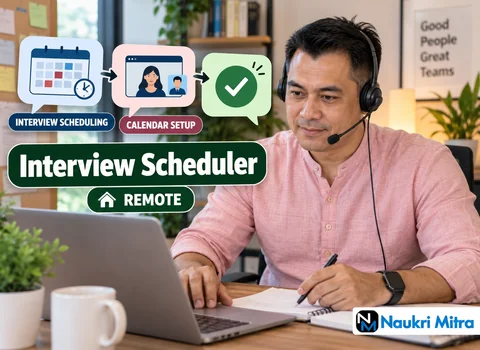
Four people need to meet on one video call. The hiring manager is in San Francisco, the senior engineer sits in London, the team lead works from Bengaluru and the candidate lives in Nairobi. Bengaluru and Nairobi never change their clocks. London and San Francisco both do, but on different weekends, so for a short stretch each autumn and spring their gap is an hour off what everyone remembers. Book from memory then and somebody joins an empty room. Spotting that trap, then finding the single window where all four are awake and free, is the daily puzzle in remote interview scheduler jobs. The opening described here wants a full-time scheduler who enjoys solving it.
An interview scheduler is the person who turns "let's talk to this candidate" into a confirmed meeting with the right people in it. You coordinate interview slots between candidates and hiring panels across time zones, send the calendar invites and video links, rebook quickly when plans change, update each candidate's status in Greenhouse, and keep candidates informed with confirmation and reminder emails. Recruiters decide who moves forward; you make sure the conversation happens.
On interview scheduler salary: the seat is full-time, home-based, available to applicants in any country, and pays $2,000 per month (USD). Per-interview rates and incentives do not appear in this listing.
Comfort with time-zone conversion is a stated requirement, and it means more than adding hours. Know which places observe daylight saving, which do not, and that regions switching in the same season can switch on different dates. Check the offset for the interview date, not today's.
Habits that keep it calm:
An invite is small, and it carries a lot. Each one needs the correct date and local time for every attendee, a working video link, the candidate's name spelled correctly, and enough context that a panelist opening it on a phone knows which role and round this is. Google Calendar can attach a Google Meet link when the event is created, and Calendly can generate a meeting link through its video conferencing integrations. Either way, open the link yourself before sending. A broken link makes the whole company look disorganised.
Plans change. An interviewer gets pulled into an outage, a manager travels, a candidate's notice period shifts. This listing asks you to reschedule quickly, and speed matters because the candidate may have rearranged their own day to be there.
Tell the candidate first, apologise briefly, offer two or three real alternatives, and cancel the old invite properly so no one shows up to a dead slot. If the team keeps a list of trained backup interviewers, a swap can sometimes save the original time altogether. Then update the record.
Proficiency with four tools is required. In general terms, this is what each one does in a scheduling seat:
Automation only works with correct inputs. An out-of-date calendar gets a clash booked cheerfully.
Candidates read scheduling emails closely. Keep confirmations short and specific: the role, the date and time in their own time zone, the format, who they will meet and the link. Reminders should repeat the essentials without new surprises. Excellent English is a requirement because tone carries weight here: warm, plain and professional, never chatty, never curt. When something goes wrong on the company's side, say so clearly.
Some hiring teams also ask the scheduler to check that each interviewer has the candidate's resume, knows which competencies their round covers, and can find the interview kit or scorecard in Greenhouse before the call. You are not judging the candidate. You are removing excuses for a rushed, repetitive interview where two panelists ask the same question.
A short internal note with the agenda and a reminder to submit feedback keeps the loop moving afterwards.
Schedulers see sensitive material: salary expectations, current employers, sometimes the fact that a well-known person is quietly looking to leave. Treat it as confidential. Do not forward resumes outside the hiring team, keep candidate names out of invite titles visible to large groups if your team prefers that, and never discuss candidates in public channels.
Attention to detail is listed as a requirement, and it shows up in tiny places. Spell the candidate's name exactly as they wrote it. Check that the time zone on the invite matches the one in your email. Confirm you invited the right interviewer, not someone with a similar name. One careful read before sending catches the slips that matter.
A graduate degree is preferred, along with six months to two years of experience in scheduling, recruiting coordination or executive assistance. That last group matters: an executive assistant who has juggled a director's diary across offices already has much of the core skill. The required items are proficiency with GoodTime, Greenhouse, Calendly and Google Calendar, excellent English, attention to detail and comfort with time-zone conversion.
For a fresher, this listing prefers some experience, so the honest route is to build related skills first. Free product tutorials from the tool makers, helping with calendars in a college placement cell or a small business, and practising time-zone planning can all strengthen a resume. No specific course or certificate is required here. When you write your resume, describe concrete scheduling work: which calendars you managed, which tools you used, how you handled changes.
Employers for this kind of work can include recruitment process outsourcing (RPO) firms, technology companies and agencies that run hiring for several clients at once.
An interview scheduler focuses on booking, rebooking and communication. A recruiting coordinator can cover that and more: offer paperwork, interviewer training, process clean-up and reporting. The line between the two titles varies by company. Scheduling can be an entry point, followed by coordination, and some people go on to sourcing or full recruiter roles once they understand how hiring decisions are made. This listing does not promise that path, but the work gives a close view of how good recruiters run a search.
Fake recruiting jobs exist, and scheduling roles are easy to imitate. Hiring teams that are real never charge a joining fee, sell you a Greenhouse access licence or make you fund your own scheduling software before day one. Be careful of anyone who interviews only by chat, pushes you to accept the same day, or asks for bank logins or one-time passwords. If an offer arrives, check that the company and recruiter exist through independent sources before sharing documents.