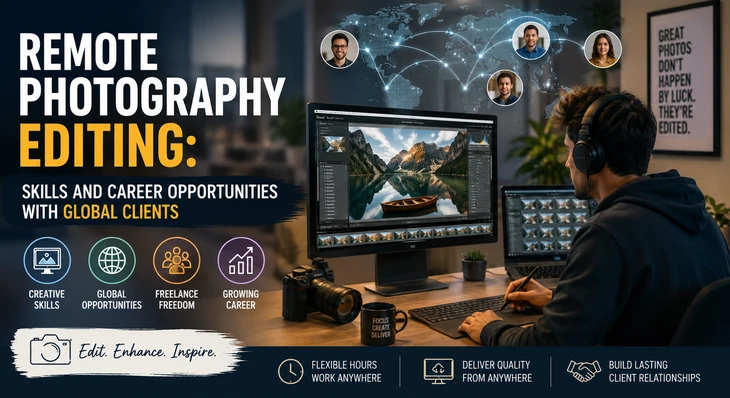
Remote Photography Editing: Skills and Career Opportunities With Global Clients
Introduction
Remote photography editing isn’t one of those careers that announces itself loudly. Most people stumble into it quietly—someone asks them to fix a photo, or they start experimenting with Photoshop late at night, and before they know it, they’re getting paid for it.
What makes this work interesting is how normal it feels once you’re inside it. You open a folder full of images, fix lighting that didn’t quite land during the shoot, smooth out distractions, and suddenly a “meh” photo turns into something publishable.
And the demand? It’s everywhere. E-commerce brands, wedding photographers, Instagram creators, even small local businesses—they all need better visuals than what they can produce on their own. That’s where remote photo editors quietly fit in.
No office. No fixed hours. Just projects, feedback, and a lot of visual judgment calls.
How this work actually looks day to day
If you imagine remote photography editing as glamorous creative work all the time, it’s only half true.
Some days, you’re working on a single portrait for an hour, adjusting skin tone so it still looks like a real person—not plastic, not overdone. Other days, you’re processing 200 product images that all need to look identical for an online store.
It’s not just “editing photos.” It’s problem-solving.
A photographer might say, “These came out too dark.” A brand might say, “Make this look premium.” Neither instruction is very specific. So you learn to interpret intent more than words.
And because it’s remote photography editing, all of this happens through files, messages, and deadlines—not face-to-face conversations.
At first, that feels distant. Later, it feels normal.
Why are so many people entering this field right now
There’s a simple reason this career keeps growing: visuals sell everything now.
Scroll any platform—Instagram, Amazon, even job websites—and what stops you isn’t text. It’s images.
That shift changed everything.
Brands no longer treat photography as optional. It’s part of survival. And instead of hiring large in-house teams, they outsource to freelancers who can deliver fast.
This is where freelance photography editing careers began to expand rapidly.
Another quiet shift is that geography no longer matters. A client in London might never know—or care—that their editor is working from a completely different country. As long as the result is right, it doesn’t matter.
That’s a big change compared to how creative work used to function.
Skills that matter more than people expect
Most beginners assume this job is about knowing Photoshop shortcuts. That helps—but it’s not what keeps clients coming back.
What actually matters is judgment.
For example, when you’re editing a portrait, you constantly decide how far is too far. Remove too much texture, and the face looks fake. Leave too much, and the client thinks it’s unfinished.
That balance is the real skill.
Still, you do need technical comfort:
- Photoshop for detailed work and retouching
- Lightroom for color consistency and batch edits
- Basic understanding of file formats and export settings
But over time, something shifts. You stop thinking in tools and start thinking in outcomes.
And communication matters more than people expect. Clients rarely explain things perfectly. You learn to read between the lines—what they say versus what they actually want.
That part takes time.
Most remote editors don’t jump between ten tools. They settle into a few and go deep.
Photoshop becomes the main workspace for detailed fixes. That’s where the precise work happens—skin cleanup, object removal, background adjustments.
Lightroom feels more like a control room. When you’re dealing with hundreds of images from a wedding or shoot, it’s the only way to keep things consistent without losing your mind.
Some people prefer Capture One for its color handling, especially in studio photography.
And then there are AI tools now. Not as replacements—but as assistants. They help remove backgrounds or speed up repetitive tasks, so you can focus on decisions rather than manual effort.
The interesting part is this: tools are getting faster, but taste still decides quality.
Starting out without overcomplicating it
Most people overthink the beginning.
You don’t need a perfect setup. You don’t even need clients right away.
You start by editing random images—stock photos, old pictures, anything. Then you compare your version with professional edits and notice what feels off.
That process repeats for weeks or months.
Slowly, you build a small collection of before-and-after work. That becomes your portfolio. Not fancy, not polished—just proof that you can improve an image.
At some point, you stop practicing only and start sharing.
That’s usually when things begin to shift.
How clients actually come in (and it’s not always predictable)
There’s no single path to finding work.
Some editors land their first projects on platforms like Upwork or Fiverr. It can be competitive, but it works if you stay consistent.
Others get clients through Instagram—posting edits, showing transformations, or even short reels of “before vs after.” People underestimate how powerful that is.
And then there’s direct outreach. Simple messages to photographers or small brands with a few sample edits attached.
It doesn’t always work immediately. But when it does, those relationships often last longer than platform gigs.
Over time, repeat clients matter more than new ones.
Pricing—where most beginners hesitate
Pricing feels confusing at first because there’s no universal rule.
Early on, people charge less just to get experience. That’s normal.
But staying there too long is where problems start.
As your work improves, pricing usually shifts based on complexity. A simple cleanup edit is very different from high-end commercial retouching or e-commerce product editing.
Many experienced editors eventually move to package-based pricing because it feels more stable than per-image rates.
The real lesson here is simple: your pricing should grow with your confidence.
The parts people don’t talk about enough
This work looks flexible from the outside, and it is, but it also comes with quiet pressure.
Deadlines can stack up quickly, especially during busy seasons. One client sends 50 images, another sends 100, and suddenly your week is full.
There’s also repetition. Editing similar images for hours can feel mentally heavy.
And because it’s remote, you spend a lot of time alone with your screen. Some people enjoy that. Some don’t.
It’s not a “hard” job in the traditional sense, but it requires consistency in a different way.
Where this career is heading next
The direction is already visible.
AI will continue handling basic corrections—such as background removal, quick enhancements, and repetitive edits.
But that doesn’t reduce demand for skilled editors. It actually changes what clients expect.
Instead of just clean images, they want images with mood, consistency, and identity.
So the role is slowly shifting from “editor” to “visual problem solver.”
And as online businesses keep growing, especially in e-commerce and creator economies, the demand isn’t slowing down anytime soon.
FAQs
Is remote photography editing a realistic long-term career?
Yes, especially if you build consistency and develop a recognizable editing style.
Do I need expensive gear to start?
No. A decent laptop and editing software are enough at the beginning.
How long before I can start earning?
Some people start small freelance work within a few months of practice.
Where do beginners usually find work?
Freelance platforms, social media, and direct outreach are the most common starting points.
Is AI going to replace photo editors?
No. It reduces manual effort, but creative decisions still depend on humans.
Conclusion
Remote photography editing sits in a very practical space between creativity and everyday business needs.
It doesn’t require a perfect start, and it definitely doesn’t follow a straight path.
What it rewards is steady improvement—learning to see images better, making small but meaningful changes, and understanding what clients actually mean when they describe what they want.
For anyone exploring freelance photography editing careers or seeking remote photo editing jobs, the opportunity is already available. It just grows with experience, one project at a time.