📚 Table of Contents
- Introduction: Starting from Zero Is More Normal Than You Think
- Understanding Freelancing in Real Terms
- Choosing Your First Freelancing Skill Without Overthinking
- Learning by Doing Instead of Waiting to Be Perfect
- Building a Portfolio Even Without Clients
- Where Beginners Actually Find Freelance Work
- Creating a Profile That Feels Trustworthy
- Getting Your First Client Without Experience
- Communication Is More Important Than You Think
- Improving Skills While Earning
- Mistakes That Hold Beginners Back
- Building Momentum Over Time
- Conclusion: Your First Step Matters More Than Your Experience
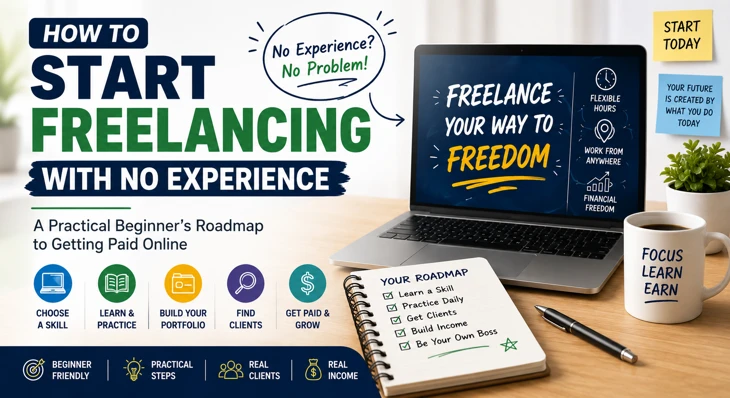
How to Start Freelancing With No Experience:
Introduction: Starting from Zero Is More Normal Than You Think
Most people who eventually build a steady freelancing income begin with no clients, no portfolio, and very little confidence. What changes everything is not prior experience, but the decision to start showing up consistently and learning through real work. Freelancing today is not limited to experts or highly technical professionals. It has opened doors for beginners willing to learn simple, in-demand skills and apply them to real projects. Whether you are a student, a job seeker, or someone looking for a side income, this path can be built from scratch with patience and clarity. The truth is simple: you don’t need to be “ready” to start freelancing. You just need to start.Understanding Freelancing in Real Terms
Freelancing is working independently with clients rather than being tied to a single employer. You offer a service, complete a task or project, and get paid for the value you deliver. It sounds simple, but the flexibility it offers is powerful. You decide your working hours, choose your clients, and build your own income path over time. Common beginner-friendly freelancing areas include:- Writing simple blog posts or website content
- Managing social media pages
- Creating basic visuals using design tools
- Handling virtual assistant tasks like emails or scheduling
- Data entry and research work
Choosing Your First Freelancing Skill Without Overthinking
One of the biggest mistakes beginners make is trying to learn everything at once. That usually leads to confusion instead of progress. A better approach is to pick a skill that is:- Easy to understand
- In demand in online marketplaces
- Simple to practice daily
- Simple video editing for short content
- Social media post creation
- Basic WordPress content uploading
Learning by Doing Instead of Waiting to Be Perfect
There is a common belief that you must complete a full course before you start freelancing. In reality, most freelancers learn while working on small tasks. Free resources are more than enough in the beginning. What matters is practice. You can start by:- Watching short tutorials on YouTube
- Copying real-world examples for practice
- Creating sample work as if a client asked for it
Building a Portfolio Even Without Clients
A portfolio is simply proof of what you can do. It does not need to come from paid work. When you are starting out, your portfolio can include:- Sample projects you created on your own
- Recreated versions of real ads or posts
- Practice assignments based on imaginary clients
Where Beginners Actually Find Freelance Work
Once you have something to show, you can start exploring freelancing platforms where clients actively look for services. Some well-known platforms include:- Fiverr
- Upwork
- Freelancer.com
- PeoplePerHour
Creating a Profile That Feels Trustworthy
Your profile is not just a formality. It is your introduction to potential clients. A strong beginner profile should feel simple, honest, and clear. Focus on:- A short introduction about your skills
- The type of work you are learning
- What value do you aim to deliver
- A few sample works from your portfolio
Getting Your First Client Without Experience
The first client is usually the hardest. Not because it’s impossible, but because confidence is still developing. Start small. Very small if needed. You can:- Apply for simple projects with low competition
- Offer competitive pricing initially
- Focus on delivering clean, error-free work
- Ask for feedback and reviews after completion
Communication Is More Important Than You Think
Many beginners underestimate the importance of communication, but it is often the deciding factor in whether a client trusts you. Good communication includes:- Replying politely and on time
- Asking questions before starting work
- Confirming instructions clearly
- Updating progress when needed
Improving Skills While Earning
Freelancing grows slowly at first, then accelerates as your skills improve. Once you complete a few projects, start upgrading your abilities:- Learn advanced tools in your niche
- Improve speed and quality of delivery
- Expand into related services
- Study successful freelancers and their approach
Mistakes That Hold Beginners Back
A lot of new freelancers struggle not because of a lack of talent, but because of avoidable mistakes:- Trying to charge high rates too early
- Waiting too long to start
- Not applying consistently for jobs
- Ignoring client instructions
- Giving up after a few rejections