
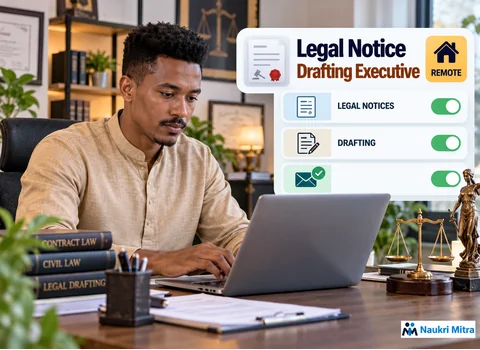
Two clocks start running the moment a cheque bounces. Once the bank returns a cheque unpaid and the payee receives that information, Section 138 of the Negotiable Instruments Act, 1881 gives the payee 30 days to send a written demand notice to the drawer. The drawer then has 15 days from receiving that notice to pay the cheque amount. Miss the first window and the notice may not support a complaint later, which is why the date on the bank's return memo is the first thing a careful drafter writes down. This listing is one of the online legal notice drafting executive jobs built around that kind of attention: a part-time, remote role paying $22 per hour (USD), open worldwide, for an LLB holder who drafts cheque bounce, money recovery, eviction and breach of contract notices for advocates to review and sign.
A good notice is short, complete and defensible, and says nothing the papers cannot back up. What follows describes the job, not legal advice for anyone's own dispute.
The work falls into four main types, each drafted from facts the client has supplied.
Each type has weak spots. A cheque notice should keep the cheque amount separate from other sums claimed, and an eviction notice with the wrong notice period invites a challenge.
Whatever the type, a notice that holds up later has the same skeleton:
No adjectives doing the work of evidence, and no threats beyond what the law permits. A judge may read it months later.
Research comes before drafting. For cheque matters the drafter confirms that the dishonour falls within Section 138 and that the 30-day window from receipt of the bank's information is still open. For contract disputes the Indian Contract Act, 1872 is the starting point, including its provisions on compensation for breach. Eviction notices depend on the Transfer of Property Act, 1882 and the rent or tenancy law of the state concerned, which differ from place to place.
Limitation needs equal care. The Limitation Act, 1963 sets the time within which suits and other proceedings can be brought, and the period depends on the kind of claim. A recovery notice for a debt that may already be time-barred is something to flag to the supervising advocate, not something to send quietly. The drafter works from bare acts and case law databases, notes the provision and the reasoning, and leaves the final legal call to the advocate.
Client facts arrive as forwarded chats, photos and rough summaries, and each is checked against the documents. For a cheque bounce, that means the cheque copy, the return memo, the amount in words and figures, and whether the drawer's name matches the account holder. Recovery needs invoices, ledgers and correspondence; eviction, the rent agreement; breach of contract, the signed agreement and exact clause.
A mismatched date or amount is raised with the team, never smoothed over.
Drafting happens in MS Word, from a template for each notice type. The drafter fills it with the facts and rewrites anything that does not fit, with tracked changes keeping the advocate's edits visible.
Notices are prepared in English and in Hindi, so clean Hindi typing in Word and a consistent choice of legal terms matter. A Hindi notice should read as drafted in Hindi, not translated word for word, with names, amounts and dates identical across both.
The drafter does not sign notices and does not advise clients. Once a notice is final, it goes to the advocate, who reviews it, makes changes if needed and signs it on the advocate's letterhead. The drafter then prepares the signed notice and its enclosures for dispatch.
Mode of service is chosen by the advocate. Registered post with acknowledgement due, speed post and courier are among the options, sometimes alongside email. The drafter keeps the paper trail: postal receipts, tracking records, the acknowledgement card and an exact copy of what was sent. In a cheque matter the drawer's 15 days run from receipt of the notice, so proof of when it was delivered can matter as much as what it said.
An LLB degree is required. Bar Council enrolment or one to two years of drafting experience is preferred, which means either strengthens an application but neither is a fixed condition. Applicants are expected to know Section 138 of the NI Act, recovery law and contract law well, to research soundly, and to draft in MS Word in both English and Hindi.
That leaves room for legal notice drafting executive jobs for freshers who hold an LLB and can show careful work. A graduate without enrolment can apply with sample notices drafted on invented facts and a CV listing internship drafting. This listing does not ask for any separate course or certification.
The pay is $22 per hour (USD), and the job type is part-time. Only an hourly rate is stated; there is no per-notice fee or other payment in this listing. For a rough picture, a 21-hour week at $22 adds up to $462 before tax, and the real figure depends on the hours you actually work.
It is legal notice drafting executive work from home, open to applicants anywhere. Law graduates researching remote drafting work may come across legal services platforms such as Vakilsearch, LegalKart or LawRato. Those names appear purely for context; none of them is behind this listing.
Notice drafting and affidavit drafting are related but different. A legal notice is a letter from the sender, through an advocate, to the other side, stating a claim and demanding action before any case is filed. An affidavit is a sworn statement of facts by the person making it, attested before an authorised officer such as a notary or oath commissioner, and used in court or official proceedings. One argues for a demand; the other vouches for facts.
Drafting experience can lead into replies to notices, Section 138 complaints and other pleadings, or into reviewing others' drafts. Nothing is promised, but the skills carry over.
Real drafting roles pay the drafter. They do not charge for a drafting test, a Bar ID verification, a template pack or a mandatory paid course before work starts. Be wary of anyone who asks for Aadhaar or bank OTPs, wants you to sign notices in your own name, or offers work only after a deposit. If money is requested before you have been paid anything, walk away.