
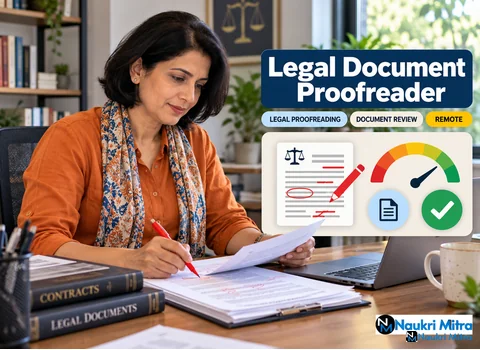
Clause 7.3 of a services agreement says the supplier's liability is capped "except as set out in clause 7.2(b)". Two drafts earlier, someone inserted a new sub-clause, and the old 7.2(b) is now 7.2(c). The carve-out for fraud has quietly become a carve-out for late delivery. Nobody meant it, but the signed text says it. Catching that kind of slip is the core of online legal document proofreader jobs, and this part-time role pays $10 per hour (USD) to do exactly that, fully remote, from anywhere in the world.
You will read contracts, agreements and legal briefs, mark every correction in MS Word Track Changes, and return clean, consistent documents within deadlines.
A legal proofreader reads differently from a casual reader. The first pass is for sense: each sentence should say one thing, and the grammar should be sound. The second pass is mechanical. Clause numbers must run in sequence, with no 4.1 followed by 4.3, schedules and annexures must carry the labels the body text gives them, and the party block on page one must match the signature block.
Small errors carry weight here. "Shall" against "may" changes an obligation into an option. A misplaced comma in a list of exclusions can widen or narrow what a party is responsible for. An amount in words that differs from the numerals invites a fight over which governs. Your job is to notice these, not to decide which reading is right.
When a contract opens with a definitions clause, a capital letter becomes a signal from then on. "Confidential Information" with capitals means the exact thing the definitions clause describes. "confidential information" in lower case may mean something looser. When a drafter defines "the Services" and later writes "the services" or "the Service", a proofreader flags it.
Checks worth running on every file include: each defined term is actually used, each capitalised term is actually defined, the spelling and form stay identical, and a term is not defined twice in two different ways. Word's Find feature, with Match Case switched on, makes this faster than reading alone.
Back to clause 7.3. Cross-references break whenever text is added, deleted or moved, and they break silently. If the drafter typed "clause 7.2(b)" by hand, nothing updates it. If they used Word's cross-reference fields, the number may still be stale until the fields are refreshed, so a reference can look correct on screen and print wrong.
A careful proofreader lists every internal reference, opens each target, and confirms the referenced clause still says what the referring clause expects. Schedules and recitals get the same treatment. It is slow work, and it is where the expensive mistakes hide.
Briefs and opinions cite cases, statutes and articles, and each citation format has its own rules. For Indian material you will see Supreme Court Cases citations, written in the pattern (year) volume SCC page, and All India Reporter citations, written as AIR, the year, the court abbreviation such as SC, and the page.
International clients may ask for the Bluebook, the citation system widely used in the United States, or OSCOLA, the Oxford standard widely used in the United Kingdom. The two differ in punctuation, the use of "v." or "v", and how they treat years and footnotes, so you follow whichever style guide the client names and apply it the same way from first page to last. You check form and consistency; you do not verify whether a case supports the argument.
Every edit goes in with Track Changes switched on, so the drafter can accept or reject it. Make the smallest change that fixes the error rather than rewording a whole sentence. Put questions in comments instead of guessing: "Clause 9.1 refers to Schedule 3, but only Schedules 1 and 2 are attached. Please confirm." Never accept or reject someone else's changes unless asked.
This boundary is what separates a proofreader from a legal editor. An editor may restructure clauses, tighten arguments and question drafting choices. A proofreader works on text that is close to final and corrects errors of form. Proofreading is not legal advice: if a clause looks commercially risky, you raise a query and leave the substance to the lawyer responsible. Nothing in this listing is legal advice either.
This listing asks for expert use of Grammarly, and it earns its place catching doubled words, agreement errors and stray spaces. It is also confidently wrong about legal language. It may suggest splitting a long sentence that has to stay as one obligation, swapping "shall" for "will", trimming "hereinafter" or turning a passive construction active in a way that changes who bears the duty. It also does not know your defined terms.
Treat each suggestion as a prompt to look, never as an instruction. Accepting changes in bulk is how a well-drafted indemnity ends up meaning something else. Before running any tool on a document, confirm that the client's confidentiality terms allow it.
A client may want two things back: a marked version showing your tracked edits and comments, and, once changes are approved, a clean version with no markup left in it. Before sending a clean copy, check that no hidden comments, tracked changes or personal metadata remain; Word's Document Inspector helps with that.
Strict confidentiality is a stated requirement. Expect to sign a non-disclosure agreement, keep files off shared or public computers, avoid pasting client text into unapproved online tools, and delete working copies when the client's rules say to. A hirer may also send a short proofreading test, a passage seeded with errors, to see what you catch and how you mark it.
An LLB or legal studies background is preferred because it means you already know why a defined term matters and how a citation is built. It is not the only route. Proven proofreading experience with legal texts is accepted, which matters for anyone weighing legal document proofreader jobs for freshers: a graduate with no law degree can still build a case with sample work.
For someone starting with no experience, a sensible path is to learn one Indian citation style and one international style properly, practise on publicly available judgments and model contracts, and keep before-and-after samples you are allowed to share. A legal document proofreader course can help with structure, but what the hirer judges is your marked-up work, together with strong English grammar and confident use of Track Changes.
Your time is paid at $10 per hour (USD), on part-time terms. To put a figure on it, a 19-hour week would bring in $190 before tax; this is only a sample, and your total moves with your hours. This listing does not mention per-page rates, bonuses or other pay.
Part time legal document proofreader jobs reward a steady rhythm: shorter, fresh reading sessions catch more than one long tired one. Tell the client early if a file looks messier than expected. Because the role is legal document proofreader work from home with no location limit, all you need is a reliable computer, MS Word, Grammarly and a private place to read. People also look for freelance legal document proofreader jobs on marketplaces such as Upwork and with legal process outsourcing firms; they are mentioned purely to show where such work turns up, and none of them posted this listing.
Remote legal proofreading is genuine work, and fake offers copy its language. Treat it as a warning sign when someone sells a "certified legal proofreader" badge as a condition of applying, charges a fee to release the test or the NDA, or sells a "law-firm internship" that requires a deposit. Genuine hirers pay for your hours; they do not bill you for the right to work. Check who you are dealing with, keep agreed terms in writing, and do not share bank OTPs or ID documents through chat links.