📚 Table of Contents
- Introduction
- What Remote Graphic Animation Looks Like in Real Work Life
- Why Remote Animation Careers Are Growing So Fast
- Skills You Actually Need (Not Just Software Knowledge)
- Understanding Motion Comes First
- Visual Thinking Matters More Than Effects
- Tools You’ll Eventually Use
- Communication Is a Real Skill Here
- Tools That Make Remote Animation Work Possible
- How People Actually Grow in This Career
- The typical path looks like this:
- A Realistic Example From the Field
- Challenges in Remote Graphic Animation Careers
- How to Stay Consistent Without Burning Out
- Future of Remote Graphic Animation Careers
- FAQs
- Is remote graphic animation a good career for beginners?
- Do I need formal education to become an animator?
- How long does it take to start earning from animation?
- What type of animation work pays better?
- Can this become a full-time remote career?
- Conclusion
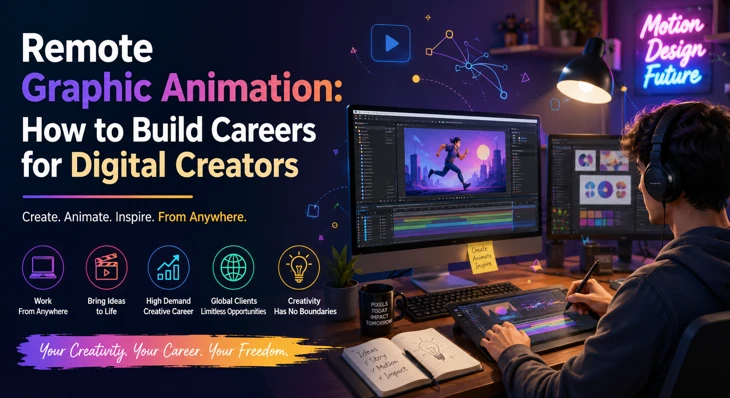
Remote Graphic Animation: How to Build Careers for Digital Creators
Introduction
Remote graphic animation has become one of those career paths that didn’t feel mainstream a few years ago, but now quietly sits at the center of digital work. Scroll through any app today, and you’ll notice it—moving logos, animated ads, kinetic typography, explainer videos. Someone, somewhere, is creating all of that from a laptop, often from home. That’s the interesting part. You don’t need a big studio anymore. You don’t even need to live in a tech city. If you can think visually and understand motion, you can build a real career in remote animation. Most people enter this field in a very simple way. They try one tutorial, animate something small, maybe a bouncing text or a logo reveal, and suddenly realize: this is actually something they can do for real clients. From there, things slowly start shifting. Remote graphic animation is not just a skill. It becomes a working style, a way of earning, and for many people, a long-term creative identity.What Remote Graphic Animation Looks Like in Real Work Life
If we remove all the fancy definitions, remote graphic animation is basically this: creating moving visuals for brands, products, and content—while working from anywhere. No fixed office. No studio pressure. Just projects, deadlines, and creative execution. In real life, the work is very mixed:- One day, you’re designing a short Instagram ad for a skincare brand
- The next day, you’re working on a SaaS explainer video
- Then you might be polishing motion graphics for a website landing page
- Or creating animated social media posts for a startup trying to stand out
Why Remote Animation Careers Are Growing So Fast
The internet has changed how people consume content. Nobody waits for slow or static visuals anymore. Everything needs movement, clarity, and quick storytelling. That’s where animation quietly took over. Brands realized something simple: motion gets attention. But there’s another side to it. Creators also want freedom. Many designers don’t want to be stuck in one office or one city. They want flexibility in how, when, and with whom they work. Remote animation careers offer exactly that balance between creativity and independence. It’s not just about earning money. It’s about building a lifestyle that feels less restricted and more creative.Skills You Actually Need (Not Just Software Knowledge)
Many beginners assume animation is just a set of software skills. Learn After Effects, Blender, Cinema 4D—and you’re done. But in reality, software is only the surface layer.Understanding Motion Comes First
Good animation feels smooth without you noticing it. Bad animation feels stiff and mechanical. That difference comes from understanding timing, spacing, and movement flow. These things are subtle, but they define quality.Visual Thinking Matters More Than Effects
You can add as many effects as you want, but if the design is weak, the animation won’t hold attention. Strong composition, spacing, and color choices often matter more than complex transitions.Tools You’ll Eventually Use
Most remote graphic animators work with a combination of:- Adobe After Effects for motion graphics
- Blender for 3D animation work
- Illustrator for vector-based design
- Cinema 4D for advanced motion projects
Communication Is a Real Skill Here
When you work remotely, you’re not just an animator. You’re also explaining ideas, receiving feedback, adjusting revisions, and managing expectations. Clear communication often decides whether a project runs smoothly or becomes stressful.Tools That Make Remote Animation Work Possible
Remote animation careers depend heavily on digital tools. Without them, this workflow wouldn’t even exist. Creative tools like After Effects and Blender help you build visuals from scratch. Collaboration tools like Slack, Trello, Notion, and Google Drive keep everything organized. Think of it simply: One set of tools helps you create. The other helps you stay on track. Both matter equally in remote graphic animation work.How People Actually Grow in This Career
Nobody really starts as a “professional animator.” It doesn’t work like that. Most people start messily. They watch tutorials, copy effects, try random animations, break things, fix them, and slowly begin to understand how motion works. Then something changes. They start building consistency. Small projects become normal. Practice becomes routine. And without noticing it, they start improving.The typical path looks like this:
- Experimenting with basic animations
- Building small personal projects
- Collecting work into a simple portfolio
- Taking small freelance gigs
- Slowly moving into better-paying client work
A Realistic Example From the Field
Imagine a designer who starts by animating simple Instagram posts just for fun. Nothing serious. Just practice. At first, the work is rough. Timing feels off. Transitions aren’t smooth. But they keep going. A few months later, someone asks them to design a small animated post for a business page. Then another request comes in. Then a small freelance project. One year later, they’re working with clients from different countries—all remotely. No dramatic moment. Just consistent improvement stacking over time.Challenges in Remote Graphic Animation Careers
This career path looks flexible, but it still has real challenges. Competition is strong. Every month, new designers enter the field. Client communication can be tricky. Sometimes expectations are not clear from the start, which leads to revisions. Time management becomes a personal responsibility. There’s no supervisor reminding you about deadlines. And the industry moves fast. Trends change, tools evolve, and styles shift quickly. If you stop learning, you fall behind.How to Stay Consistent Without Burning Out
Success in remote animation careers is not about doing everything at once. It’s about staying consistent without losing direction. A few simple habits help a lot:- Focus on building your own style instead of copying every trend
- Keep communication clear before starting projects
- Set small weekly creative goals instead of overwhelming targets
- Learn new tools only when they are actually needed