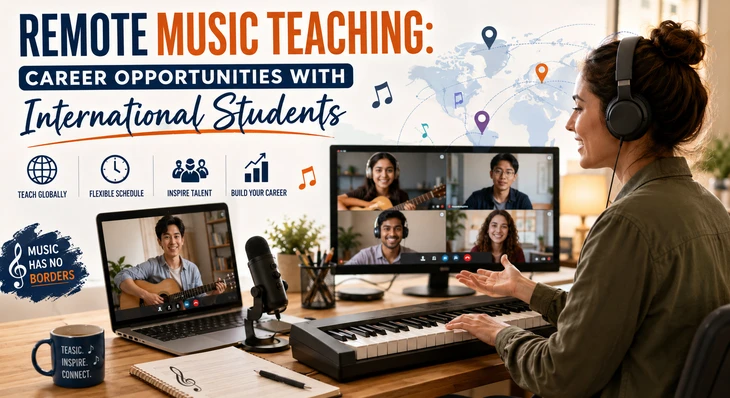
Remote Music Teaching: Career Opportunities With International Students
Introduction: When Music Starts Crossing Borders
A few years ago, teaching music usually meant one thing: students came to you. Your studio, your home setup, or maybe a local academy. That was it.
Now things feel very different.
A guitar teacher in one country can be helping a teenager in another country figure out their first chord. A vocal coach can correct breath control for someone sitting thousands of miles away, probably in a completely different time zone. And strangely enough, it works better than most people expect.
Remote music teaching has quietly become one of those careers that doesn’t look “traditional” on paper but feels very real in practice. For many musicians, it’s not just a side income anymore—it’s the main stage.
And international students? They’re at the center of it all. They’re actively searching, signing up, showing up on time (well, most of the time), and genuinely wanting to learn.
Why This Whole Shift Actually Happened
It didn’t happen because of one big change. It was more like a bunch of small ones that finally stacked up.
People don’t want rigid schedules anymore
Let’s be honest—life is busy. Students today don’t always have the freedom to travel across town just for a 45-minute lesson. Online learning removes that pressure. You just open your laptop, and you’re in class.
Some students take lessons before school. Some after work. A few even squeeze them in late at night with headphones on so they don’t wake anyone up. It’s flexible in a way that traditional classrooms just can’t match.
Teachers suddenly have a global classroom
This is probably the biggest change.
A music teacher is no longer tied to a postcode. You could teach someone in Canada in the morning, a student in India in the afternoon, and someone in Europe at night. Same skill, different continents.
That kind of reach used to sound unrealistic. Now it’s normal.
Technology stopped being the problem
Earlier, online lessons used to feel clunky—lag, bad sound, frozen screens. But that’s mostly gone now.
With decent internet, a clear mic, and platforms like Zoom or similar tools, lessons feel surprisingly smooth. You can share screens, show sheet music, play along, and even record sessions for practice.
It’s not perfect. But it’s good enough—and that’s what matters.
Real Ways People Build Careers in Remote Music Teaching
This isn’t a one-track career. There are several directions people take, depending on what they’re good at and enjoy.
Piano teaching that grows quietly but steadily
Piano is still one of the most requested instruments online. A lot of beginners just want structure—what to practice, how to sit, how to read notes without feeling overwhelmed.
And then there are advanced learners preparing for exams or auditions. They usually want refinement, not basics.
Over time, piano teachers often build a steady stream of regular students. It doesn’t feel explosive—it feels stable.
Guitar lessons that never really go out of demand
Guitar students are everywhere. Some want to play their favorite songs. Some want to understand fingerstyle. Others just want to improvise without overthinking theory.
The interesting part? You don’t need to teach everyone the same way. One student might learn through songs, another through scales, another through pure experimentation.
That variety keeps things interesting for the teacher, too.
Vocal coaching that’s more personal than people expect
Singing is emotional. So online vocal coaching ends up being surprisingly personal.
Students often come in a bit unsure—worried about pitch, tone, or confidence. A big part of the job is just helping them relax enough to actually hear themselves properly.
Breathing techniques, pitch control, performance mindset—it all blends together. And when a student finally sings something cleanly for the first time, it hits differently.
Music theory and songwriting guidance
Not everyone wants to perform.
Some just want to understand why music works the way it does. Others want to write songs but don’t know how to structure them.
Teachers in this space often work more like guides—helping students connect ideas rather than just taking notes.
Niche instruments quietly finding global audiences
Violin, drums, flute… even less common instruments have their own online audiences.
It’s not always fast growth, but it’s steady. And the students who show up usually care deeply about learning.
Starting a Remote Music Teaching Career (Without Overcomplicating It)
A lot of people delay starting because they think they need everything to be perfect. You don’t.
Start with what you already know
If piano is your strength, start there. If it’s vocals or guitar, same thing.
You don’t need five instruments or a full curriculum on day one. You just need something you can teach confidently.
Your setup doesn’t need to look like a studio
A quiet room. Decent lighting. Clear sound.
That’s enough.
Students care more about how you teach than what your background looks like.
There are too many options, honestly.
Zoom, Skype, teaching platforms, social media calls—it’s easy to get stuck deciding.
Just pick one and start. You can always expand later.
Keep lessons simple at first
Most good lessons follow a natural rhythm:
You check where the student is → you teach something small → they try it → you correct → they repeat.
That loop is enough.
Trial sessions help more than marketing ever will
A short trial lesson tells a student everything they need to know.
How do you explain? How patient you are. How you handle mistakes.
It’s less about selling and more about letting them experience it.
What Changes When You Teach International Students
This is where things start feeling different.
You become more adaptable without trying
Different countries, different learning styles, different expectations.
Some students want structure. Some want freedom. Some just want motivation.
Over time, you adjust naturally without even noticing it.
Your schedule starts feeling like yours again
This is a big one.
You’re not locked into one location or one timing system. You start building your own rhythm—morning sessions, late-night practice slots, weekend intensives.
Income becomes less one-dimensional
Most teachers don’t stop at one-on-one lessons forever.
Group classes. Short workshops. Recorded sessions. Even beginner courses.
It grows slowly, but it grows.
Geography stops being a limitation
At some point, you stop thinking about where students are from.
They’re just students.
The Not-So-Perfect Parts (Because They Exist)
It’s not a fantasy job. There are real challenges, too.
Internet issues always show up at the wrong time
Even the best setup has bad days.
That’s why many teachers keep a backup connection ready. Not glamorous, just practical.
Keeping attention online takes effort
People get distracted easily online. It’s normal.
So lessons often need more interaction—asking questions, breaking tasks into smaller steps, and checking progress more often.
Time zones can mess with your rhythm
A student’s morning might be your night.
It takes a bit of planning to balance everything without burning out.
Some things are just easier in person
No way around it.
But angles, close-up demos, recordings, and slow breakdowns help a lot more than people expect.
Skills That Actually Matter in This Field
Not everything is about being the “best musician.”
You need a strong command of your instrument
That part is obvious. If you don’t understand it deeply, teaching becomes difficult quickly.
You need to explain things in a simple way
If a student leaves confused, the lesson didn’t land.
Clarity matters more than complexity.
You need patience that doesn’t rush people
Some students improve fast. Some don’t.
Both are normal.
Audio settings. Video calls. Screen sharing.
Nothing advanced—just functional.
A Pattern That Happens More Than You Think
Many teachers don’t plan this path.
They start locally. A few students here and there. Someone suggests online lessons. They try it casually.
Then one day, they realize half their students aren’t even in their country anymore.
And that’s usually how it becomes a career instead of a side experiment.
Where This Is All Heading
Remote music teaching isn’t slowing down.
If anything, it’s getting more normal.
Better sound tools, smarter learning apps, more interactive classrooms—everything is moving toward making online lessons feel less “remote” and more natural.
And as long as people want to learn music without restrictions, this space will keep growing.
FAQs
1. Do I need teaching experience to start online music lessons?
Not necessarily. Many people start with strong musical skills and learn to teach as they go.
2. Which instruments work best online?
Piano, guitar, and voice training are the most common, but almost any instrument can work.
3. Do I need expensive gear?
No. A basic mic, camera, and stable internet connection are enough.
4. How do students usually find online music teachers?
Through social media platforms, referrals, or personal websites.
5. Is this actually a stable career?
Yes, especially as more people prefer flexible learning options.
Conclusion: A Career That Feels Global by Default
Remote music teaching isn’t just a modern workaround—it’s becoming a real, steady career path for musicians who want more freedom and reach.
It allows you to teach what you love, connect with students from different cultures, and build something that isn’t limited by geography.
And over time, it stops feeling like “online teaching” at all.
It just feels like teaching music—anywhere, anytime, to anyone who wants to learn.