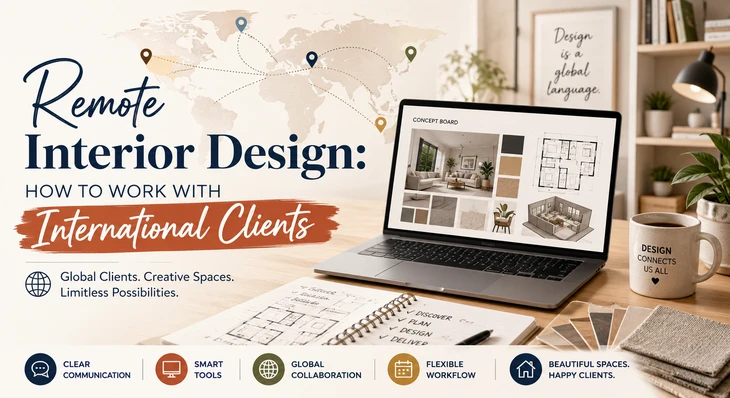
Remote Interior Design: How to Work With International Clients
Remote interior design isn’t just a modern convenience anymore—it’s becoming a normal way of working for designers who want to grow beyond borders. A few years ago, most projects depended on site visits, face-to-face meetings, and physical samples. Today, a laptop, a stable internet connection, and a clear process can take you from a small studio setup to working with clients across continents.
What’s interesting is how natural this shift feels now. Clients don’t hesitate to hire designers they’ve never met in person. Instead, they care about style, clarity, communication, and trust. And for designers, this opens up a completely different kind of freedom.
Let’s break down what really matters when building a successful remote interior design practice and how to confidently work with international clients without feeling lost in the process.
The Real Meaning of Remote Interior Design Today
At its simplest, remote interior design means handling the entire design journey online—from the first conversation to the final delivery. No site visits. No in-person walkthroughs. Everything happens digitally.
But in practice, it’s not as cold or mechanical as it sounds.
A client might send you a few photos of a living room taken on their phone. Maybe a short video where they walk through the space while explaining what feels wrong. Sometimes, it’s just a rough sketch or even a list of frustrations: “the room feels too dark,” “I don’t know where to place storage,” or “I want it to feel calmer.”
From there, the design begins to take shape.
This is where virtual interior design services really shine. You translate incomplete, imperfect information into something visual, structured, and livable. Mood boards, layout planning, and 3D visuals become your language.
And slowly, a space that once existed only as confusion starts becoming clear.
Why International Clients Are Turning to Online Interior Design Consultation
There’s a quiet shift happening in the design world. More clients are actively choosing designers from outside their country—and not just for cost reasons.
Sometimes it’s style mismatch locally. A client in Europe might want a warm, layered, bohemian look but can’t find anyone nearby who truly understands it. Or a homeowner in the Middle East may want minimalist Scandinavian interiors that feel hard to source locally.
That’s where international interior design clients start looking globally.
Another reason is comfort. Remote collaboration removes pressure. There’s no need to schedule physical meetings or wait for someone to visit the site. Everything moves at a more flexible pace.
And honestly, clients also appreciate the clarity that comes with online interior design consultation. Everything is documented—messages, visuals, revisions. Nothing gets lost in translation as easily as it does in verbal conversations.
It’s structured, but still creative. That balance is what makes it work.
Skills That Actually Matter in Virtual Interior Design Services
There’s a misconception that remote design is easier than traditional design. In reality, it just requires different strengths.
Communication That Feels Clear, Not Complicated
When you’re not physically present, your communication carries the entire project. You can’t rely on gestures or quick walkthroughs. Everything has to be explained clearly—without overwhelming the client.
The best designers don’t over-explain. They simplify. They show instead of telling whenever possible.
The Ability to Read Between the Lines
International clients often struggle to describe what they want. They might say “modern but cozy” or “clean but not empty.” Your job is to interpret that language into actual design decisions.
This is where experience quietly builds confidence.
You don’t need every software available. You just need a stable workflow that helps you move ideas forward:
- Visual presentation tools for concepts
- Rendering tools for realistic previews
- Simple communication platforms for updates
- Organized systems for tracking progress
The goal isn’t to look technical. It’s to stay consistent.
Patience With Time Zones and Pace Differences
Working globally means things don’t always move instantly. Some clients reply in hours, others in days. Once you accept that rhythm, the stress reduces significantly.
You start working in cycles instead of constant back-and-forth.
How a Real Remote Interior Design Workflow Unfolds
Every designer eventually develops their own system, but most successful remote workflows follow a natural flow.
It usually begins with a simple but very important step: understanding the client’s life, not just their space.
You’re not just designing a room—you’re designing how someone moves through it every day.
After that, things start to take shape slowly.
First comes the discovery stage. Clients share visuals, notes, and sometimes even inspiration images that don’t fully match each other. That’s normal. It’s your job to connect those dots.
Then comes the concept stage, where rough ideas become direction. Colors start to feel consistent. Furniture styles begin to align. The space gets a personality.
Once that direction is approved, the design becomes more real. Layouts are refined. Materials are chosen. Visuals are created so the client can actually see what their space will look like.
And finally, everything comes together in a deliverable that isn’t just pretty—it’s usable. Shopping lists, layout guidance, and clear instructions turn the design into something actionable.
That’s what makes remote interior design work so well when done properly.
Working Across Time Zones Without Losing Flow
At first, time zones feel like a challenge. But over time, they become part of your rhythm.
Instead of trying to sync every conversation in real time, most designers shift toward asynchronous communication. A recorded walkthrough replaces a live call. A shared board replaces endless messaging.
It sounds simple, but it changes everything.
You stop waiting. You start progressing in parallel.
And once a week, a short live session is often enough to realign everything. No overload. No confusion.
What really helps is setting expectations early. When both sides understand each other's response times and working styles, the entire project runs more smoothly.
Pricing Remote Interior Design Services Without Confusion
Pricing is often where new designers hesitate the most.
There’s no single correct method, but clarity matters more than anything else.
Some designers prefer fixed packages. A simple consultation. A full room design. A premium 3D visualization package. Clients like this because it feels predictable.
Others prefer project-based pricing, especially for larger or more complex spaces. This gives flexibility when scope changes.
And then there’s hourly consulting, which works well for quick guidance or smaller design decisions.
The method doesn’t matter as much as transparency. Clients should always know what they’re getting—and why it costs what it does.
Challenges You’ll Actually Face (And Not Just Theoretical Ones)
Remote work sounds smooth until real projects begin.
One of the most common issues is misunderstanding. Not because people aren’t trying—but because words mean different things to different people. A “minimal” room can look completely different in two minds.
Another challenge is delayed feedback. Clients are busy, and sometimes projects pause unexpectedly. The solution isn’t pressure—it’s structure. Built-in buffer time makes everything easier.
Measurements can also become tricky. Since you’re not on-site, you depend entirely on what the client provides. Clear instructions help reduce errors significantly.
And sometimes, expectations shift mid-project. That’s normal too. Good communication keeps things grounded.
A Simple Real-Life Scenario
Imagine a designer based in India working with a client in Canada.
The client wants a calm, modern apartment but struggles to explain what “calm” means in design terms.
So the process starts with conversation—not design.
They share photos of their current space. A few Pinterest references. Some frustration about clutter and lighting.
From there, the designer slowly builds direction. Soft tones, warm textures, open layouts.
Over time, the space becomes clearer—not just visually, but emotionally.
By the end, the client isn’t just approving a design. They’re recognizing their own lifestyle reflected in it.
That’s the real outcome of good remote interior design.
The Direction This Industry Is Moving In
The demand for virtual interior design services is growing quietly but steadily.
People want flexibility. They want access to designers they resonate with, not just those nearby.
For designers, this shift is less about competition and more about opportunity. Geography is no longer a limit. Style, clarity, and communication matter far more than location.
Those who adapt early—who build systems, learn to communicate visually, and simplify their process—naturally move ahead.
Conclusion
Remote interior design has changed how designers and clients connect. It’s no longer about being in the same room—it’s about understanding the same vision.
Working with international clients might seem complex at first, but once your process becomes structured and your communication becomes clear, everything starts to flow.
The real advantage of this way of working isn’t just flexibility. It’s reach. You’re no longer limited by your city or country. You’re working in a global creative space where your ideas can travel as far as your internet connection allows.
And in that space, clarity will always matter more than complexity.
FAQs
What is remote interior design in simple terms?
It is a process in which interior design services are delivered entirely online, without physical site visits.
How do designers manage international interior design clients?
They use digital tools, structured communication, and visual presentations to collaborate effectively across borders.
Is online interior design consultation effective for real homes?
Yes, when done properly, it can be just as effective as in-person design with clear visuals and instructions.
Rendering tools, communication platforms, and mood board systems are commonly used.
How do time zones affect remote interior design work?
They are managed through asynchronous communication and scheduled check-ins.
Can remote interior design grow into a full-time career?
Yes, many designers now build full global businesses using remote systems and international clients.