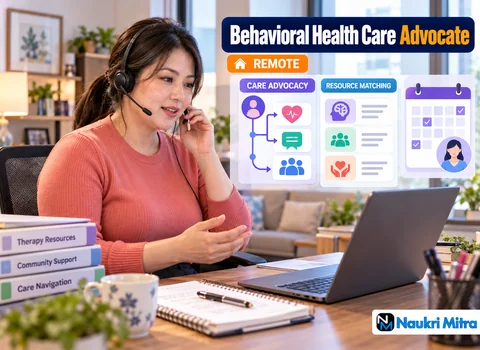
The phone rings, and a member says, a little haltingly, that she isn't sure what kind of help she needs. Maybe therapy, maybe someone to talk to, maybe something for sleep. The advocate on the line doesn't begin with diagnoses or plan codes. The first questions are about safety: is she safe right now, and is anyone else at risk? Only once that's settled does the conversation turn to what she'd prefer. Would she rather see someone in person or over video? Does she want a clinician who speaks Spanish? What can she manage to pay after her plan covers its part? That call, repeated with very different people through the week, is the core of remote behavioral health care advocate jobs, and that is the work this listing wants filled.
The position is full-time, remote, open to licensed clinicians worldwide, and paid USD 78,000 per year. You'd work by phone from a private home office, handling intakes, risk screening, provider matching, and member follow-up.
Advertisement
Phone work, from first question to follow-up
Put simply, the advocate sits between a member who needs help and the clinicians who can provide it. You don't hold an ongoing therapy caseload. You assess, screen, match, and follow through.
Structured intakes and risk screening
Each intake follows a structured protocol. You gather the presenting concern, past treatment, medications as the member reports them, and any risk indicators, using the screening tools the employer's protocol specifies.
When a call needs escalation
Sometimes a call shows that a member may need urgent support. When that happens, you follow the employer's crisis protocol: keep the member engaged, bring in the escalation contact or emergency resource the protocol names, and record what happened. The protocol exists so that nobody has to improvise in those moments.
Matching members with providers
Matching is where an advocate earns the member's trust. You weigh clinical need (a therapist, a psychiatrist for medication management, or both), how soon a provider can actually see someone, and whether that clinician is in the member's network. Then you add the preferences from the start of the call. A perfect clinical fit with a six-week wait can be worse than a solid fit who can see the member by video on Thursday.
Coordination and follow-up calls
After a referral you check back. Did the member book? Did the first session happen? Some members need a third call before care starts.
Charting, software and the home office
Documentation lives in an electronic health record (EHR) and a care management platform. Intake notes, screening results, referrals, and every follow-up attempt go in, usually during or right after the call. If you've charted in any EHR before, the learning curve is mostly the employer's templates.
The listing requires a private, HIPAA-compliant home office. In practice, employers usually look for a room with a door that closes, where no one can overhear calls, a secure and reliable internet connection, and screens household members can't see. HIPAA is a US privacy law; treat it as context and treat the employer's own privacy rules as the standard you need to meet.
Caseload, boundaries and staying well
You'll hear hard stories all day, often from people at a low point. Burnout is a real risk in this field, and it's fair to ask about it before you accept an offer. Worth raising: how caseloads are set, whether there's supervision or peer consultation after difficult calls, and whether time is protected for notes. On your side, boundaries do a lot of the work. Log off when the shift ends, keep the office separate from where you rest.
As for growth, advocates often move into lead or senior advocate roles, clinical quality review, training new hires, program management, or back into direct practice with a far clearer picture of how members experience the system. None of these is promised here.
Licensure: required, and worth checking twice
An active independent clinical license is required, such as LCSW, LPC, or LMFT, along with a master's degree in social work, counseling, or psychology. The listing's qualifications treat both as requirements, which fits the clinical judgment screening and escalation require.
Because applicants can be anywhere in the world, portability matters. A license is issued by a particular state or country, and whether it allows you to practice with members located elsewhere varies widely. License recognition arrangements differ by state and country, and many do not exist. Before applying, check with your licensing board and ask the employer where its members are and which licenses it accepts. This is general context, not legal advice.
Clinical experience for remote behavioral health care advocate jobs
The listing asks for at least two years of clinical behavioral health experience. Outpatient therapy, community mental health, crisis services, and hospital social work all count. Reviewers usually want to see assessment work, comfort with risk screening, and some familiarity with how referrals and insurance networks function.
Useful behavioral health care advocate skills include:
- Running a structured phone intake that doesn't sound scripted
- Risk screening and following escalation protocol under pressure
- Telling when someone needs a therapist, a prescriber, or a higher level of care
- Quick, accurate charting in EHR and care management software
- Reading benefits and network information without getting lost
- Patience with members who are frightened, embarrassed, or frustrated
About entry-level remote behavioral health care advocate jobs: this role isn't one. The license and two years of clinical practice are firm requirements. If you're looking for behavioral health care advocate jobs with no experience, roles such as care coordinator or intake specialist can build the background you'd need later.
Advocate or case manager?
The two titles overlap, but the emphasis differs. An advocate usually focuses on the front end: intake, screening, matching and making sure care begins. A behavioral health case manager more often follows a smaller group of members over months, frequently with complex needs, coordinating several services at once. Read each behavioral health care advocate job description closely.
Annual salary and questions for the offer
The behavioral health care advocate salary here is USD 78,000 per year for full-time work, and no other pay figure appears in the listing. Ask about pay schedule and benefits at the offer stage. When comparing behavioral health care advocate salaries across offers, look at expected call volume too.
Health plans, EAPs and other employers
Health plans, EAPs, and other employers
After the master's: supervised practice first
To become a behavioral health care advocate after a master's, the usual route is supervised clinical practice first. Many licensing boards require post-degree supervised hours and an exam before granting an independent license; details depend on where you're licensed, so check with your board.
No single behavioral health care advocate course is universally expected, and no behavioral health care advocate certification replaces a license. Continuing education in risk assessment, motivational interviewing, trauma-informed care, and the screening tools common in your setting will help.
Leading the resume with your license
A strong behavioral health care advocate resume opens with your license type, jurisdiction, and status, then shows the settings and volume of your assessment work. Specifics carry weight: "completed eight to ten intakes a day at a community clinic" says more than "strong assessment skills."
Role-play intakes and interview questions
Common behavioral health care advocate interview questions ask how you'd respond if a member disclosed risk partway through a routine call, how you'd choose a match when the ideal provider has no openings, and how you look after yourself after hard calls. A role-play intake is likely.
Documents to have ready when applying
Applying via this page is free. A payment request tied to an application, interview, or onboarding is a warning sign, because real employers don't ask for one. Have your license number and jurisdiction ready, an up-to-date resume, and a few lines about your home office. Since these are behavioral health care advocate jobs remote worldwide, mention your time zone and the hours you can cover. For behavioral health care advocate work-from-home jobs like this one, you use clinical training every day.