
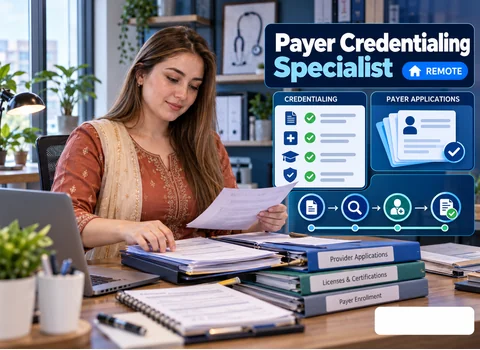
Tracker row 112: Provider: Rosa, licensed clinical social worker (new hire) | CAQH ProView status: complete, payers authorised | Last attested: 09/02 | Commercial payer A applied: 09/08 | Commercial payer B applied: 09/10 | State Medicaid plan applied: 09/15 | Medicare (PECOS) applied: 09/17 | Next follow-up: 10/27, OVERDUE. That last cell is the whole reason remote payer credentialing specialist jobs exist, and the person in this seat is the one who spots it turning red before anybody else does.
This listing is for a full-time remote role at a rate of USD 21 per hour, open to applicants worldwide. The work follows a provider's credentialing file from the first scanned document to the first renewal, and the sections below do the same with Rosa's file.
Nothing goes to a payer until the file is complete. For a provider like Rosa that usually means a copy of her state licence, a malpractice certificate of insurance with the policy dates visible, a CV with work history down to the month, education and training documents, a signed attestation, and the group's tax and billing details. You request these by email and log the date each one lands.
A CV that says "2019 to 2021" with no months is a classic snag. You ask for exact months rather than guessing. This is the plain answer to what a payer credentialing specialist does: you assemble an accurate, verifiable record of a provider's qualifications, then keep it that way.
Many commercial payers pull provider data from CAQH ProView, so the profile has to match the paper in your file line for line. You enter practice locations, hospital affiliations and work history, upload the current licence and malpractice certificate, and authorise the specific payers that need to see it. The profile also has to be re-attested on a recurring cycle set by CAQH.
So the tracker carries a "last attested" date and a reminder set well ahead of the next one. When Rosa's malpractice carrier issues a renewed certificate, the new PDF goes into ProView that same week.
Every application leans on the provider's National Provider Identifier, and the NPPES record behind it should show the correct taxonomy code, practice location and mailing address. A mismatch between NPPES and what you type on a payer form is a common reason an application comes back with questions. You check the NPI registry and flag stale details for correction.
Medicare enrollment generally runs through PECOS, and on a small team the credentialing specialist often prepares and tracks those alongside the commercial and Medicaid files. Requirements change, so read each program's current instructions rather than relying on memory.
With the file complete, you prepare provider applications to commercial and government payers. You attach the right documents, check individual and group details field by field, and record the submission date and any reference number in the tracker.
Each payer then gets a status: submitted, received, in review, more information requested, approved, or denied with a reason. Timelines vary by payer and by region, and nobody on the provider side controls them.
Remote credentialing specialists spend a good part of the week on follow-up calls and portal checks, and every touch goes into the spreadsheet: date, who you spoke to, call reference, what they said, next action and next follow-up date. A typical note might read: "10/29, provider relations, rep Dana, ref 55821, app received, pending verification, recheck 11/12."
If a payer says an application never arrived, you resend it with proof of the original submission and log both attempts. When a portal shows the same status for weeks, pick up the phone.
Approval is not the end of Rosa's file. Payers recredential providers on a cycle, and licences, board certifications, DEA registrations where they apply, and malpractice certificates all carry expiry dates. You keep an expiry column for each, ask the provider for renewals ahead of time, upload new copies to CAQH ProView and answer recredentialing requests before they lapse.
Once a practice has twenty or thirty providers, most of the credentialing work lives in the tracker. A workable layout keeps one row per provider and payer pair, frozen headers, conditional formatting that turns follow-up dates red once they pass, and a separate tab of expiry dates sorted soonest first. Some teams use credentialing software; others use Excel or Google Sheets.
Either way, the payer credentialing specialist job description comes down to clean data entry, sensible filters and the discipline to update a row the same day something changes.
People often ask about payer credentialing vs provider enrollment, and in small offices the line blurs. Broadly, credentialing is verifying and maintaining a provider's qualifications so a payer will accept them. Enrollment is the step that sets the provider up in the payer's network and billing systems so claims can be paid. This page covers the credentialing side.
Formally, you need a high school diploma; an associate degree would be welcome but is not essential. On top of that come 1 to 2 years spent in credentialing, provider enrollment or medical billing. You should have used CAQH ProView, PECOS and NPPES hands-on, and your spreadsheet tracking should be strong enough to show in a sample. The NAMSS CPCS credential (Certified Provider Credentialing Specialist) counts in your favour but is optional.
Payer credentialing specialist skills that matter day to day:
If you are hoping for payer credentialing specialist jobs with no experience, or entry level remote payer credentialing specialist jobs, be realistic: this posting wants a year or more. A common route is a front desk, billing or medical office job where you start helping with credentialing paperwork and then take it over. Anyone asking how to become a payer credentialing specialist can begin by reading the provider help guides for CAQH ProView, NPPES and PECOS, and build a mock tracker you can walk through. A payer credentialing specialist course from a community college or medical office program can help; check what it covers before paying. For payer credentialing specialist certification, CPCS from NAMSS is the one this listing mentions; check the eligibility terms with NAMSS directly before you plan around it.
This position pays USD 21 per hour on a full-time basis, as stated in the listing. Bonuses and benefits go unmentioned, so don't build them into your sums. Searches for payer credentialing specialist salary or payer credentialing specialist salary per hour will turn up figures that vary by employer and region; for this posting, $21 per hour is the number to weigh.
Payer credentialing specialist jobs remote worldwide are usually posted by medical groups, outsourced billing and revenue cycle companies, telehealth practices and credentialing service firms. Confirm working hours and time zone overlap at interview.
For a payer credentialing specialist resume, lead with what you can back up: how many providers you maintained, how many payers you worked with, which systems you used. Name CAQH ProView, PECOS and NPPES only if you have actually logged into them.
Payer credentialing specialist interview questions often sound like these:
Is medical credentialing a good work from home career? It can suit people who like order and don't mind phone queues. The work is repetitive, so be honest with yourself before applying for payer credentialing specialist work from home jobs.
Sending an application on Naukri Mitra costs nothing; a real employer will not bill you for a job. If you are scanning credentialing openings that are hiring now, send your resume with a two-line note describing one tracking habit you rely on.