
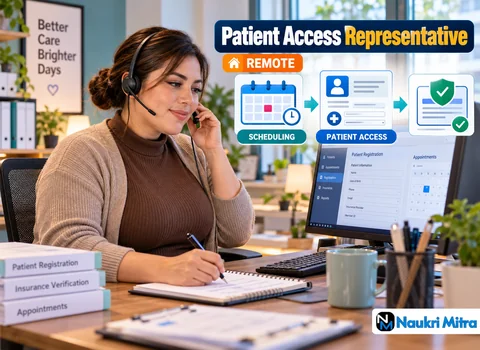
The first person a patient speaks to at a hospital is often not clinical at all. It is someone at a desk or on a headset, and what that person gets right (the spelling of a surname, the insurance plan on file, the appointment slot that matches the order) shapes every step that follows. This post counts among those remote patient access representative jobs: a full-time, home-based post at $21 per hour (USD) that accepts candidates from any country. You register patients, update their details, check coverage at a basic level and book or move appointments, mostly over the phone.
Below is the patient access representative job description as a real shift runs, then what gets you hired.
Every call starts the same way. You greet the caller, ask for their full legal name and date of birth, and match both against the record before you discuss anything. Many departments add a third identifier, such as a home address or phone number, because two patients with the same name and birthday are more common than beginners expect.
This protects privacy under HIPAA and prevents duplicate charts. If someone calls for a parent or partner, check they are listed as an authorized contact first. When something does not line up, ask again. A polite second question costs ten seconds; a merged or wrong chart can take a records team days to untangle.
Most of your screen time is in the registration module: Epic Prelude in many hospitals, Cerner (now Oracle Health) in others. Either way, you create or update demographics so the record is complete before the visit.
Read each field back when you can. "That is S-M-Y-T-H, with a Y?" sounds fussy, yet it catches the mistakes that cause trouble later.
Patient access staff do a lighter version of insurance work than a dedicated benefits verification team. You ask whether the coverage has changed, capture the member ID and group number exactly as printed on the card, and note who the subscriber is. Then you run an eligibility check in the system to confirm the plan is active for the date of service.
If the response comes back inactive or the plan name does not match, you do not guess. You ask the patient for a newer card, flag the account for follow-up, or route it to the team that handles deeper coverage questions. Most of this follows US payer rules, so even an applicant outside the US should get comfortable with terms like commercial plan, Medicare, Medicaid, co-pay and deductible.
Scheduling in Epic Cadence (or the Cerner equivalent) looks simple until you see how many rules sit behind a calendar. A new patient visit may need a longer slot than a follow-up. Some providers only see certain visit types on certain days. An imaging appointment might require an order on file before you can book it.
A good scheduler reads the visit type, checks the order or referral, offers a few options, and confirms date, time, location and any preparation instructions. When rescheduling or canceling, free the old slot properly and record the reason.
Many departments ask you to tell patients about their expected co-pay and collect payment details, or at least let them know what to bring. You read what the system shows for their plan and put it in everyday language. You are not the final word on what a patient owes, and it is fine to say so: the estimate depends on the plan and on what happens at the appointment. Follow your employer's script and payment security rules closely, especially when card details are involved.
People rarely call a hospital because their day is going well. You will hear from someone worried about a test result, a parent juggling several children's appointments, or a patient angry about a bill.
Let the caller finish. Name what you heard: "So the appointment was moved twice and nobody told you." Say what you can do right now, and be honest about what you cannot. If a question is clinical, such as whether symptoms need urgent care, you never answer it yourself; you follow the department's transfer or triage process. Callers forgive a lot when they feel someone is actually handling their problem.
Here is the part new staff often underestimate. A claim travels from registration all the way to the insurer, and the insurer checks the details you entered. A transposed digit in a member ID, a wrong date of birth, an old plan left as primary, or a missing referral can each send the claim back unpaid. Billing staff then fix it while the patient receives a confusing statement.
That is why patient access teams are often measured on accuracy as well as call handling. Treat every registration as if you will have to defend it later, because in a sense you will.
For this role you need a noise-canceling headset, a quiet room where your side of each call stays private, and stable internet. Employers usually connect you through a secure remote desktop, and many prefer wired internet to Wi-Fi. A door you can close matters, since you hear health details on every call. Check each posting for its own equipment list, as some organizations ship hardware and others expect you to supply it.
The baseline is a high school diploma or its equivalent plus one year of customer service experience, ideally in healthcare. Basic medical terminology and insurance knowledge are preferred, as is hands-on use of Epic Prelude and Cadence or Cerner. The NAHAM Certified Healthcare Access Associate (CHAA) credential is welcome but not something you must hold before applying.
Wondering how to become a patient access representative with no healthcare background? A year answering phones at a bank, call center, pharmacy counter or retail help desk still counts, because calm service and careful data entry are the patient access representative skills hiring teams weigh first. Close the gap with a short medical terminology class or a patient access representative course, plus an introduction to US health insurance. On your patient access representative resume, show accuracy and how you resolved complaints. Typical patient access representative interview questions include how you would handle a caller who refuses to give a date of birth, or two records that look like the same person.
Employers include hospitals, health systems, specialty clinic groups and outsourced patient access vendors. Some screen applicants with background checks or hire only from certain countries, and each posting spells that out.
A medical receptionist in a small practice usually greets walk-ins, answers general phones and keeps one office calendar. Patient access sits inside a larger hospital system, with more structured registration, eligibility checks and scheduling rules across many departments. The work is more data-heavy and tied more directly to whether claims get paid.
The role is a common starting point. Strong representatives often move into senior or lead roles, trainer positions, scheduling coordinator jobs, financial counseling or benefits verification, and later patient access supervisor or manager. Accuracy, the CHAA and a record of handling difficult calls well are what move people up, though no step is promised. For now, the role offers full-time hours at $21 per hour (USD) and a solid grounding in how a hospital's front end works.