
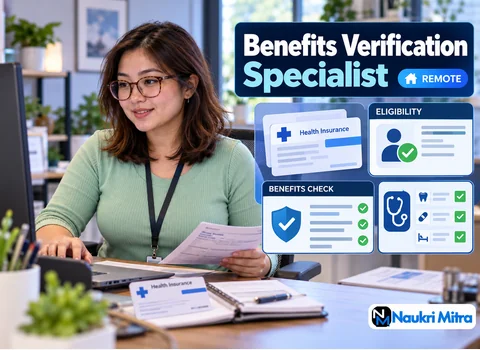
A patient drives forty minutes for an infusion that was booked weeks ago, signs in, and is told at the desk that the plan termed last month, or that a deductible nobody mentioned still has to be met before the insurer pays anything. The chair sits empty and the patient goes home upset. Catching that problem three or four days earlier, while there is still time to fix it, is the whole point of this role. These remote benefits verification specialist jobs are full-time, pay $21 per hour in USD, and can be done from anywhere with a reliable connection.
Applications are welcome from any country, yet nearly every plan you check belongs to a US insurer working under US rules. Someone based abroad should ask early whether the employer permits patient data to be opened from their country.
A benefits verification shift usually begins with a work queue built from the upcoming schedule. You are not looking at today. You are looking at patients booked later this week, sorted by appointment date, so there is room to act on whatever you find.
For each name you pull the demographics and insurance on file: subscriber name, date of birth, member ID, group number, and whether the patient is the subscriber or a dependent. One wrong digit in a member ID can make an active plan look inactive, so compare the card image with the system.
Most checks start with an electronic eligibility request. Clearinghouse tools such as Availity and pVerify send the request to the insurer and return a response that shows whether coverage is active on the date of service, the plan type, and the benefit details for the type of service you asked about. Some payers give fuller answers on their own provider portals, so you learn which source is most reliable for each insurer.
The first question is simple: is the plan active on the appointment date? After that, you confirm the provider is in network, the service type you queried matches what is scheduled, and the patient has no other coverage that should pay first.
One of the benefits verification specialist skills employers test most is explaining these terms simply:
Imagine a hypothetical patient booked for an MRI who has met only a small part of a large deductible. That patient deserves to hear about it before the scan, not from a bill weeks later.
Electronic responses are often incomplete. A portal may confirm the plan is active but say nothing about a specific procedure, a visit limit, or whether a benefit sits with a separate vendor. When that happens, you call the payer's provider line. Good calls are short: member ID, date of service, the codes the office gave you, and a clear list of questions. At the end you note the representative's name and the call reference number, because someone may need to quote it later if a claim is disputed.
Part of every check is asking whether the service needs approval from the insurer in advance. Imaging, infusions and many specialty drugs commonly do, though rules differ by plan. You are not the person who builds the clinical case for approval in most offices. Your job is to notice the requirement, confirm whether an approval already exists on file, and route the account to whoever handles authorizations, with enough lead time for them to act.
A verification is only useful if the next person can read it in ten seconds. You record your findings in the practice management or EHR system in the format the team uses: active or inactive, network status, deductible met and remaining, copay, coinsurance, out-of-pocket status, authorization needed or on file, and how you confirmed it.
When something is wrong, you flag it to staff the same day. Typical issues include terminated coverage, an out-of-network provider, a missing referral, or a large estimated patient balance. The goal is a phone call to the patient while there is still time to update insurance, reschedule, or talk through costs calmly.
Because you are handling protected health information, the setup matters as much as the skill. This listing asks for typing at around 35 WPM, HIPAA awareness, and a quiet workspace where insurer calls stay private and nobody else in the household can glance at a patient record. Most benefits verification specialist work from home jobs add their own HIPAA training and may require a VPN or headset, along with an automatic screen lock.
Expect $21 per hour USD for a full-time week. Hours often track the office or payer business day, so people outside US time zones should check the shift times on each posting. Other employers quote a benefits verification specialist salary shaped by their own region and experience bands, and this listing does not promise extra hours or raises.
The same work exists across physician groups, hospital systems, imaging and infusion centers, revenue cycle outsourcing firms, and pharma hub services that check coverage for specialty medications on behalf of drug manufacturers.
A high school diploma or equivalent is the education asked for here, and one year in a medical office, billing or insurance verification is preferred. Preferred is not the same as required, but you will need to show you understand deductibles, copays, coinsurance and portals like Availity and pVerify.
If you have no direct experience, aim for the nearest adjacent seat: front desk check-in, scheduling, patient registration, or a billing support role. Free clearinghouse tutorials and a short benefits verification specialist course in insurance basics can fill gaps. On your resume, describe concrete tasks such as catching inactive plans before visits. Common benefits verification specialist interview questions ask you to walk through a sample check and explain a deductible to a nervous patient.
Certifications are not required for this role, though they help. Two that hiring teams recognize are NAHAM's CHAA (Certified Healthcare Access Associate), built around patient access, and HFMA's CRCR (Certified Revenue Cycle Representative), which spans the revenue cycle. Eligibility rules and exam fees change, so confirm them with each body.
The two roles sit side by side and are often confused. A benefits verification specialist answers the question: what does this plan cover for this patient on this date, and what will the patient owe? A prior authorization specialist takes the cases that need insurer approval and gets that approval, gathering clinical notes, submitting requests, and following up on pending decisions. Verification identifies the need. Authorization does the asking. Many people move from the first into the second once they know payer behavior well.
Verification gives you a close view of why claims fail before they are even sent, which is useful knowledge anywhere in the revenue cycle. Common next steps include prior authorization, financial counseling for patients with large balances, patient access lead or supervisor, insurance follow-up and denials, or reimbursement work in pharma hub programs. Promotions come at each employer's pace, and accurate notes and calm patient conversations are what supervisors remember.