📚 Table of Contents
- Introduction: Where Healthcare Meets Real-Time Intelligence
- Understanding Health Informatics in Simple Terms
- Why Remote Healthcare Analytics Careers Are Expanding So Fast
- Digital Healthcare Is Now the Standard
- Decisions Now Depend on Data
- Work Is No Longer Location-Bound
- Demand Is Outpacing Skilled Talent
- Skills That Shape a Strong Career in Health Informatics
- Technical Capabilities
- Analytical Thinking
- Healthcare Awareness
- Communication Skills
- Education Pathways and Certifications That Help You Stand Out
- Career Roles in Healthcare Analytics and Informatics
- Healthcare Data Analyst
- Clinical Informatics Professional
- EHR Implementation Specialist
- Public Health Data Specialist
- Healthcare Reporting Analyst
- Building a Strong Remote Career in Healthcare Analytics
- Salary Outlook in Health Informatics Careers
- Challenges You May Encounter in This Field
- Data Privacy Requirements
- Complexity of Systems
- Fast-Changing Technology
- Remote Collaboration
- Future Trends Shaping Healthcare Analytics
- FAQs
- Is health informatics a good option for remote work?
- Can someone enter this field without a medical background?
- What tools are most important in healthcare analytics jobs?
- Is experience required to start a career in health informatics?
- What makes this career future-proof?
- Conclusion: A Career Built on Data, Impact, and Flexibility
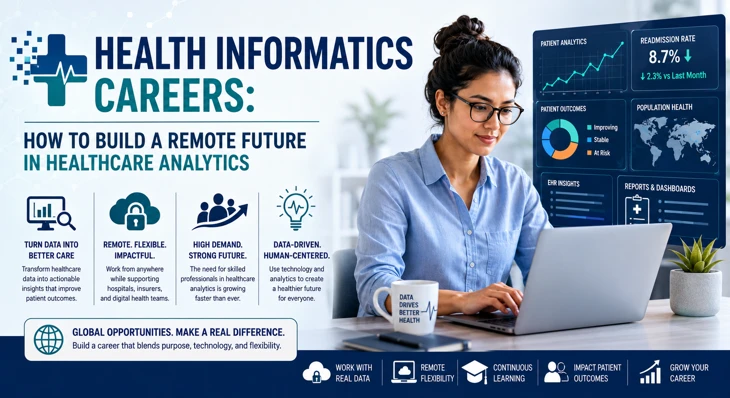
Health Informatics Careers: How to Build a Remote Future in Healthcare Analytics
Introduction: Where Healthcare Meets Real-Time Intelligence
Healthcare today runs on more than doctors, hospitals, and equipment—it runs on information. Every appointment, prescription, test result, and insurance claim generates data. When that data is understood correctly, it changes how care is delivered. That’s exactly where health informatics careers come in. This field sits at the intersection of healthcare and data analytics, helping organizations make smarter decisions based on real-world evidence. What makes this space even more interesting is how quickly it is shifting toward remote healthcare analytics jobs. You no longer need to be physically present in a hospital system to contribute to patient outcomes. With the right skills, professionals now work from home or anywhere, supporting hospitals, insurance companies, and digital health platforms through data-driven insights. This guide breaks down how the field works, what skills matter, and how people are building long-term careers in healthcare analytics without being tied to a physical workplace.Understanding Health Informatics in Simple Terms
Health informatics is essentially the practice of turning healthcare data into useful knowledge. Instead of just storing medical records, professionals in this field analyze patterns, track outcomes, and support better decisions in patient care. In real terms, it often involves working with:- Electronic Health Records (EHR) systems
- Hospital databases and reporting tools
- Clinical dashboards and analytics platforms
- Patient outcome tracking systems
Why Remote Healthcare Analytics Careers Are Expanding So Fast
The demand for remote healthcare analytics jobs is not random—it’s the result of several major shifts in the industry.Digital Healthcare Is Now the Standard
Most hospitals and clinics have already moved to digital record systems. This means data is available electronically, making remote analysis possible.Decisions Now Depend on Data
Healthcare organizations are under pressure to reduce costs while improving patient outcomes. Data analytics helps them do both more effectively.Work Is No Longer Location-Bound
Since healthcare data can be securely accessed through cloud systems, analytics work can easily be done outside traditional offices.Demand Is Outpacing Skilled Talent
More healthcare organizations are investing in data than there are trained professionals, creating strong opportunities for health informatics careers.Skills That Shape a Strong Career in Health Informatics
Success in this field comes from a balanced mix of technical ability, healthcare understanding, and communication skills.Technical Capabilities
Most professionals rely on tools such as:- SQL for database queries
- Excel for quick analysis and reporting
- Python for deeper data exploration
- Tableau or Power BI for visualization
Analytical Thinking
It’s not just about running reports. The real value comes from understanding what the data means and how it impacts healthcare decisions.Healthcare Awareness
Knowing how hospitals function, how patients are treated, and how medical systems operate adds context to every dataset.Communication Skills
Since many roles are remote, explaining insights clearly through reports, dashboards, and virtual collaboration becomes essential.Education Pathways and Certifications That Help You Stand Out
One of the strengths of health informatics careers is flexibility in educational background. You don’t always need a medical degree to enter the field. People often come from:- Data science or computer science
- Public health programs
- Nursing or clinical backgrounds
- Information systems or IT fields
- Google Data Analytics Certificate
- Certified Health Data Analyst (CHDA)
- Microsoft Data Analytics Certification
- Healthcare Informatics-focused online programs