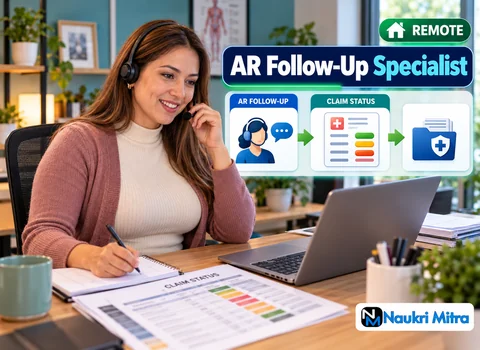
Eleven minutes into the hold music, the rep finally picks up. The claim in front of you came back denied with a remark that boils down to "additional information needed from the provider." You already read the EOB twice, so you know the payer never got anything. The rep checks and tells you it was the referral number. You note the reference number, fix the claim, send it back, and set a follow-up date. That is a normal Tuesday morning in remote AR follow-up specialist jobs, and this full-time listing pays USD 21 per hour for someone who can do it calmly, call after call.
The job is home-based with no country restriction: phone calls, payer portals, and careful notes on claims that are unpaid, underpaid, or denied.
Advertisement
Chasing Unpaid Claims: The AR Follow-Up Specialist Job Description
People sometimes ask what an AR follow-up specialist does in medical billing that a biller does not. The short answer is that a medical biller mostly gets claims out the door: coding checks, charge entry, clean submission. You pick them up after they have gone quiet or come back wrong. Your job is to find out why money has not arrived and get it moving. You call payers, check status online, correct and resubmit claims, and appeal when needed.
Working the AR Queue, Hour by Hour
Ordering the queue before dialing
Nobody works a queue top to bottom. You sort it first. Older claims get attention because many payers have timely filing windows, and a claim that drifts past one can become very hard to recover. Higher balances matter too. A practical habit: oldest high-value accounts first, small balances batched later through quick portal checks.
Reading the EOB and the remittance
Before you pick up the phone, read what the payer already told you. The explanation of benefits and the electronic remittance show what was billed, what was allowed, what was paid, and the adjustment and remark codes that explain the gap. Often the answer is already there. A call is for what the paperwork cannot tell you.
Denial categories in plain words
- Missing or incomplete information: the payer wants something it did not receive, such as a referral, an authorization number, or medical records.
- Eligibility problems: coverage was inactive on the date of service, or the patient had a different primary plan.
- Coding mismatches: the procedure code doesn't match the diagnosis, or a modifier is missing.
- Timely filing: the claim arrived after the payer's deadline, and you need proof it was sent on time.
- Underpayment: the claim was paid, but below what the contract or fee schedule should allow.
CPT and ICD-10 at the level you need
You are not a coder. CPT codes describe what was done; ICD-10 codes describe why. When a payer says the diagnosis doesn't support the procedure, you should be able to spot the mismatch, explain it on the call, and route it to coding if a fix is needed.
Portals, calls and notes
Much of the checking happens in Availity or Waystar: eligibility, claim status, sometimes remittance lookups. If the portal answers it, you skip the call. Afterward, log every action in the account notes in Epic or whichever billing system the client uses. A good note reads like this: "Called payer, rep Dana, ref #4471, claim denied for missing auth, auth on file dated 03/02, corrected claim sent, follow up in 14 days." Short, factual, and dated.
Corrected claims, appeals and escalation
Some denials only need a corrected claim with the right field filled in. Others need a written appeal with supporting documents, sent within the payer's appeal window. When an account keeps bouncing, or a payer rep gives answers that conflict with the contract, you escalate to a lead rather than calling the same line a fifth time. Productivity targets, such as accounts touched or calls completed, vary by employer, so ask how your work will be measured.
Tools You Will Have Open All Day
The listing names Epic, Waystar, and Availity. In many billing teams, patient accounts and notes sit in the EHR or billing system, while claim and payer portals handle status, eligibility, and remittance lookups. You should have used at least one and be comfortable switching screens while someone talks in your ear.
Eligibility for Remote AR Follow-Up Specialist Jobs
Requirements start with a high school diploma or equivalent and 1 to 2 years of medical billing or AR follow-up experience. Trained freshers are considered, meaning someone who has completed a medical billing or RCM training program and can talk through an EOB, even without paid experience. That makes this one of the more realistic entry-level remote AR follow-up specialist jobs for people who have done the groundwork.
You should know CPT, ICD-10, EOBs, and denial codes, and have worked in Epic, Waystar, or Availity. The HFMA CRCR (Certified Revenue Cycle Representative) counts in your favor but is optional; it signals you have studied how a claim moves from patient registration to payment.
Some of the most useful ar follow-up specialist skills are less obvious: patience on hold, a steady phone voice, the habit of asking the rep to repeat a reference number, and enough curiosity to read a remittance line by line instead of guessing.
Headset, Quiet Room and Patient Privacy
A headset, a quiet room, and stable internet are required. A noise-canceling headset, a door you can close, and a connection that holds up through a long call make the work much easier.
You will see patient names, dates of birth, member IDs, and diagnoses all day. Treat that information carefully: work only in the employer's approved systems, keep your screen out of view of others in the house, never save claim details on personal devices, and follow whatever privacy rules and training the employer provides.
About schedules: payers keep their own business hours, usually US hours for US claims. The listing doesn't specify a shift pattern. Depending on your time zone, matching payer hours may mean working evenings or nights. Raise it early with the hiring team.
Per-Hour Pay and Open Questions
The pay is USD 21 per hour for full-time work. Beyond that rate, no other ar follow-up specialist salary per hour detail appears for this role. Ask the employer about the pay schedule, payment method, and expected weekly hours during the interview.
Fresher Route into AR Follow-Up Work
If you are a fresher, the usual route is a medical billing or RCM training program, followed by practice reading sample EOBs and denial letters until the codes feel familiar. Payer provider manuals and portal help pages are also worth reading. An AR follow-up specialist course can help you get started, and the CRCR is a well-known AR follow-up specialist certification, but neither replaces time on real claims. If you are searching for ar follow-up specialist jobs no experience, look for listings like this one that consider trained freshers.
Growth tends to follow the work. People who get good at spotting denial patterns often move into denial management or appeals, then into a denial management lead or team lead role.
Mock Calls, Resume Lines and Interviews
For your AR follow-up specialist resume, name the systems you have used, the payer types you have called (commercial or government plans), and the denial types you have worked. Freshers should list training, practice work, and any typing or call-handling experience.
Common AR follow-up specialist interview questions include walking through an EOB, explaining what you do when a claim shows "no claim on file," and how you would handle a payer rep who gives a wrong answer. Practice a mock payer call out loud.
Last Step for AR Follow-Up Specialist Work From Home Jobs
Send your application through this page, adding a few lines on which systems you know and how much AR or billing time you have. It costs nothing to apply. Be wary of anyone who wants a processing fee, since legitimate billing companies don't charge applicants.
RCM companies that recruit for AR follow-up include medical billing outsourcing firms, revenue cycle service vendors, hospital billing offices, and physician practice groups. If you are scanning AR follow-up specialist jobs remotely worldwide and this listing is still open, it is worth a look.