
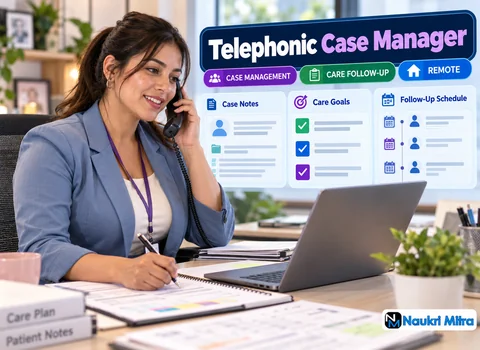
Monday, 8:10 a.m., coffee next to the headset. Three names sit at the top of your caseload list (all invented for this example). Mr. D. went home Friday after four days on a cardiac unit for heart failure, and his first post-discharge call is due today. Ms. R. was supposed to hear from her nurse two weeks ago and somehow slipped past her call date. Mrs. K. finished physical therapy, so her care plan goals no longer match her life. If that list makes you want to start dialling, read on. This opening sits among remote telephonic case manager jobs meant for registered nurses: full-time, USD 78,000 per year, worked from your own quiet room wherever you are able to practise.
The telephonic case manager job description in one paragraph: you are an RN supporting members with chronic or complex conditions entirely by phone. You assess, plan, coordinate, teach and document. There is no bedside and no 7 p.m. handover. Instead you have a schedule of calls, a caseload that is yours to manage and notes a colleague can follow without asking you. If you are looking at telephonic case manager work from home jobs because floor nursing is wearing on your back or your sleep, your clinical judgment carries straight over; you just apply it to what you hear rather than what you see.
Mondays lean on transitions of care. Someone like Mr. D. needs a call soon after discharge: did he get his new prescriptions filled, does he know which follow-up appointment is first, does he have a scale at home and is he using it. The assessment covers symptoms, function, home support and his grasp of the discharge instructions. You never examine anyone, so a pause before "yes, I'm fine" tells you something.
Assessments only matter if they turn into a plan. You write goals with the member, not for them: "Walk to the mailbox and back three days this week" works better than "increase activity." For Mrs. K., Tuesday is the day old goals retire and new ones, plus a call frequency, get agreed.
Medication reconciliation within your RN scope fills part of most weeks. In general terms, that means comparing what the member says they take with what is on record, spotting gaps or duplicates, and flagging concerns to the prescriber or pharmacist through the proper channel. Member education stays inside your scope and your organization's protocols. The rest is coordination: a provider office, a community meal or transport program, a social worker colleague.
Some programs ask case managers to support utilization and transitions-of-care work, such as gathering information for a reviewer or confirming post-hospital services are in place; details vary by organization. Thursday afternoon is for the overdue list. Ms. R. gets her call, an apology for the gap, and a fresh date in the calendar.
Every contact goes into the EHR or case platform the same day: findings, plan changes, education given, next step. On Friday you check that nothing is half-written before the weekend. A caseload never empties, so ask any employer how breaks and after-hours cover are handled.
Much of the skill in this role is deciding who to call first. A typical morning starts by sorting members into rough tiers: new discharges and anyone with a recent emergency visit first, then overdue contacts, then routine follow-ups and plan reviews. Software acuity scores help, but a "routine" member who left a worried voicemail moves up. Caseload sizes differ by employer, so ask about expected members and weekly contacts at interview.
An active RN licence is the credential this listing requires. The listing names no particular degree, so the licence is what counts. Because the role is open worldwide, read the next part carefully: whether your licence lets you work with members in a given state or country can depend on rules where the member is located, not only where you live. Licensing arrangements vary between states and countries, so before applying, check with the relevant nursing regulator where your licence allows you to practise and ask the recruiter which regions the caseload covers. Treat this as general context, not legal advice.
The listing asks for at least three years of clinical nursing. Prior case management or utilization management experience is preferred, and the Certified Case Manager (CCM) credential from the CCMC is an advantage you can do without. Strong EHR documentation and phone assessment skills round it out.
The core telephonic case manager skills are listening, structured questioning, prioritizing and clean documentation. Med-surg, cardiac, home health and discharge planning backgrounds translate well. Truly entry level remote telephonic case manager jobs are uncommon, and telephonic case manager jobs for nurses with no experience at all seldom appear, for this reason: employers want nurses who have seen how chronic illness plays out after discharge. Without case management on your record, lean on your discharge teaching and family calls.
The main telephonic case manager certification is the CCM, awarded by the Commission for Case Manager Certification once you meet its experience rules and pass an exam; check the CCMC site for current criteria. No telephonic case manager course is required here. On how to become a telephonic case manager, the usual order is an RN licence, several years of clinical nursing, then employer onboarding and professional association resources.
A utilization review nurse mostly reads records and applies criteria to requested services, with little member contact. A telephonic case manager mostly talks with members, building relationships over months. Some roles blend both, which is why UM experience is welcome. If you like the conversation side of nursing, case management usually fits better.
You will need a private, HIPAA-compliant home office. In general terms: a door that closes, nobody overhearing calls or seeing your screen, reliable internet, and locking your screen whenever you step away. Ask employers what equipment they supply.
The figure on this listing is USD 78,000 per year for a full-time role. That is the only telephonic case manager salary per year this page can speak to; it mentions no bonuses or perks.
Experienced case managers often move into complex caseloads, quality and auditing, team lead roles or care transitions programs. Members with long-term conditions need ongoing support, so demand tends to be steady, though no role is certain.
Your telephonic case manager resume should read like a care coordination record. Lead with your licence and where it is active, then clinical years, then discharge planning, phone education and care plan writing. Name the EHR systems you know and put a CCM beside your name if you hold it.
Expect telephonic case manager interview questions built around scenarios: a member who refuses to engage, a missed follow-up you discover late, a call where the member sounds confused, or how you would prioritize twenty contacts in a day. Answer with real examples. Many first interviews happen by phone, since that is how the work itself is done.
Employers that hire for this role include health insurers and health plans, care management companies, hospital systems with post-discharge programs, workers' compensation and disability carriers, and third-party administrators. Those are kinds of organizations to watch, not a claim about who is recruiting today.
Among telephonic case manager jobs remote worldwide, this one is full-time at USD 78,000 per year, for RNs who can practise where the caseload sits. No fee applies at any stage, and an employer who asks for one is not genuine. Read the listing details, confirm your licence status, shape your resume around care coordination and send your application.