
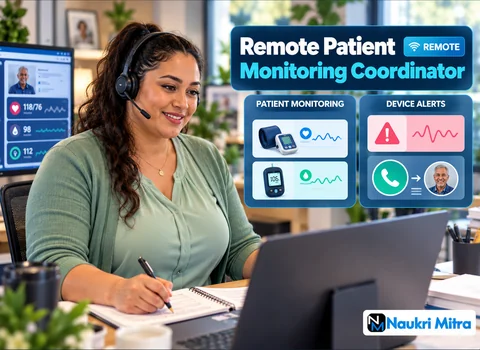
Picture the morning queue. Mrs. Alvarez sent a blood pressure reading at 6:40 and it sits comfortably inside her range. Mr. Okafor's scale logged his weight at 7:15, right on schedule. Then there is Dorothy, whose blood pressure cuff has not synced for four days, and a fourth tile glowing amber because Ray's reading came in above the threshold his care team set. (These names and numbers are made up to show the idea.) In remote patient monitoring coordinator jobs, you don't puzzle over what Ray's number means. You follow the protocol: flag the reading to the nurse on duty, note that you did, then pick up the phone and find out why Dorothy's cuff has gone quiet.
That is most of the job in one screen. Here is the patient monitoring coordinator job description in plain terms: a full-time, fully remote role, open worldwide, paid $21 per hour. It suits someone who likes clear rules, steady phone work and getting a stubborn device back online.
You open the RPM platform and work through the day's data: blood pressure, glucose and weight readings sent from connected devices in patients' homes. Many platforms sort normal readings, flagged readings and patients with no data into separate groups, and you work each group before moving on.
When a reading crosses a limit the care team has set, you send it to a nurse using the route the protocol spells out. You record what you sent, who received it and when. The nurse decides what happens next.
A good share of the afternoon is spent on the phone. Some patients missed a reading because they were traveling. Others have a cuff with flat batteries, a glucometer that lost its Bluetooth pairing or a cellular hub unplugged to charge a phone. You talk them through simple fixes and arrange a replacement if the program offers one.
New enrollees often need a walk-through on their first day with a device. You might stay on the line while someone pairs a scale to a hub, check that a test reading lands in the platform and show them where the cuff should sit on the arm, following the program's written instructions.
Every call, alert and device issue gets documented in the EHR or the RPM platform. Before you log off, you book upcoming check-ins so the next coordinator, or you tomorrow, knows who needs a call.
A coordinator does not give clinical advice and does not interpret results. If Ray asks, "Is 168 over 102 bad?", the honest answer is that a nurse will review it and get back to him, and then you make sure that happens. You don't suggest changing a medication, skipping a dose or going to the emergency room on your own judgment. If a patient describes symptoms that sound urgent, you follow the emergency steps your program trains you on, which usually means getting a clinician involved straight away.
Nurses and clinicians make the clinical decisions. Your job is to get each flagged reading to the nurse promptly, with a clear note of what you saw and when.
Some programs combine RPM and chronic care management (CCM) coordination, but they differ. In general, RPM work centers on device data: readings arriving, readings missing and alerts to route. CCM coordination leans more toward care plans, follow-up appointments, medication reminders and broader conversations with the patient about their conditions. This listing is the device-monitoring side.
A high school diploma is required. A Medical Assistant or CNA certificate, or about a year in a clinical or patient-facing setting, is preferred but not required, which puts this among the entry level remote patient monitoring coordinator jobs open to people still building that background. Front-desk work at a clinic, pharmacy counter experience or time on a patient support line all count as useful exposure.
Beyond that, the patient monitoring coordinator skills that matter most are practical:
Since you will be on calls for much of the day, the listing asks for a quiet home workspace, a headset and reliable internet. A door you can close keeps patient conversations private, which also protects their information. Shift hours and the phone system itself (a softphone app, a dialer inside the platform or something else) are set by each program, so ask about both during interviews. Don't assume a schedule before it is confirmed in writing.
This role pays $21 per hour, full-time. That is the patient monitoring coordinator salary stated in the listing, and the only figure given here. If you are looking up patient monitoring coordinator salary per hour figures elsewhere, remember that rates swing between employers and regions. Use the stated $21 per hour as your reference point for this role. Perks and bonuses aren't part of what's stated, so leave them out of your planning.
Plenty of people looking into how to become a patient monitoring coordinator wonder whether patient monitoring coordinator jobs for people with no experience really exist. This one is open to them: the MA, CNA or patient-facing background is preferred, not required. A few things will strengthen your application:
A good patient monitoring coordinator resume puts phone work and patient contact up front. List the systems you have used, even outside healthcare: scheduling tools, ticketing systems, any EHR. Mention times you followed a strict procedure, such as cash handling checklists.
Common patient monitoring coordinator interview questions tend to be scenario-based. Expect something like: "A patient's glucose reading is over the threshold and they ask you what to do. How do you respond?" The strong answer escalates to the nurse, tells the patient someone clinical will follow up and avoids any advice.
Patient monitoring coordinator jobs remote worldwide, including patient monitoring coordinator work from home jobs, usually come from telehealth companies that run RPM programs, RPM software vendors that offer monitoring services to clinics, physician practices and health systems with in-house programs and care-management outsourcing firms. Future demand depends on how many practices take up home monitoring, which nobody can predict with certainty, so judge each role on its own terms.
Ready now? Hit apply on this page. Nobody should bill you for being considered, and a request for payment is a warning sign. When you hear back, ask about shift times, how training on the platform works and who you escalate to on a weekend.