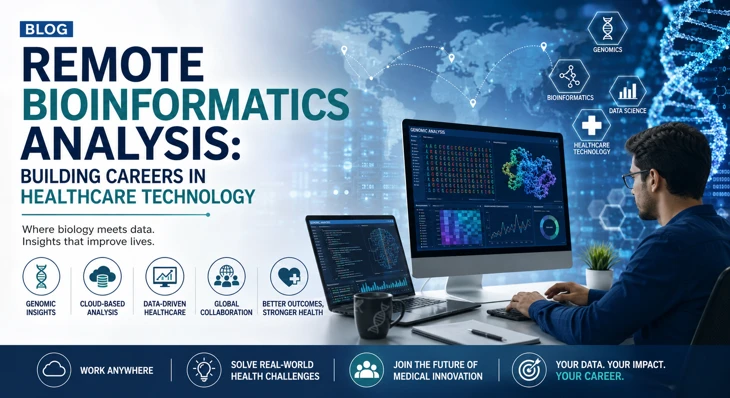
Remote Bioinformatics Analysis: Building Careers in Healthcare Technology
Introduction: Where Biology Meets Data and Remote Work
Healthcare is no longer limited to hospitals, labs, and physical research centers. A quiet but powerful shift is happening in the background—biological science is becoming deeply digital. At the center of this change is
remote bioinformatics analysis, a field where biology, data science, and healthcare technology come together in practical, impactful ways.
Instead of working only in traditional lab environments, professionals now analyze genetic data, study disease patterns, and support medical discoveries from virtually anywhere. All they need is a strong internet connection, the right tools, and the ability to interpret complex biological information.
What makes this space even more interesting is how naturally it connects science with real-world healthcare outcomes. Every dataset tells a story—about disease progression, treatment response, or genetic variation—and bioinformatics professionals help decode it.
Bioinformatics is essentially the science of turning biological data into meaningful insights. In healthcare technology, it plays a critical role in interpreting DNA sequences, protein structures, and large-scale clinical datasets.
Rather than relying solely on traditional lab results, modern healthcare systems increasingly rely on computational analysis to understand diseases more deeply.
Some of the most important contributions of bioinformatics include:
- Supporting genomics data analysis for identifying disease-linked mutations
- Improving early detection models for complex conditions
- Enhancing drug discovery and testing processes
- Powering personalized treatment approaches
- Strengthening predictive healthcare systems through data modeling
As healthcare becomes more data-driven,
bioinformatics careers in healthcare technology continue to grow steadily across research institutions, biotech companies, and remote-first organizations.
The growing popularity of remote bioinformatics analysis is not accidental. It is the result of multiple shifts occurring simultaneously in science and technology.
One of the biggest reasons is the rise of cloud-based research environments. Large biological datasets no longer need to be stored locally or processed on physical machines. Instead, researchers can access powerful computing systems from anywhere.
Another major factor is global collaboration. A researcher in one country can now work on the same dataset as a scientist on the other side of the world, contributing to shared discoveries in real time.
Healthcare innovation has also moved toward a more personalized approach. With genetic testing becoming more common, the demand for professionals who can interpret genomic data has increased significantly.
Remote work culture has simply made all of this more accessible. Many organizations now hire professionals for
remote bioinformatics jobs without requiring relocation, especially for data-heavy roles that rely more on skills than on physical presence.
A successful career in this field is built on a combination of biology understanding and technical capability. Neither alone is enough—the real strength lies in connecting both worlds.
On the technical side, programming is essential. Python and R are widely used for analyzing biological data, while SQL is used to manage structured datasets. Linux environments are also commonly used in research pipelines.
But technical tools are only part of the picture. A solid understanding of biology, especially genetics and molecular biology, is equally important. Without this foundation, interpreting data correctly becomes difficult.
Equally valuable are analytical thinking and problem-solving abilities. Bioinformatics work often involves identifying patterns in large datasets where results are not immediately obvious.
In remote environments, communication also becomes important. Teams rely heavily on written updates, shared documentation, and digital collaboration tools to stay aligned across time zones.
One of the strengths of this field is its flexibility. There isn’t just one career path—there are multiple directions depending on interest and expertise.
A bioinformatics analyst typically interprets genomic data and generates insights to support research or clinical decisions.
Computational biologists focus primarily on developing models and algorithms to simulate biological systems and predict outcomes.
Genomics data specialists work deeply with sequencing data, helping identify genetic markers associated with diseases or treatment responses.
Healthcare data professionals often bridge the gap between clinical systems and biological data, ensuring that insights can be applied in real-world healthcare environments.
Remote research roles are also becoming more common, allowing professionals to contribute to scientific studies without being physically present in laboratories or universities.
Each of these paths contributes to the larger goal of improving healthcare outcomes through better data understanding.
Behind every insight in bioinformatics is a set of powerful tools designed to handle large and complex datasets.
Some widely used platforms include BLAST for sequence alignment, Bioconductor for statistical analysis, and Galaxy for workflow management.
Machine learning frameworks like TensorFlow are increasingly being used to identify patterns in biological data that would be difficult to detect manually.
Researchers also rely on major genomic databases such as NCBI, Ensembl, and UCSC Genome Browser to access structured biological information.
Collaboration is supported through platforms like GitHub for version control and cloud services such as AWS and Google Cloud for scalable computing.
These tools enable professionals to work efficiently in
remote bioinformatics analysis roles, even when handling extremely large datasets.
A Real-World Scenario: Remote Collaboration in Genomic Research
Imagine a researcher working from a small town who is part of a global cancer research initiative. Instead of working in a physical laboratory, they access tumor genome datasets stored on a secure cloud platform.
Their task involves identifying mutations that could respond to targeted therapies. They collaborate with oncologists in Europe and data scientists in North America, sharing findings through secure communication channels.
This kind of setup shows how location is no longer a limitation in healthcare technology careers. What matters most is the ability to interpret data accurately and contribute meaningful insights.
Challenges Professionals Face in This Field
Even though remote bioinformatics careers offer flexibility and opportunity, they also come with real challenges.
One of the biggest challenges is data complexity. Biological datasets are often massive, requiring both computational power and careful interpretation.
Another challenge is the need for continuous learning. Tools, algorithms, and research methods evolve quickly, and professionals must stay updated to remain effective.
Working remotely can also create communication gaps, especially when teams are distributed across different time zones. Clear documentation and consistent communication become essential.
Data privacy is another important concern, particularly when working with sensitive healthcare or genetic information. Strict protocols must always be followed.
The future of
remote bioinformatics analysis is closely connected with advancements in artificial intelligence and machine learning.
Healthcare systems are moving toward predictive models that can detect diseases earlier and recommend personalized treatments more accurately.
As genomic sequencing becomes faster and more affordable, the amount of biological data will continue to grow rapidly. This will increase demand for professionals who can interpret and apply this information effectively.
Remote-first research teams are also expected to become more common, especially in biotech startups and global research collaborations.
In many ways, bioinformatics is becoming one of the most important foundations of modern healthcare innovation.
FAQs
It refers to analyzing biological and genomic data using computational tools from any location, often via cloud-based platforms.
Yes, it is one of the fastest-growing fields due to the increasing importance of genomics and personalized medicine.
Yes, programming languages like Python and R are essential for working with biological datasets effectively.
Many roles, such as data analysis, research support, and computational biology, can be performed remotely.
Biotech companies, healthcare organizations, pharmaceutical firms, and research institutions regularly hire in this field.
Conclusion: A Career Path Built on Data, Biology, and Innovation
Remote bioinformatics analysis is reshaping the evolution of healthcare technology in today’s digital world. It brings together biology, computation, and data science to solve complex medical challenges in ways that were previously impossible.
For professionals entering this field, the opportunity is not just about building a career—it is about contributing to advancements that can directly impact human health.
As healthcare continues to embrace data-driven innovation, bioinformatics will remain at the heart of discovery, collaboration, and global medical progress.