📚 Table of Contents
- Understanding Remote Occupational Therapy Consulting
- Why Remote Occupational Therapy Consulting Is Expanding So Fast
- Healthcare is becoming more digital
- People prefer care at home
- Better tools, smoother sessions
- Gaps in healthcare access
- Career Paths in Remote Occupational Therapy Consulting
- Telehealth Occupational Therapist
- Workplace and Corporate OT Consultant
- Pediatric Remote Occupational Therapist
- Rehabilitation Program Consultant
- Independent or Freelance Consultant
- Skills That Actually Matter in Remote OT Consulting
- Strong clinical judgment
- Clear, simple communication
- Comfort with digital tools
- Flexibility in approach
- Time awareness
- Tools That Support Remote Occupational Therapy
- Benefits of Remote Occupational Therapy Consulting Careers
- More control over time
- Wider reach
- Variety in work
- Less burnout from commuting
- Income flexibility
- Challenges You Should Know About
- Growth Opportunities in Remote Occupational Therapy Consulting
- Entering the Field of Remote Occupational Therapy Consulting
- Future of Remote Occupational Therapy Consulting
- FAQs
- What does remote occupational therapy consulting involve?
- Can occupational therapists really work remotely full-time?
- Is remote OT consulting a stable career option?
- What skills help most in this field?
- Do therapists lose effectiveness when working online?
- Conclusion
Remote Occupational Therapy Consulting: Career Paths and Growth Opportunities
Remote occupational therapy consulting is quietly reshaping how therapy fits into everyday life. Not too long ago, most occupational therapists spent their days inside clinics, hospitals, or rehabilitation centers. Today, many of them are working through screens, guiding recovery plans, supporting patients at home, and even advising companies on workplace wellbeing—without ever being in the same room. What makes this shift interesting is not just the technology behind it, but the way it changes the rhythm of work itself. It gives therapists more flexibility, clients more comfort, and healthcare systems a wider reach than ever before. Let’s break it down in a simple, real-world way.Understanding Remote Occupational Therapy Consulting
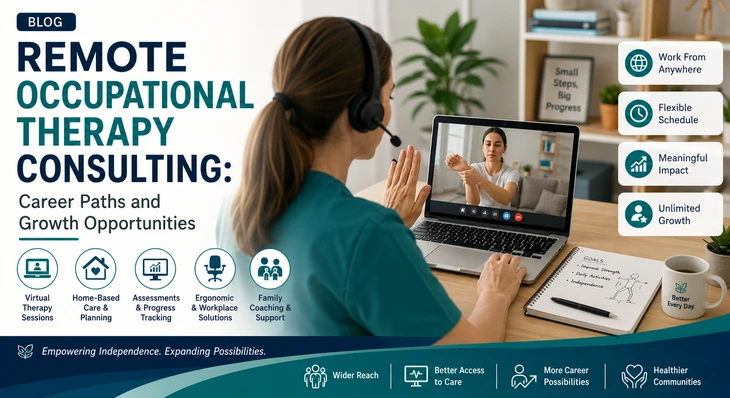
At its core, remote occupational therapy consulting is still occupational therapy. The goal hasn’t changed—helping people regain independence in their daily activities. What has changed is the delivery. Instead of in-person visits, sessions are held online via video calls and digital platforms. Therapists guide patients through exercises, observe movements, suggest modifications for home routines, and track progress digitally. It often includes:- Virtual therapy sessions for recovery and rehabilitation
- Home-based activity planning tailored to real living spaces
- Online assessments for physical and cognitive functioning
- Ergonomic advice for desks, workplaces, and routines
- Family coaching so care continues beyond sessions
Why Remote Occupational Therapy Consulting Is Expanding So Fast
This shift didn’t happen randomly. It’s the result of several real-world changes coming together.Healthcare is becoming more digital
Over the past few years, virtual healthcare has become normal rather than optional. Occupational therapy naturally fits into this system because many interventions don’t require physical touch.People prefer care at home
Patients recovering from surgery, injury, or long-term conditions often feel more relaxed in their own environment. It’s easier to follow therapy when you’re already surrounded by your daily setup.Better tools, smoother sessions
Video platforms are more stable, apps track progress better, and digital health records keep everything organized. What used to feel “experimental” now feels routine.Gaps in healthcare access
In many regions, there simply aren’t enough occupational therapists available. Remote consulting helps bridge that gap by connecting professionals with people who would otherwise wait too long for care.Career Paths in Remote Occupational Therapy Consulting
One of the most interesting things about this field is how many directions it opens up. It’s not a single career track—it’s more like a network of possibilities.Telehealth Occupational Therapist
This is the most direct path. Here, therapists work one-on-one with clients through online sessions. A typical day might include:- Checking in with patients recovering from surgery or injury
- Demonstrating exercises and watching form through video
- Adjusting therapy plans based on progress
- Helping patients stay consistent with routines at home
Workplace and Corporate OT Consultant
This role feels a bit different—it moves beyond individual patients and into organizations. Companies bring in occupational therapy consultants to improve employee comfort, reduce strain injuries, and support long-term wellness. Work often includes:- Reviewing home or office setups through virtual assessments
- Suggesting ergonomic improvements that actually make daily work easier
- Designing injury prevention programs
- Supporting employees returning after medical leave
Pediatric Remote Occupational Therapist
Working with children remotely requires creativity, patience, and a bit of imagination. Therapists often:- Use games and interactive activities during sessions
- Guide parents in supporting therapy at home
- Track developmental milestones over time
- Coordinate with schools through online meetings
Rehabilitation Program Consultant
Some occupational therapists step away from direct sessions and focus more on system-level work. They may:- Design structured rehabilitation frameworks
- Improve therapy protocols for organizations
- Train other therapists remotely
- Analyze recovery outcomes to improve treatment quality
Independent or Freelance Consultant
Then there are therapists who choose full independence. They might work with:- Private clients across different regions
- Telehealth platforms as independent professionals
- Companies needing short-term consulting support
Skills That Actually Matter in Remote OT Consulting
Technical knowledge is important, but it’s not the only thing that defines success here.Strong clinical judgment
You still need a solid foundation in occupational therapy principles. That doesn’t change just because the setting does.Clear, simple communication
Online sessions depend heavily on how clearly instructions are given. Patients need to understand exactly what to do without confusion.Comfort with digital tools
From video platforms to digital tracking systems, technology becomes part of everyday work.Flexibility in approach
Not every home environment is the same. Therapists often adapt exercises based on space, equipment, and patient limitations.Time awareness
Working with multiple clients across different schedules requires a steady sense of organization.Tools That Support Remote Occupational Therapy
Behind every smooth online therapy session, there’s usually a set of tools quietly doing the heavy lifting.- Video consultation platforms for real-time sessions
- Mobile apps that help patients follow routines
- Digital progress tracking systems
- Wearable devices that monitor movement
- Cloud-based documentation for records and reports
Benefits of Remote Occupational Therapy Consulting Careers
There’s a reason so many professionals are moving toward this space.More control over time
Schedules feel less rigid, and work can often be shaped around personal routines.Wider reach
Therapists can support clients beyond their immediate city or region.Variety in work
From one-on-one therapy to corporate consulting, the mix keeps the work interesting.Less burnout from commuting
Removing travel alone significantly changes daily energy levels.Income flexibility
Depending on specialization and experience, earning potential can grow steadily over time.Challenges You Should Know About
No career path is perfect, and this one is no exception. Some patients may still need physical guidance that cannot be replaced online. Internet connectivity can also affect session quality. Licensing rules may limit where services can be offered. And sometimes, reading body language through a screen is just harder. But most professionals adapt to these challenges with experience and better systems.Growth Opportunities in Remote Occupational Therapy Consulting
What makes this field exciting is how many directions it can grow in. Therapists often move into:- Specialized areas like neurology, pediatrics, or geriatrics
- Leadership roles in telehealth organizations
- Online education and training programs for other professionals
- Cross-border consulting projects
- Independent digital health businesses
Entering the Field of Remote Occupational Therapy Consulting
Most professionals enter this space gradually rather than switching overnight. It usually begins with strong academic training in occupational therapy, followed by real-world clinical experience. Over time, many therapists start exploring digital platforms, online consultations, or hybrid work models. As confidence grows, remote consulting becomes a natural extension of existing practice rather than a separate career altogether.Future of Remote Occupational Therapy Consulting
The direction is pretty clear—healthcare is becoming more connected and digital. In the coming years, we’re likely to see:- Smarter AI-assisted rehabilitation tools
- More advanced remote monitoring systems
- Greater acceptance of virtual care across healthcare networks
- More personalized digital therapy experiences