
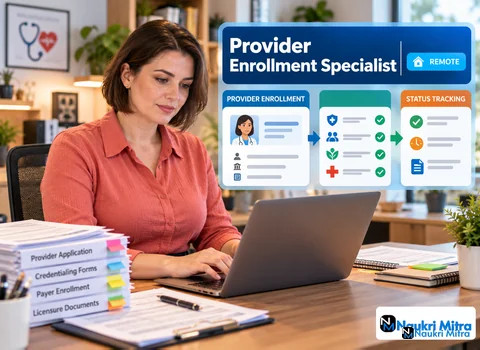
A group practice opens a second location on the first of next month. Four clinicians will see patients there from day one, and not one of them can bill a visit at that address until every payer they take has them enrolled at that site. Closing that gap before opening day is the job of the person in this role. Among the remote provider enrollment specialist jobs posted on Naukri Mitra, this one is full-time, open worldwide, with pay of $21 per hour in USD, and centered on getting providers and locations set up with Medicare, Medicaid and commercial payers on time.
The operations manager forwards a lease, a go-live date and the list of payers the practice already bills at its main office. Some will only need the new address added to an existing group record. Others want a fresh application for every clinician. Sort the list by how slow each payer tends to be and start with the slowest.
That is the provider enrollment specialist job description in brief: file the applications and updates that let each clinician bill each payer at each location, chase them to approval, and keep the dates straight afterwards.
Nothing gets submitted until the basics are gathered and checked against each other. A mismatch in one character of an address can send an application back weeks later. The packet for a new site usually holds:
For Medicare, PECOS is the usual online enrollment route. On a new-location project the usual work is adding the practice location to the group's existing enrollment and checking that each clinician's link to the group reflects it. The exact path depends on the provider type, the regional contractor and what the group already has on file, so read the current instructions every time instead of working from last year's memory. Save the confirmation number and submission date, and log any request for more information straight into the tracker.
Each state runs its own Medicaid enrollment portal with its own login, document list and screen layout. One state may want a separate record for every service location; another may want the location added to the group and then each clinician linked to it. Managed Medicaid plans can be a separate step on top of the state enrollment. Keep notes on each portal's habits; a sample line such as "large uploads failed, split the PDF" can save time on the next file.
Commercial applications vary the most. Some payers take a short location-add form by email. Others need a full application through their own provider portal. Many pull clinician data from CAQH ProView, so before any commercial form goes out you confirm each profile shows the new practice location, current documents and a recent attestation, and that the payer has been given access. A stale CAQH profile can leave a file sitting untouched.
Some plans also send a new clinician through their credentialing committee before the contract is loaded. That review is credentialing, a separate task with its own specialists. Your piece is the application, the location load and the effective date that comes out at the end.
The date printed on an approval letter matters as much as the approval. Claims with a date of service before a payer's effective date for that clinician at that location are likely to deny, and whether a payer will backdate is up to that payer. So the effective date for every provider, payer and location gets recorded the day it arrives and shared with the billing team and the front desk. If the clinic opens on the first and one commercial plan is not live until the fifteenth, scheduling needs to know which patients to book where.
Enrollment does not end at approval. Medicare and state Medicaid programs ask enrolled providers to revalidate on their own cycles, and a missed revalidation can interrupt payment. Payers also need to hear when something changes: a clinician joins or leaves, a suite number changes, or the practice adds a new tax ID. You file those change-of-information updates, update NPPES when a practice address changes, and confirm each payer has actually processed them rather than assuming.
For a remote provider enrollment specialist, deadlines and revalidation dates live in one place, usually a spreadsheet or the practice's enrollment software. A workable tracker has a row per provider, per payer, per location, with columns for:
A sensible routine is to sort by follow-up date early in the week and send the practice a short status note at the end of it, with upcoming deadlines highlighted. Files stay audit-ready because every call and upload is logged as it happens.
Schooling-wise, a high school diploma is the floor and an associate degree is a preference. Experience-wise, one to two years in provider enrollment, credentialing or medical billing is expected. Hands-on skill with PECOS, CAQH ProView, NPPES and state Medicaid portals is required, not optional. NAMSS CPCS or CPMS certification earns credit without being a condition. The provider enrollment specialist skills that matter most are careful data entry and patient, persistent follow-up.
People coming from billing often make strong candidates because they have already seen what an enrollment gap does to a claim. For billers asking how to become a provider enrollment specialist, a good start is to take on the enrollment-related denials at your current job and note what you fixed. Provider enrollment specialist jobs for people with no experience hardly ever turn up, and this one expects at least a year, so entry level remote provider enrollment specialist jobs here means early career, not brand new.
The rate here is $21 per hour, paid in USD, for a full-time remote position open to applicants worldwide. The listing does not state a fixed shift, so ask about expected working hours and overlap with the practice's time zone during the interview. On provider enrollment specialist salary per hour more broadly, rates differ by employer and region; this page states only what this listing offers.
Provider enrollment specialist jobs remote worldwide tend to come from group practices, multi-site clinics, medical billing companies, revenue cycle vendors and telehealth groups that add clinicians in many states. Searching provider enrollment specialist work from home jobs, or adding words like "hiring now", will surface similar openings; read each posting carefully before applying.
Your provider enrollment specialist resume should name the portals you have used, the number of payers or states you handled, and one concrete fix, such as clearing a backlog of pending Medicaid applications. Common provider enrollment specialist interview questions cover how you would handle a missing effective date, what you check in CAQH before a commercial application, and how you plan for a revalidation wave.
Payer and government websites publish free enrollment guides, and NAMSS explains its provider enrollment specialist certification options; any provider enrollment specialist course you pick should teach the portals, not just theory. There is no charge to apply on Naukri Mitra, and real employers do not ask candidates to pay. Send your CV with a short note on the payers and portals you know best.