
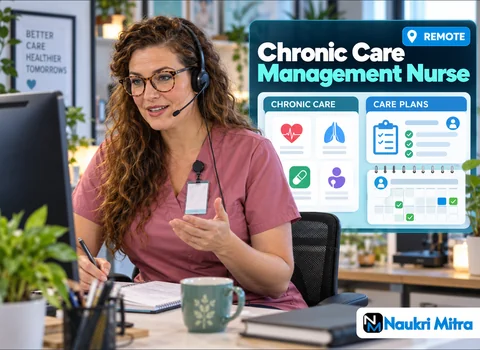
The phone rings four times before the patient, a man in his seventies, picks up. You give your name, say you are the nurse on his doctor's care team calling for his monthly check-in, and ask how the past month has gone. He laughs a little. He stopped writing down his sugar readings around the middle of the month, and the cardiologist he saw last week started him on something new, a small white tablet whose name he cannot remember. That answer, and the plan that follows it, is the work. Among remote chronic care management nurse jobs, this one is full-time at $78,000 per year (USD), with a home-based caseload open to nurses worldwide, although the patients, payers and billing rules behind it are American.
Chronic care management, usually shortened to CCM, is a Medicare service set up by CMS for patients living with two or more chronic conditions that are expected to last a long time and that put them at real risk of getting worse. Examples include type 2 diabetes alongside heart failure, or hypertension with kidney disease. Patients agree to take part, the practice keeps a comprehensive care plan for each of them, and someone on the care team stays reachable between office visits.
That someone, much of the time, is you. Physicians rarely have room in a clinic day to phone every complex patient each month, so practices and the telehealth companies they contract with hire registered nurses to carry a caseload of these patients and keep the plan alive between appointments.
A good call starts in the record. Before each patient, you open the EHR and look at the last care plan, the most recent visit note, any hospital or emergency discharge since your previous call, new lab results and the current medication list. You check which goals the patient chose last time. If someone was working on walking after dinner or cutting back on salty takeout, you want that in front of you so the conversation picks up where it left off.
The call is unhurried by design, and it carries most of the weight in the chronic care management nurse job description. Open questions come first:
For this patient, the skipped readings are not a scolding moment. Maybe his strips ran out, maybe the routine slipped after a family visit. Finding the reason is the nursing work, and it shapes the plan more than the missing numbers do.
A CCM care plan lists the patient's problems, the expected outcomes, measurable goals, planned interventions, the medications, community resources and who is responsible for what. Write it so the patient could read it and nod. Goals in their own words ("check my sugar before breakfast") stick better than clinical shorthand.
You update it whenever something meaningful changes: a new diagnosis, a new specialist, a hospital stay, a goal met or dropped. The patient gets a copy.
The new tablet from the cardiologist is where medication reconciliation earns its keep. You ask the patient to bring every bottle to the phone and read the labels aloud: name, strength, directions, prescriber. Then you compare that with the chart, supplements and over-the-counter products included.
You do not change doses or stop drugs on your own. Your part is spotting the mismatch, documenting it and making sure the right physician sees it quickly.
Patients with several conditions often see several doctors who never talk to each other. CCM nurses close that loop. After a call like that one, you might send a message to the primary care physician about the new cardiac medication, request the cardiologist's visit note, and flag a question for the pharmacist. You also follow up on referrals and chase missing discharge records. Keep messages short: a physician reading between patients should see the issue and your request in a few lines.
CCM is billed with time-based monthly codes, which means the documentation has to show how much clinical staff time was spent on each patient that month and what that time was for. You log the minutes of each call, care plan update and coordination task, and write a note that supports them. Without that record the practice cannot bill the service.
This role expects you to know the CCM billing codes well enough to understand which activities count, how time adds up across the month and what a compliant note contains. Payment amounts are the billing team's concern, and CMS updates the rules regularly, so check current guidance.
A CCM call is a scheduled, non-urgent service. If a patient describes chest pain, sudden weakness on one side, severe shortness of breath or anything else that sounds like an emergency, the check-in ends and the escalation protocol begins: you direct them to emergency services and follow the practice's procedure for notifying the physician. Every employer has its own written pathways for urgent symptoms, and following them exactly is part of the job.
The same boundary applies to advice: you educate and coordinate, while diagnosis and prescribing stay with the provider.
An active RN license is required. Because the patients are usually in the United States, nursing boards care about where the patient sits during the call, so a compact license under the Nurse Licensure Compact, or several state licenses, is preferred and widens the patients you can be assigned. For a nurse based abroad, the license section of a posting matters more than its location line, since many employers can only take nurses licensed in particular states.
The role also asks for a HIPAA-compliant home office and reliable internet. Chronic care management nurse work from home jobs mean a private room with a door, nobody overhearing patient names, a locked screen when you step away, a headset and a connection steady enough for back-to-back calls. Hardware policies differ, so find out what you are expected to buy.
The usual answer to how to become a chronic care management nurse runs through 2+ years of clinical nursing in primary care, chronic disease or case management. Clinic, home health and discharge-heavy hospital nurses make the move most comfortably. Clinical time cannot be skipped: you work alone on the phone with complex patients, and no short course replaces it.
On a chronic care management nurse resume, lead with chronic disease education, care coordination, medication reconciliation and the EHR systems you know. Telehealth companies, physician groups, health systems and care management vendors that contract with practices all hire for this work.
The Certified Case Manager credential from the Commission for Case Manager Certification can help an application, especially for leadership roles later, but this role does not require it. Many nurses earn it after a few years in case management.
People sometimes confuse this role with remote patient monitoring nursing. RPM nurses watch device readings sent from home and respond to alerts; CCM nurses own the monthly relationship and the care plan. Some practices run both.
Long term, it suits nurses who prefer continuity and teaching to acute care. Hours are steadier than shift work, and the experience leads toward care management leadership, transitional care, quality and population health roles. The honest catch: the work depends on CMS rules that change, and some nurses miss hands-on care. Nothing is guaranteed, but nurses who can hold a complicated plan together stay in demand.