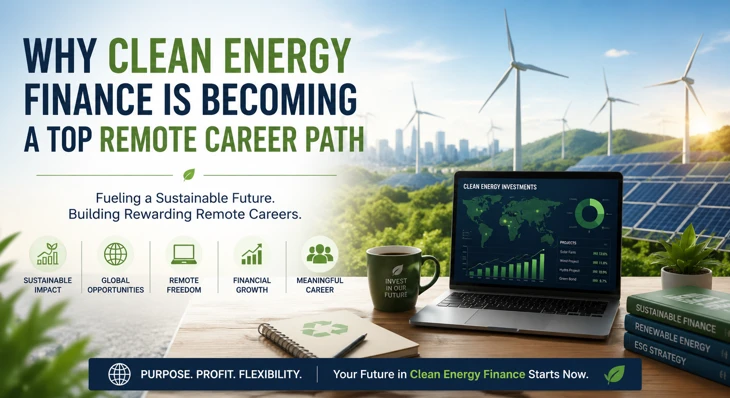
Why Clean Energy Finance Is Becoming a Top Remote Career Path
The global job market is shifting faster than ever, and one of the most exciting changes is happening at the intersection of sustainability and finance. Clean energy finance has quietly evolved from a niche specialization into one of the most promising remote career paths of the decade. With companies, governments, and investors accelerating their transition toward renewable energy, professionals who understand both numbers and sustainability are now in high demand.
What makes this field even more appealing is its flexibility. Many roles in clean energy finance can be performed remotely, allowing professionals to contribute to global climate solutions from anywhere. This combination of purpose, stability, and remote freedom is driving strong interest among job seekers worldwide.
The Rise of Clean Energy Finance in a Changing World
Over the last decade, climate change has moved from a future concern to an urgent global priority. Countries are committing to net-zero targets, corporations are investing heavily in renewable infrastructure, and financial institutions are redirecting capital toward green investments.
Clean energy finance sits right at the center of this transformation. It involves evaluating, funding, and managing financial projects related to renewable energy sources such as solar, wind, and hydro, as well as emerging technologies like hydrogen energy storage.
As governments introduce green incentives and carbon reduction policies, the need for skilled financial professionals who understand sustainable investment models continues to grow rapidly.
Why Clean Energy Finance Is Becoming a Remote-Friendly Career
Unlike many traditional finance roles tied to physical office environments, clean energy finance relies heavily on digital tools, data analysis, and global collaboration. This naturally supports remote and hybrid work structures.
1. Digital-First Work Environment
Most financial modeling, risk assessment, and investment analysis tasks are performed using cloud-based tools and advanced software platforms. Teams collaborate across continents using video conferencing and project management tools, making physical presence less essential.
2. Global Nature of Clean Energy Projects
Renewable energy projects are not limited to one geography. A solar farm in India, a wind project in Europe, and a hydroelectric investment in South America can all be managed by distributed teams working remotely.
3. Growing Demand for Specialized Talent
The shortage of professionals with expertise in both finance and sustainability has pushed companies to widen their hiring pools globally. Remote hiring allows organizations to access top talent regardless of location.
4. Shift Toward Flexible Work Culture
The post-pandemic work culture has normalized remote jobs, especially in analytical and consulting roles. Clean energy finance firms are increasingly adopting hybrid and fully remote models to attract skilled professionals.
Key Roles in Clean Energy Finance You Can Do Remotely
The clean energy finance ecosystem includes several remote-friendly roles that cater to different skill sets and experience levels.
Financial Analyst – Renewable Energy Projects
Financial analysts evaluate the viability of renewable energy projects. They assess costs, forecast returns, and analyze risks. Much of this work involves spreadsheets, financial modeling tools, and reporting systems that can be easily handled remotely.
Sustainability Investment Associate
These professionals help investment firms identify profitable and environmentally responsible opportunities. They analyze ESG (Environmental, Social, and Governance) metrics and guide investment decisions toward sustainable portfolios.
Project Finance Consultant
Consultants structure financing models for large-scale renewable projects. They coordinate with stakeholders, prepare financial documentation, and support funding negotiations—all tasks that can be done virtually.
ESG Risk Analyst
ESG analysts evaluate environmental and regulatory risks associated with investments. They provide insights that help companies avoid long-term financial and reputational risks.
Green Bond Specialist
Green bonds are financial instruments used to fund eco-friendly projects. Specialists in this area manage bond issuance, compliance, and investor relations remotely.
Skills Required to Build a Career in Clean Energy Finance
Success in this field requires a blend of technical finance skills and sustainability awareness. Employers look for professionals who can connect environmental goals with financial performance.
Strong Financial Modeling Skills
Understanding how to build and interpret financial models is essential. Professionals often work with projections, valuation techniques, and investment simulations.
Knowledge of Renewable Energy Systems
A basic understanding of how solar panels, wind turbines, and energy storage systems work helps in evaluating project feasibility.
ESG Framework Expertise
Environmental, Social, and Governance standards are central to modern investment decisions. Familiarity with ESG reporting frameworks is highly valuable.
Proficiency in tools like Excel, Python, Power BI, and financial databases is often required for remote collaboration and reporting.
Communication and Stakeholder Management
Since remote work involves cross-border collaboration, clear communication and documentation skills are critical.
Why Companies Are Investing Heavily in This Field
Clean energy finance is not just a trend—it is becoming a core part of global economic planning. Organizations are investing in this area for several strategic reasons.
Regulatory Pressure
Governments are enforcing stricter carbon regulations, encouraging businesses to adopt sustainable financial practices.
Investor Demand for ESG Compliance
Institutional investors are increasingly prioritizing ESG-compliant portfolios, pushing companies to align with sustainability goals.
Long-Term Profitability
Renewable energy projects often deliver stable, long-term returns once initial infrastructure costs are covered.
Brand Reputation
Companies that invest in clean energy finance improve their public image and attract environmentally conscious customers and investors.
Real-Life Example: Remote Clean Energy Finance in Action
Consider a global consulting firm managing a solar energy project in Southeast Asia. The financial modeling team is based in Europe, ESG analysts are in North America, and project coordinators are in India.
Despite being spread across different time zones, the entire team collaborates seamlessly using cloud-based dashboards and virtual meetings. Financial forecasts are updated in real time, and investment decisions are made without anyone needing to be physically present.
This is a clear example of how clean energy finance enables fully remote global collaboration.
Career Growth Opportunities in Clean Energy Finance
One of the biggest advantages of entering this field is long-term career stability and growth potential.
Entry-Level Opportunities
Fresh graduates can start as junior analysts, ESG researchers, or financial assistants supporting renewable energy portfolios.
Mid-Level Growth
With experience, professionals move into roles such as investment managers, project finance leads, or sustainability consultants.
Senior-Level Positions
Senior professionals often become directors of sustainable finance, portfolio managers, or policy advisors for international organizations.
The demand for leadership in this sector is expected to grow significantly as global green investments expand.
Challenges in Remote Clean Energy Finance Careers
While the opportunities are strong, the field also comes with challenges.
Complex Regulatory Environment
Different countries have different renewable energy policies and financial regulations, which require constant learning.
High Analytical Demand
The work involves deep financial analysis and precision, leaving little room for error.
Fast-Evolving Technology
New energy technologies and financial instruments require professionals to continuously upgrade their knowledge.
Despite these challenges, the long-term benefits outweigh the difficulties for most professionals in the field.
Future Outlook of Clean Energy Finance Jobs
The future looks highly promising. As global investment in renewable energy continues to rise, clean energy finance professionals will become even more critical.
Remote work will also continue expanding, allowing companies to build diverse, global teams. Emerging technologies like AI-driven financial modeling and blockchain-based energy trading may further transform the industry.
Professionals who enter this field today are likely to benefit from strong long-term career security and global mobility.
FAQs
1. What is clean energy finance?
Clean energy finance involves funding, analyzing, and managing financial investments in renewable energy projects such as solar, wind, and hydro power.
2. Can clean energy finance jobs be done remotely?
Yes, many roles, such as financial analysis, ESG research, and consulting, can be performed remotely using digital tools and global collaboration platforms.
3. What skills are needed for a remote clean energy finance career?
Key skills include financial modeling, ESG knowledge, data analysis, understanding of renewable energy, and strong communication skills.
4. Is clean energy finance a good long-term career choice?
Yes, it is considered a high-growth field due to increasing global focus on sustainability and renewable energy investments.
5. Do I need a finance degree for this career?
A background in finance or economics is helpful, but professionals from engineering, environmental science, or data analytics can also enter the field with relevant skills.
Conclusion
Clean energy finance is emerging as one of the most dynamic and future-ready career paths in today’s global economy. It brings together sustainability, innovation, and financial expertise in a way that directly contributes to a greener planet. The rise of remote work has made this field even more accessible, allowing professionals to participate in meaningful global projects from anywhere.
As renewable energy continues to reshape industries, those who develop expertise in clean energy finance will find themselves at the center of one of the most important economic transformations of our time. It is more than just a career—it is a long-term opportunity to build financial success while supporting a sustainable future.