📚 Table of Contents
- Introduction: The Quiet Shift Reshaping Global Work
- What Net-Zero Really Means for the Job Market
- Why are employment opportunities expanding
- The Rise of Green Economy Careers
- Renewable energy careers taking center stage
- Sustainable construction and urban development
- Electric mobility and transport transformation
- Emerging Careers Built Around Net-Zero Goals
- Carbon management and climate data roles
- ESG and sustainability leadership roles
- Climate finance and sustainable investment careers
- Skills That Define the Future Workforce
- Analytical and technical capabilities
- Knowledge of green technologies
- Human-centered professional skills
- Regions Leading the Global Green Job Transition
- Europe: policy-driven transformation
- Asia-Pacific: rapid industrial change
- North America: innovation and clean technology growth
- How Corporate Hiring is Changing with Climate Commitments
- Sustainability is becoming core to business operations
- Growth of hybrid roles
- Real Example: Energy Industry Transformation
- Education and Skill Development for Green Careers
- Academic programs are gaining popularity
- Online learning opportunities
- Challenges in the Green Job Transition
- Skills shortage
- Fast-changing technologies
- Policy uncertainty in some regions
- The Future of Net-Zero Careers
- FAQs: Careers in the Net-Zero Economy
- What are net-zero careers?
- Which industries are creating the most green jobs?
- Do I need a technical background for these careers?
- Are green careers growing globally?
- How can someone start in this field?
- What is the long-term outlook?
- Conclusion: Careers That Align With a Changing World
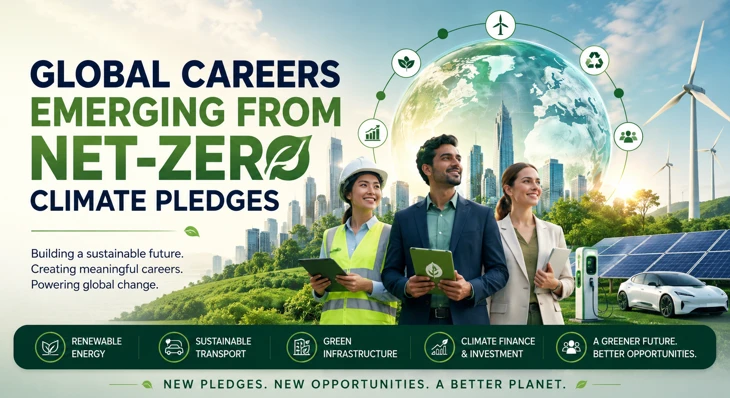
Global Careers Emerging From Net-Zero Climate Pledges
Introduction: The Quiet Shift Reshaping Global Work
Across the world, something significant is unfolding in the background of everyday business decisions. Governments are committing to net-zero emissions, companies are redesigning operations, and industries are slowly rebuilding themselves around sustainability. What does this mean for people looking for work? Quite simply, it is creating an entirely new landscape of global careers. The push toward net-zero is no longer just an environmental ambition—it has become an economic force. As organizations rework their systems to reduce carbon output, new roles are appearing in energy, transport, construction, finance, and even technology. Many of these careers did not exist in their current form a decade ago. For job seekers, professionals, and students, this shift is opening doors to long-term, future-focused opportunities that combine purpose with stability.What Net-Zero Really Means for the Job Market
At its core, net-zero refers to balancing greenhouse gas emissions with removal efforts from the atmosphere. But behind this simple definition lies a massive restructuring of global industries. When countries and corporations commit to net-zero targets, they are essentially committing to changing how they produce energy, build infrastructure, move goods, and manage resources. And every change requires people—skilled professionals who can design, manage, and improve these systems.Why are employment opportunities expanding
The transition to a low-carbon economy is driving demand in several areas:- Large-scale renewable energy expansion
- Cleaner transportation systems
- Carbon monitoring and reporting frameworks
- Sustainable product design and manufacturing
- Climate risk analysis and planning
The Rise of Green Economy Careers
The green economy is one of the fastest-growing employment sectors globally. It focuses on building economic systems that reduce environmental harm while maintaining productivity and growth.Renewable energy careers taking center stage
Solar, wind, hydro, and other clean energy sources are rapidly replacing fossil fuels in many regions. This transition is creating a wide range of roles, such as:- Wind energy technicians working on offshore and onshore farms
- Solar installation specialists supporting residential and commercial projects
- Energy system analysts are improving efficiency across power grids
Sustainable construction and urban development
Modern cities are evolving to become energy-efficient and environmentally responsible. This has led to demand for professionals in:- Green building design and architecture
- Sustainable materials engineering
- Smart city planning and urban sustainability consulting
Electric mobility and transport transformation
The shift toward electric vehicles and low-emission transport systems is also reshaping careers:- Electric vehicle engineering and battery innovation
- Charging infrastructure planning and deployment
- Sustainable logistics and supply chain optimization
Emerging Careers Built Around Net-Zero Goals
Beyond traditional industries, entirely new career categories are emerging due to net-zero commitments.Carbon management and climate data roles
Companies now track emissions with the same seriousness as financial performance. This has created demand for roles such as:- Carbon data analysts
- Emissions reporting specialists
- Climate impact measurement consultants
ESG and sustainability leadership roles
Environmental, Social, and Governance (ESG) has become a core business priority rather than a side initiative. As a result, organizations are hiring:- ESG strategy consultants
- Corporate sustainability managers
- Responsible investment analysts
Climate finance and sustainable investment careers
The financial world is also adapting quickly. Investors are shifting toward greener portfolios and sustainable projects, leading to roles like:- Climate finance advisors
- Green investment analysts
- Sustainable asset managers
Skills That Define the Future Workforce
Success in net-zero-related careers depends on a mix of technical ability and an understanding of sustainability.Analytical and technical capabilities
- Interpreting climate and energy data
- Understanding environmental modeling
- Designing efficient energy systems
Knowledge of green technologies
- Renewable energy systems and infrastructure
- Electric mobility technologies
- Smart grid and energy storage solutions
Human-centered professional skills
- Strategic decision-making
- Cross-functional collaboration
- Problem-solving in uncertain environments
Regions Leading the Global Green Job Transition
The growth of net-zero careers is not limited to one region. It is a global movement with different countries contributing in different ways.Europe: policy-driven transformation
Europe has been at the forefront of climate policy. Countries like Germany, the UK, and Denmark are investing heavily in renewable energy and carbon-reduction programs, leading to strong job creation in green sectors.Asia-Pacific: rapid industrial change
India, China, Japan, and other countries in the region are scaling renewable energy capacity and electric mobility solutions at a fast pace. This is creating millions of jobs across manufacturing, engineering, and infrastructure.North America: innovation and clean technology growth
The United States and Canada are focusing heavily on clean tech innovation, green startups, and sustainable urban development projects.How Corporate Hiring is Changing with Climate Commitments
Net-zero goals are reshaping how companies recruit and structure teams.Sustainability is becoming core to business operations
Instead of being a separate department, sustainability is now integrated into:- Supply chain management
- Product innovation and design
- Corporate governance systems
Growth of hybrid roles
Employers increasingly prefer professionals who understand both business operations and environmental responsibility. This has led to hybrid roles combining traditional expertise with sustainability knowledge.Real Example: Energy Industry Transformation
The energy sector clearly reflects the shift toward net-zero economies. Workers in traditional oil and gas roles are gradually transitioning into renewable energy positions. Engineers are now working on solar farms, wind projects, and energy storage systems instead of fossil fuel extraction. This transition shows that existing professionals can adapt their skills and move into emerging green careers without starting over completely.Education and Skill Development for Green Careers
Education systems are evolving to meet the demand for sustainability-focused professionals.Academic programs are gaining popularity
- Environmental science and climate studies
- Renewable energy engineering
- Sustainable business and management
- Climate policy and governance
Online learning opportunities
Professionals are also using online platforms to gain certifications in:- ESG reporting and compliance
- Carbon accounting
- Renewable energy systems
Challenges in the Green Job Transition
Even though opportunities are growing, challenges still exist.Skills shortage
Many industries are struggling to find professionals with the right combination of technical and sustainability knowledge.Fast-changing technologies
The pace of innovation in clean energy and climate technology requires constant upskilling.Policy uncertainty in some regions
Inconsistent climate policies can sometimes affect long-term planning and job stability. Despite these challenges, the overall direction remains strongly positive.The Future of Net-Zero Careers
Looking ahead, the demand for sustainability-focused professionals is expected to grow significantly over the next decade. Key developments likely to shape the future include:- Expansion of carbon-neutral cities
- AI-powered climate solutions
- Sustainable product innovation across industries
- Integration of climate goals into every business function