📚 Table of Contents
- Why Water Conservation Careers Are Becoming More Important
- Industries Creating Opportunities in Water Conservation Careers
- Environmental and Non-Profit Sector
- Government and Urban Infrastructure
- Agriculture and Farming Systems
- Industrial and Manufacturing Sector
- Research, Innovation, and Education
- Skills That Shape Successful Water Conservation Professionals
- Understanding Environmental Systems
- Working with Data and Technology
- Problem Solving in Real Situations
- Communication and Coordination
- Global Demand for Water Conservation Careers
- Technologies Transforming Water Conservation Careers
- Smart Monitoring Systems
- Artificial Intelligence in Water Management
- Water Recycling Innovations
- Climate and Environmental Modeling
- Career Paths in Water Conservation Fields
- Challenges in Water Conservation Careers
- Future Outlook of Water Conservation Careers Worldwide
- FAQs
- 1. What are water conservation careers?
- 2. Which qualifications are needed for water conservation jobs?
- 3. Is this a stable career path?
- 4. What skills are important in this field?
- 5. Where can professionals work in this field?
- Conclusion
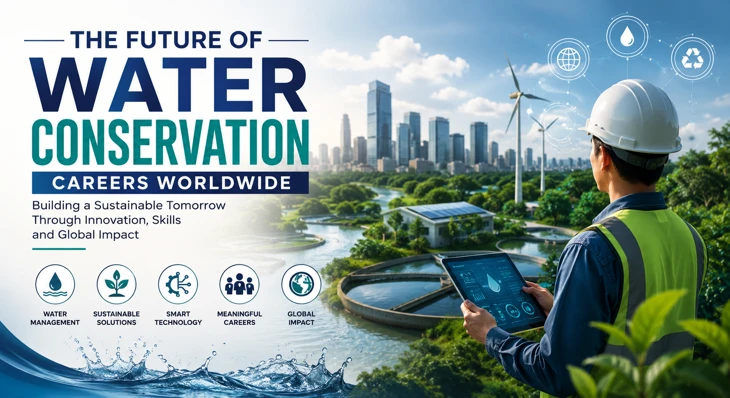
The Future of Water Conservation Careers Worldwide
Water is quietly becoming one of the most important resources shaping the way the world lives, works, and grows. As demand rises and natural supply becomes more uncertain, careers in water conservation are no longer limited to environmental specialists alone. They are expanding into engineering, technology, agriculture, public policy, and even data science. What used to feel like a niche interest has now become a global career direction with long-term relevance and real impact. Across countries, organizations are rethinking how water is sourced, used, reused, and protected. From large cities struggling with supply shortages to rural regions working to improve access, the need for skilled professionals in water conservation careers is steadily increasing. This shift is not temporary—it reflects a long-term global change in how societies value and manage water.Why Water Conservation Careers Are Becoming More Important
The world is facing a pressing challenge: water is scarce, but demand keeps growing. Population growth, industrial expansion, and climate change are all putting pressure on freshwater systems. In many regions, rainfall patterns are no longer predictable, and groundwater levels continue to drop. Because of this, careers in water resource management are gaining importance in both the public and private sectors. Governments are investing in better infrastructure, while companies are focusing on reducing water waste in production and operations. Climate change has also made the situation more urgent. Longer dry seasons, sudden floods, and shifting weather conditions are affecting how water systems are planned. Professionals who understand hydrology careers and environmental systems are now essential for building resilience. At the same time, awareness among people and industries is increasing. Businesses no longer see water efficiency as optional—it is becoming part of long-term strategy and compliance. This has opened doors for environmental conservation jobs and sustainability-focused roles across sectors.Industries Creating Opportunities in Water Conservation Careers
Water conservation is not tied to one specific field. Instead, it connects multiple industries that rely on water every day.Environmental and Non-Profit Sector
Environmental organizations play a key role in protecting natural water systems. These groups work to restore rivers, clean polluted lakes, and protect wetlands. Careers in this space often involve fieldwork, research, and policy advocacy.Government and Urban Infrastructure
Public water systems depend on strong planning and maintenance. Municipal departments hire engineers, planners, and environmental officers to manage supply networks, wastewater systems, and urban drainage. These roles are central to sustainable water management jobs.Agriculture and Farming Systems
Agriculture uses the largest share of freshwater globally. This has created demand for experts in irrigation planning, soil water management, and crop efficiency. Modern farming now depends heavily on smart irrigation systems that reduce waste and improve yield.Industrial and Manufacturing Sector
Factories and production units are under increasing pressure to reduce water consumption. Many companies now hire sustainability experts to monitor usage, recycle wastewater, and ensure compliance with environmental regulations.Research, Innovation, and Education
Universities and research institutions are developing new technologies for water purification, climate prediction, and ecosystem protection. This path suits those interested in long-term innovation and scientific problem-solving.Skills That Shape Successful Water Conservation Professionals
Working in this field requires a mix of technical knowledge and practical thinking. While the exact skills vary by role, some abilities are becoming increasingly important.Understanding Environmental Systems
A strong foundation in hydrology, environmental science, and earth systems helps professionals understand how water moves through natural and urban environments.Working with Data and Technology
Modern water management relies heavily on digital tools. Professionals often use modeling software, GIS mapping, and data analytics to track water usage and predict future conditions.Problem Solving in Real Situations
Water-related challenges are often unpredictable. Whether it is a drought, a leak in a major pipeline, or pollution in a water source, quick thinking and practical solutions are essential.Communication and Coordination
Many water conservation projects involve multiple stakeholders, including government bodies, local communities, and private companies. Clear communication ensures smoother execution of plans and better outcomes.Global Demand for Water Conservation Careers
Opportunities in this field are not limited to one region. In fact, water challenges exist everywhere, which makes this a truly global career path. In developed regions such as North America and Europe, the focus is on upgrading existing infrastructure. Professionals are working on smart water networks, wastewater recycling systems, and advanced monitoring technologies. In Asia and Africa, rapid population growth is driving demand for new infrastructure. Engineers and environmental specialists are needed to expand access to clean drinking water and improve sanitation systems. In the Middle East, water scarcity has led to heavy investment in desalination and water reuse technologies. This region offers specialized opportunities for engineers and technical experts. Coastal and island regions are also adapting to rising sea levels and climate-related risks, creating roles focused on flood control and ecosystem protection.Technologies Transforming Water Conservation Careers
Technology is changing how water is managed at every level. As innovation grows, new career opportunities are emerging.Smart Monitoring Systems
Sensors connected through IoT systems now allow real-time tracking of water usage. These systems help detect leaks early and improve efficiency across cities and industries.Artificial Intelligence in Water Management
AI is being used to study consumption patterns, predict shortages, and optimize distribution networks. This is creating demand for professionals who understand both environmental systems and machine learning.Water Recycling Innovations
Advanced filtration and treatment systems now enable the safe reuse of wastewater in agriculture, industry, and even urban supply systems.Climate and Environmental Modeling
Simulation tools are helping scientists understand long-term water availability and prepare strategies for future climate conditions.Career Paths in Water Conservation Fields
There is no single route into this profession. Instead, multiple career paths lead to water conservation and sustainability work. Some common roles include:- Water Resource Engineer
- Hydrologist
- Environmental Consultant
- Sustainability Analyst
- Irrigation Specialist
- Climate Adaptation Planner
- Wastewater Management Technician