📚 Table of Contents
- Introduction
- Understanding the Circular Economy in Practical Terms
- What this looks like in real life
- Why the Circular Economy Is Changing the Job Market
- Emerging Career Paths in the Circular Economy
- Sustainable Product Design and Innovation Roles
- Green Supply Chain and Sustainable Logistics Careers
- Waste Management and Recycling Innovation Jobs
- Renewable Energy and Resource Recovery Careers
- Circular Economy Consulting and Strategy Roles
- Skills That Matter in Circular Economy Careers
- Technical capabilities
- Human and workplace skills
- Industries Leading the Circular Economy Shift
- Manufacturing
- Fashion
- Construction
- Technology
- Global Demand for Circular Economy Professionals
- Challenges in Building a Circular Economy Career
- The Future of Circular Economy Careers
- FAQs
- 1. What does circular economy actually mean in simple words?
- 2. What kinds of jobs exist in the circular economy?
- 3. Do I need technical skills to work in this field?
- 4. Which industries are hiring circular economy professionals?
- 5. Is this career path growing globally?
- 6. Can circular economy jobs be remote?
- Conclusion
How the Circular Economy Is Creating Global Career Opportunities
Introduction
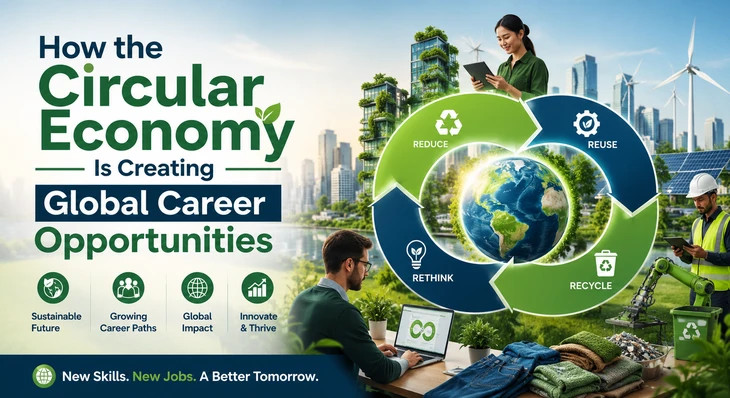
Something interesting is happening in the way the world works. The old take–make–dispose habit is slowly breaking down, and in its place, a smarter, more responsible system is taking shape—the circular economy. It sounds technical at first, but the idea is simple. Instead of throwing things away after use, we keep materials in circulation for as long as possible. Repair them. Reuse them. Recycle them. And rethink how products are designed in the first place. What makes this shift even more important is not just the environmental side, but also the way it is quietly reshaping the global job market. New roles are emerging, old roles are evolving, and companies are actively searching for people who understand sustainable systems. In short, the circular economy is no longer just a sustainability concept—it is becoming a real career pathway across industries.Understanding the Circular Economy in Practical Terms
At its core, the circular economy is about extending the life cycle of everything we use. Think of it like giving products a second, third, or even fourth life instead of letting them become waste. In the traditional system, resources move in a straight line. But in a circular system, they move in loops. Nothing is truly “end of life” if it can be recovered or repurposed.What this looks like in real life
- A smartphone designed so that its battery can be replaced instead of the entire device
- Clothes made from recycled fibers that can be recycled again
- Packaging materials that return to the production cycle instead of landfills
Why the Circular Economy Is Changing the Job Market
Here is where things get really interesting. Every time an industry transforms, job opportunities follow. The shift toward sustainable development and circular economy practices is pushing companies to rethink how they operate. Governments are also tightening environmental rules, which is forcing industries to adapt faster than ever before. And when systems change, skills change too. That is why we are now seeing a rise in circular economy careers across manufacturing, technology, energy, fashion, and logistics. Instead of focusing only on production and profit, companies now need professionals who can balance efficiency with environmental responsibility.Emerging Career Paths in the Circular Economy
Sustainable Product Design and Innovation Roles
One of the most exciting areas of growth is product design. But not the old kind of design—the new focus is on sustainability from the ground up. Professionals in this space are asked to think differently:- Can this product be repaired easily?
- Can materials be reused later?
- Can we reduce waste during production?
Green Supply Chain and Sustainable Logistics Careers
Behind every product is a supply chain, and this is where another big transformation is happening. Companies are now tracking the environmental impact of every step—from sourcing raw materials to delivering the final product. New roles include:- Sustainable supply chain analysts
- Carbon tracking specialists
- Eco-logistics managers
Waste Management and Recycling Innovation Jobs
Waste is no longer treated as something to be simply discarded. Instead, it is being seen as a resource. Modern waste management systems use technologies such as AI-driven sorting, smart recycling plants, and data-driven waste tracking. This shift has opened up careers such as:- Recycling process engineers
- Waste reduction strategists
- Circular system designers
Renewable Energy and Resource Recovery Careers
The circular economy and renewable energy often go hand in hand. As the world moves away from fossil fuels, there is a growing demand for professionals who can work with solar, wind, and bioenergy systems. At the same time, resource recovery specialists are finding ways to extract valuable materials from waste products—turning something useless into something valuable again. This combination of energy transition and resource recovery is creating a strong global job market.Circular Economy Consulting and Strategy Roles
Not every role is technical. Some of the fastest-growing opportunities are in strategy and consulting. Businesses need experts who can help them shift from linear to circular models without losing profitability. These professionals work on:- Designing circular business models
- Improving sustainability performance
- Helping companies meet environmental regulations
Skills That Matter in Circular Economy Careers
This field is diverse, so the skill requirements are equally broad.Technical capabilities
- Understanding of sustainability systems
- Data analysis and environmental reporting
- Engineering or design knowledge
- Familiarity with renewable technologies
Human and workplace skills
- Problem-solving in real-world scenarios
- Creative thinking for innovation
- Adaptability in fast-changing industries
- Collaboration across different sectors
Industries Leading the Circular Economy Shift
Manufacturing
Factories are being redesigned to reduce waste and reuse materials wherever possible. This has created demand for sustainability engineers and production planners.Fashion
The fashion world is undergoing one of the biggest transformations. Sustainable fabrics, clothing rental models, and recycling programs are now mainstream topics of discussion.Construction
Builders and architects are focusing on energy-efficient designs and reusable construction materials.Technology
Tech companies are rethinking product lifecycles and working on reducing electronic waste through better design and recycling systems.Global Demand for Circular Economy Professionals
What makes this trend powerful is its global reach. Countries across Europe, Asia, and North America are investing heavily in sustainability-driven industries. At the same time, emerging economies are adopting circular practices to manage waste and improve resource efficiency. This means professionals in this field are not limited to one region. Opportunities are opening up internationally, and remote collaboration has made cross-border work even more common.Challenges in Building a Circular Economy Career
Like any growing industry, this one comes with challenges:- Lack of standard global regulations
- Limited awareness in some regions
- Need for advanced technical training
- High cost of transitioning existing systems
The Future of Circular Economy Careers
The direction is clear. Sustainability is no longer optional—it is becoming a core business requirement. In the coming years, we can expect:- More AI-driven sustainability tools
- Strong growth in green jobs worldwide
- Circular thinking embedded in all industries
- Increased demand for hybrid skills (tech + sustainability + business)